Head and jaw
tension headaches and TMJ dysfunction, where the neck and jaw are often driving symptoms felt somewhere else entirely
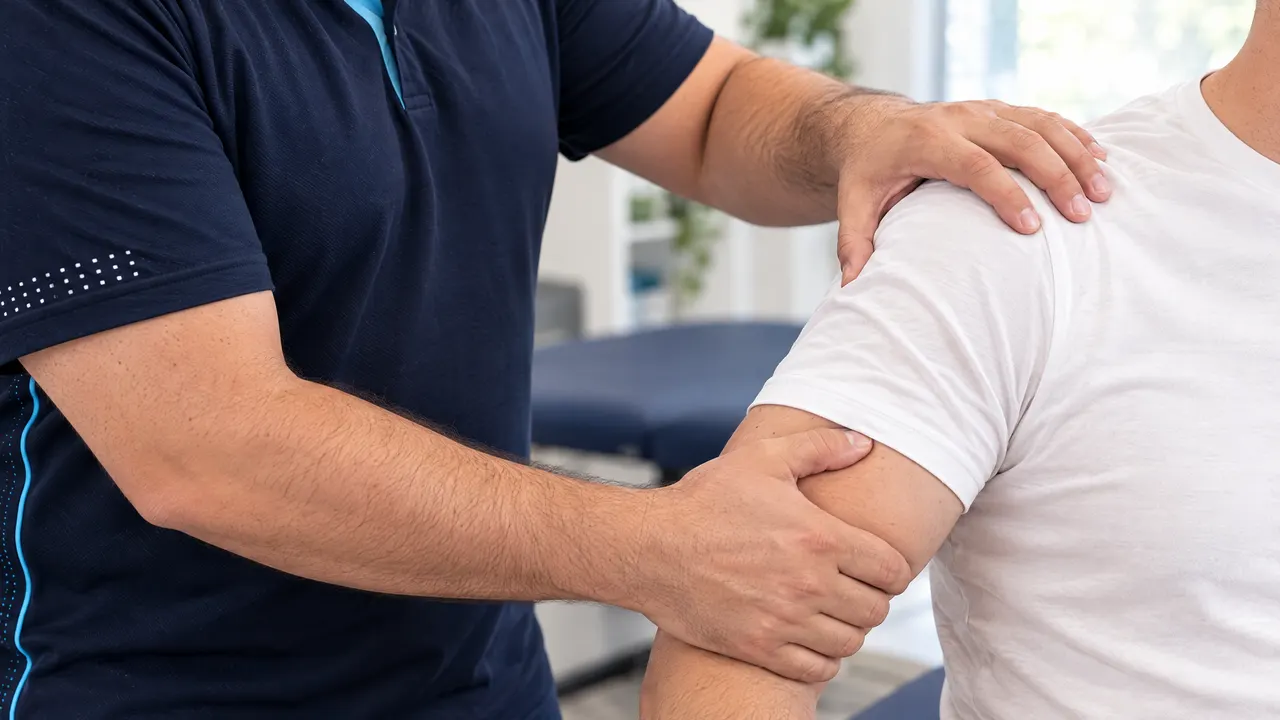
If you've seen a physiotherapist before, manual therapy is probably the part you remember: someone puts their hands on the sore area, works through it, and something shifts. It's the technique we use most often at Well Motion, across more conditions than anything else we do. Manual therapy is part of a standard appointment at every Well Motion clinic, from Engadine in Sydney's south out to Appin on the south-western fringe.
It's also the one most often mistaken for the whole treatment. It isn't. Hands-on work opens a window. What you do with that window is what makes the change hold.
Manual therapy is an umbrella term for the hands-on techniques a physiotherapist uses directly on your joints and soft tissue. In practice that means three things: mobilising a stiff joint through its restricted range, working through muscle and tissue that has tightened or guarded, and moving a limb for you so you can feel what a normal range feels like before you try to produce it yourself.
If you want the longer version (the individual techniques, what each one is for, how it differs from massage), we've written that up separately in What Is Manual Therapy? A Plain-English Guide.
What matters on this page is narrower: how we decide whether to use it on you, and what happens in the room.
Manual therapy isn't something you book on its own here. It's a technique your physiotherapist may choose during a standard physiotherapy appointment, so the session starts the way every session at Well Motion starts.
We assess first. We'll talk through what's bothering you, how long it's been going on, what makes it better or worse, and what you're trying to get back to. Then we'll look at how the area moves: what's stiff, what's guarding, what hurts and at which point in the range. That last part matters more than it sounds, because the restriction often isn't sitting where the pain is.
Then we decide whether hands-on work is the right tool. If what's limiting you is a joint that won't move through its range, tissue that has tightened protectively around an old injury, or pain high enough to stop you loading the area at all, manual therapy is usually part of what we use. If what's limiting you is strength, or how much load the area can currently tolerate, hands-on work won't fix that. We'll tell you so rather than doing it because it feels productive.
The hands-on part takes a portion of the session, not all of it. You'll usually feel pressure, stretch, or a firm sustained hold. Some of it is comfortable; some of it is the kind of discomfort that eases while it's happening. We check in as we go and adjust. There's nothing to be gained from pushing through something that hurts, and you should say so when it does.
We finish with the part that makes the change last. Once the area moves better, we use that range straight away: specific movement or loading work you'll take home, and a clear sense of what should feel different by your next appointment. If nothing has changed by then, that tells us something useful too, and we'll adjust the plan rather than repeat the same session.
The reason we don't sell manual therapy as a block of sessions is that it isn't the goal. It's a way of reaching the goal faster.
Turning your head to reverse out of a driveway without bracing. Getting through a full workday without your neck tightening by mid-afternoon. Reaching the top shelf again. Getting back on the field for the second half of the season. Those are what we build a plan around, and every technique gets kept or dropped on whether it's moving you toward them.
That also means the answer to "how many hands-on sessions will I need?" is that it depends on how you respond. Some people get a clear change in one or two sessions, and the plan shifts quickly toward active work. Others need the hands-on component for longer while strength builds underneath it. We'd rather tell you that than commit you to a number before we know.
Manual therapy turns up across most of what we treat. These are the ones where it's usually a core part of the plan rather than an occasional addition:
tension headaches and TMJ dysfunction, where the neck and jaw are often driving symptoms felt somewhere else entirely
neck pain and whiplash, where restoring range early tends to matter more than resting it
frozen shoulder, rotator cuff tears and shoulder impingement
facet joint pain, where a single stiff segment can be doing most of the work
hamstring strain, calf strain, and the range of ankle and foot problems we see
If posture is part of the picture (desk work, rounded shoulders, a neck that's sore by every afternoon), the hands-on work usually pairs with specific positional and strength changes. We've covered that combination in Rounded Shoulders: Causes and How to Fix Your Posture.
Manual therapy is the base layer, and several of our other techniques sit alongside it rather than replacing it.
Dry needling targets one specific tight point in a muscle, which is a narrower job than mobilising a joint through its range; the two are often used in the same session for different parts of the same problem. Dynamic cupping works in the opposite direction to hands-on pressure: it lifts and decompresses tissue rather than pressing into it, which reaches some restrictions direct pressure doesn't. If you're training or playing, sports taping supports the area between sessions while the tissue catches up.
And the part that holds the result is exercise prescription: the loading and movement work that turns a temporary improvement in range into something your body can hold on its own. That's the pairing that matters most on this page. Hands-on work without it tends to need repeating.
You can see the full range of what we offer on our services page.
Manual therapy is available with our physiotherapists at all four clinics:
996 Old Princes Hwy, Engadine NSW 2233
Shop 11/13 Main St, Mount Annan NSW 2567
22 Sharman Cl, Harrington Park NSW 2567
49 Appin Rd, Appin NSW 2560
All four clinics are reachable on (02) 8111 5633.
It's used to bring pain down and get movement back: mobilising a stiff joint through its restricted range, releasing tissue that has tightened up protectively, and guiding a limb through a range you can't yet produce on your own. The point of doing that is what comes next: once the area moves and hurts less, you can start the loading and strength work that changes things. It's the step that makes the rest of the plan possible, not the plan itself.
In Australia, manual therapy isn't a separate profession; it's a set of hands-on techniques used within physiotherapy. At Well Motion it's delivered by an AHPRA-registered physiotherapist as part of a physiotherapy appointment, alongside assessment, diagnosis and the exercise side of your plan. You may see "manual therapist" used as a job title overseas; here, the person doing it is your physio.
It depends on what's wrong. For a stiff joint or a painful, guarded area, it can make a clear difference to how you move and how much you hurt, often fairly quickly. For a problem that's really about strength or load tolerance, hands-on work alone won't hold. What's consistent across most conditions is that it works best combined with exercise rather than used on its own, which is why we never plan it as a stand-alone course of treatment. If it isn't helping you, we'd rather change the plan than keep booking it.
The most common one is short-lived soreness afterwards (a bit like the day after unfamiliar exercise), which usually settles within a day or two. It also isn't appropriate for everyone, or for every stage of an injury, which is why we assess before we use it rather than starting every session the same way. Tell us about any relevant medical history, recent fractures, or medications you're taking, and tell us during the session if something doesn't feel right. We adjust, or we stop.
No. You can book directly with a physiotherapist in Australia without a GP referral. A referral is only needed for specific funding pathways, and if that applies to you we'll walk you through it.

How would you like to reach us?
Message us on WhatsAppFor bookings and enquiries. Please don't send medical details. Call (02) 8111 5633Request a call-back
Request sent
Thank you. We'll call you back on the number you gave us.
This is a preview, so nothing was actually sent.