Engadine
996 Old Princes Hwy, Engadine NSW 2233
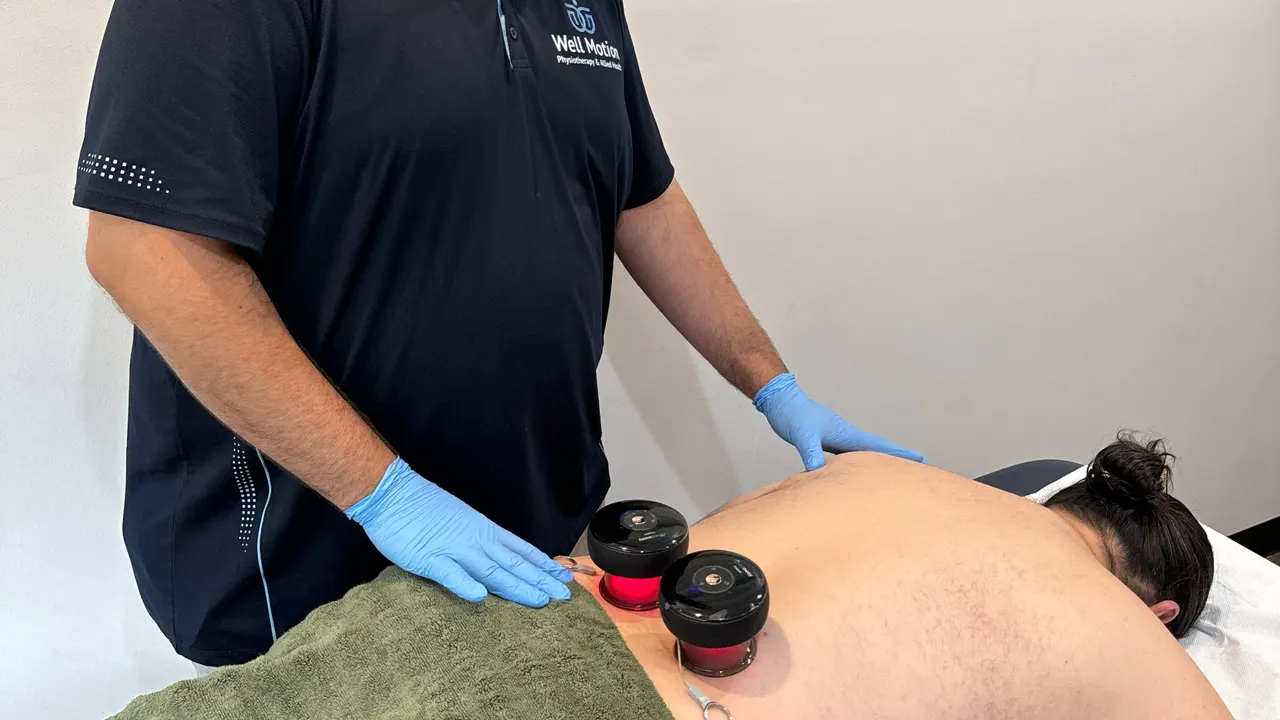
You've probably seen the marks (neat circular bruises across a swimmer's shoulders or a footballer's back) and wondered whether cupping would do anything for the tightness you've been carrying around for months. Or you've had it once before at a massage clinic, liked how it felt, and want to know whether a physiotherapist does it differently.
We do. Dynamic cupping is one of the hands-on techniques we use at Well Motion, and it works best when it's chosen deliberately from what your assessment shows, not sold as a standalone treatment you book by the session. Dynamic cupping therapy with a physiotherapist is on offer in Sydney's southern suburbs and the south-west, inside a standard appointment at any Well Motion clinic.
A cup is placed on the skin and the air inside it is drawn out, creating negative pressure. That suction lifts the skin and the soft tissue underneath it slightly away from the layers below.
That's the opposite of what most hands-on treatment does. Massage, trigger point work and most manual techniques push into tissue. Cupping pulls it upward and apart. Different direction, different effect, and for certain kinds of tightness, that difference is the point.
The word "dynamic" describes what happens next. Instead of leaving the cup sitting in one place, we move it along the muscle while the suction is maintained, so the decompression travels across the tissue rather than concentrating in a single spot.
Most cupping therapy you'll have seen (the circular bruise marks that made headlines during the Olympics) is static cupping: the cup is placed and left in one spot. Well Motion uses dynamic cupping, where the cup is moved across the muscle while suction is maintained, combining the tissue-decompression effect of cupping with an active myofascial release technique. It's applied as part of a broader manual therapy plan, not as a stand-alone treatment, the same approach we use for every technique on this site.
Because the cup keeps moving, dynamic cupping tends to leave less of the distinct circular marking static cupping is known for. You may still see some light colour change through the treated area afterwards. It isn't a bruise in the usual sense, and it isn't a measure of how well the treatment worked.
Cupping isn't something you book on its own here; it's a technique your physiotherapist may choose during a standard physiotherapy appointment. So the session starts the same way every session at Well Motion starts.
We assess first. We'll talk through what's been bothering you, how long it's been going on, what makes it better or worse, and what you're trying to get back to. Then we'll look at how the area moves and where the restriction sits, which isn't always where the pain is.
Then we decide what the tissue needs. If what we find is the kind of restriction that responds well to decompression (tightness through a broad muscle group, tissue that feels stuck between layers, a scar-tissue pattern that hasn't shifted with direct pressure), dynamic cupping is likely to be part of what we use that day. If it isn't, we'll say so and use something better suited instead.
The technique itself takes a few minutes, not the whole session. Cups are applied to the area, suction is set to a level that's comfortable for you, and the cup is moved along the muscle. You'll feel a firm pulling or stretching sensation. We check in as we go and adjust the suction; there's no benefit to pushing through something that hurts.
We finish with what makes the change last. Hands-on work opens a window; what you do with that window is what holds the result. You'll usually leave with specific movement or loading work to do between sessions, and a clear sense of what should feel different by the next appointment.
The reason we don't sell cupping as a package of sessions is that it isn't the goal. It's one tool for getting to the goal.
Getting back to Saturday football. Sleeping through the night without your shoulder waking you. Lifting your toddler without bracing for it. Sitting through a full workday without your neck tightening by mid-afternoon. Those are the things we build a plan around, and the techniques we use along the way get chosen, kept or dropped based on whether they're moving you toward them.
That also means the answer to "how much cupping will I need?" is that it depends on how you respond. Some people notice a clear change in how an area moves after one session, and we build from there. Others get more out of a different combination of work. We'd rather tell you that than commit you to a fixed number of sessions before we know.
Dynamic cupping sits inside our broader manual therapy toolkit, and it's rarely used on its own. The most common pairing is with the mobilisation and soft-tissue work in that same category: decompression to open up a restricted area, then more targeted work through what it opens up.
If you train regularly or you're working back toward a sport, it also pairs well with sports taping. Cupping addresses the restriction in the clinic; taping supports the area while you rebuild training load. Plenty of our sport-focused patients use both across a season.
You can see the full range of what we offer on our services page.
Dynamic cupping is available with our physiotherapists at:
996 Old Princes Hwy, Engadine NSW 2233
Shop 11/13 Main St, Mount Annan NSW 2567
22 Sharman Cl, Harrington Park NSW 2567
49 Appin Rd, Appin NSW 2560
All four clinics are reachable on (02) 8111 5633.
Cupping creates negative pressure that draws blood flow to the treated area and creates space between layers of tissue that can become stuck together after injury or overuse. The evidence for pain relief and short-term range-of-motion improvement is reasonable, though, like most manual therapy techniques, it works best as one part of a structured plan, not as a stand-alone fix.
Most patients describe it as a strong pulling or stretching sensation rather than pain. You may have some light bruising or marking afterward, which fades within a few days. We'll always check how comfortable you are during the session and adjust the suction to suit.
Massage therapy pushes into the tissue; cupping pulls it upward and apart instead. For some tightness and scar-tissue patterns, that decompression effect reaches restrictions that direct pressure doesn't, which is why we use both, depending on what your assessment shows.
This depends on what we find in your assessment and how you respond. We build it into your broader treatment plan and don't sell it as a fixed-session package.
Cupping is billed as part of a standard physiotherapy consultation, so the same private health fund physiotherapy rebates apply. It isn't separately Medicare-rebatable outside a GP chronic condition management plan, same as our other manual therapy techniques.
How would you like to reach us?
Message us on WhatsAppFor bookings and enquiries. Please don't send medical details. Call (02) 8111 5633Request a call-back
Request sent
Thank you. We'll call you back on the number you gave us.
This is a preview, so nothing was actually sent.