Need urgent care? 24/7 Mobile & After-Hours Emergency Physiotherapy Call (02) 8111 5633 For life-threatening emergencies, always call 000
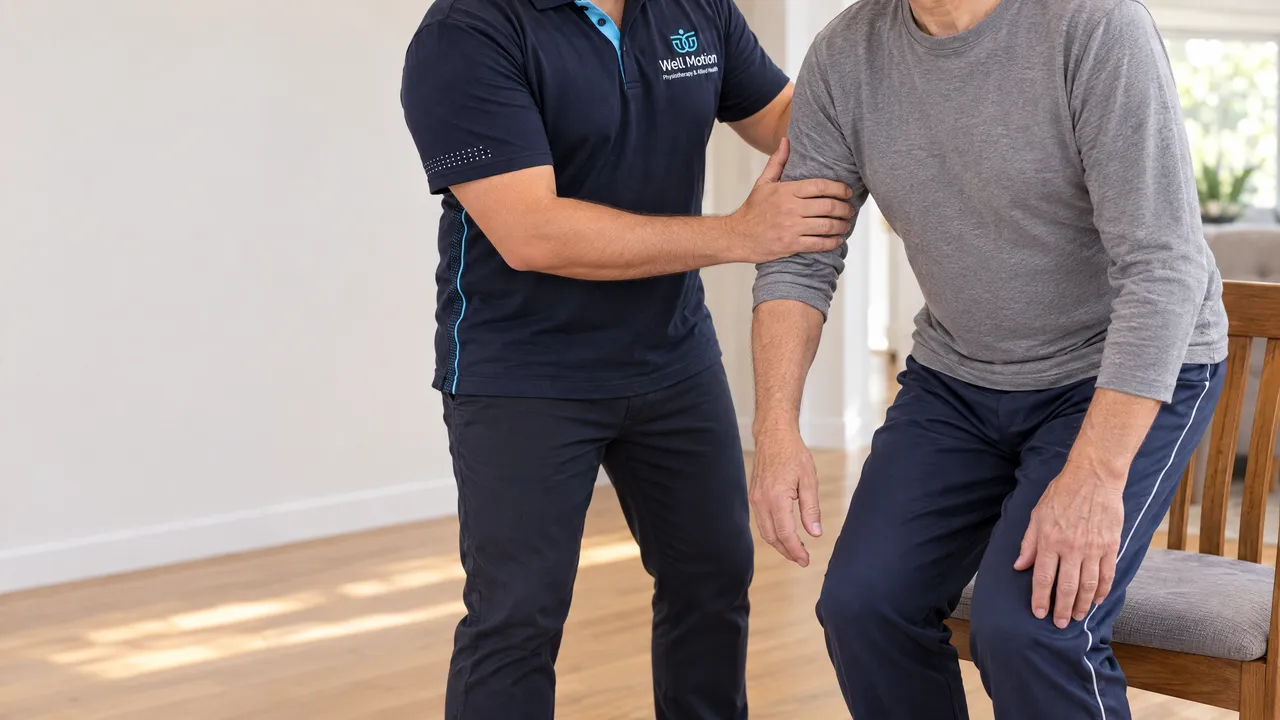
Close-up of a physiotherapist supporting an older male NDIS participant through a sit-to-stand exercise from a dining chair at home
NDIS & WorkCover

NDIS Physiotherapy

5.0 average rating on Google
Registered NDIS Provider
SIRA Registered Provider

You've got a plan, there's funding in it for physiotherapy, and now you have to find someone who'll use it the way it was meant to be used. Maybe the last provider ran the same session every week for a year. Maybe nobody ever explained what the physio funding was supposed to achieve. Maybe you're a support coordinator with a participant who needs someone reliable, this month, not in eleven weeks.

Well Motion Physiotherapy & Allied Health is a registered NDIS provider (registration number 4-KPN4WRT). That registration belongs to the practice, which is how the NDIS registers providers: as a business, not as an individual clinician.

We work with participants and with support coordinators, across the Sutherland Shire, South-West Sydney and the Macarthur region. NDIS physiotherapy sessions happen in clinic, at your home or by telehealth, so participants in this part of Sydney are not limited to those who can travel.

Before your first session

You don't need much, and what you don't have, we'll sort out.

A copy of your plan, or the goals from it. The physiotherapy part matters most, but the goals section matters more. Your plan's wording (get back to work, stay on my feet at home, keep walking the dog) is what your program gets built toward.

Who pays the invoice. Plan manager's details if you're plan-managed, or just tell us you're self-managed or NDIA-managed. Say which one you are when you book and we'll take it from there.

Your support coordinator's details, if you have one. We'll keep them in the loop on progress and reporting without you having to relay messages.

Anything you've already been told. Previous reports, scans, a specialist's letter, an old exercise program that didn't stick. Bring it. Knowing what's already been tried saves you repeating it.

If you don't have some of this yet, book anyway and tell us what's missing. We'd rather work it out with you than turn you away at the desk. What to wear, how early to arrive and how long a session runs are on our FAQs page.

What an appointment looks like

We listen first. What's changed, what's hard now, and what you want to be able to do that you can't. Not a symptom checklist, the actual shape of your week.

We assess properly. Movement, strength, balance, and where things are limited. That gives us a starting measurement, which matters twice over: it's how we know whether the program is working, and it's what a plan review needs to see.

We explain what we've found. In plain English, with no assumption that you've been through this before. If we're not sure yet, we'll say so.

You get a program with a destination. Written down, tied to a specific goal in your plan, with a point where we reassess and adjust. Exercise prescription is usually the backbone of it: graded, progressed, and built around the task you want back.

We write it up. Objective findings, progress against your goals, and what we think the next period should fund, sent where it needs to go, in time for your review.

Built around your plan, not around the appointment slot

The failure mode in NDIS physiotherapy is a standing weekly booking that nobody ever reviews. A year later the funding is gone and nothing has measurably changed.

We work the other way. Every program has a stated goal, a rough timeframe, and a reassessment point where we ask whether it's working. If it isn't, that's information: we change the plan, or we tell you plainly that physiotherapy isn't the right use of this funding and what might be. That's an uncomfortable conversation to have and it's the honest one.

For progressive conditions the goal is often maintenance rather than recovery: holding onto movement, strength and independence for as long as possible. That's a legitimate goal, we'll say so in the reporting, and the program is designed for the long run, not a burst of sessions. The clinical detail on that work sits on our Neurological Physiotherapy page, and for participants whose primary issue is persistent pain, on our Chronic Pain Management page.

How the funding side works

Plan-managed. Your plan manager pays our invoices. Give us their details and we'll invoice them directly. You don't handle any of it.

Self-managed. You pay and claim it back yourself. We'll give you a clear invoice with everything the NDIS portal asks for, so the claim goes through first time.

NDIA-managed. We claim through the NDIS portal on your behalf. This is the pathway where provider registration is checked, and Well Motion is registered (4-KPN4WRT), so it's available to you here.

Whichever one you're on (plan-managed, self-managed or NDIA-managed), we handle the paperwork so you don't have to.

The service agreement terms that apply to NDIS participants specifically are set out on our NDIS Terms of Service page.

If getting here is part of the problem

For a lot of participants, travel isn't a detail. It's the barrier.

Mobile physiotherapy means the assessment and the program happen in your own home, with your own furniture, your own steps and your own bathroom. For a program about daily function, that's often better than a clinic anyway.

Telehealth physiotherapy works well for reviewing and progressing an exercise program between hands-on sessions, or when getting out isn't realistic that week.

For support coordinators

If you're coordinating rather than participating, the short version: we take referrals directly, we can usually offer a same-week first appointment across our four clinics, and we report against plan goals rather than session counts. Support coordinators and plan managers can make a referral online.

Send through the participant's goals and the funding arrangement using our NDIS referral form, and we'll confirm availability and what we can realistically commit to. If we're not the right fit (wrong location, wrong clinical need, wrong timeframe) we'll tell you that quickly rather than accepting a referral we can't service properly.

Who you'll see

Ahmed Elsayed, our Principal Physiotherapist, leads the clinical side of Well Motion, with more than 18 years of practice across Egypt, Saudi Arabia and Australia.

One thing to be precise about, because providers are often vague on it: the NDIS registration (4-KPN4WRT) is held by Well Motion Physiotherapy & Allied Health as a practice. Ahmed's own registration is with AHPRA, as it must be for anyone using the title physiotherapist. Both are real, both are checkable, and they're two different things.

FAQs

Does the NDIS cover physiotherapy?

Physiotherapy is commonly funded through NDIS plans, usually under supports relating to daily living or improved health and wellbeing. What matters is what's written in your own plan and how it connects to your goals, so the practical first step is to look at your plan's goals section, or ask us and we'll help you read it.

Do I need a doctor's referral to use my NDIS funding for physiotherapy?

You can book with us directly: you don't need a GP referral to see a physiotherapist. If you have a recent referral, report or specialist letter, bring it, because it saves you retelling the whole story. If you don't, that's not a barrier to getting started.

Can I use Well Motion if my plan is self-managed or plan-managed?

Yes. Registered providers can see plan-managed and self-managed participants as well as NDIA-managed ones. Registration doesn't limit who we can work with, it widens it. Tell us which arrangement you're on when you book and we'll set the invoicing up accordingly.

Can you come to me instead?

Often, yes. Mobile physiotherapy brings the session to your home, and telehealth covers reviews and program progression when getting out isn't realistic. Ask when you book and we'll tell you what's available in your area. You can also check our service areas.

Ready to use your plan properly?

Book an appointment and tell us whether you're plan-managed, self-managed or NDIA-managed. We'll handle the rest. Support coordinators and plan managers can send a referral through our NDIS referral form. You can see us at Engadine (996 Old Princes Hwy, Engadine NSW 2233), Mount Annan (Shop 11/13 Main St, Mount Annan NSW 2567), Narellan (22 Sharman Cl, Harrington Park NSW 2567; the clinic is listed as Narellan but sits just over in Harrington Park) or Appin (49 Appin Rd, Appin NSW 2560). Call (02) 8111 5633 if you'd rather talk it through first, or browse the full range of services.

We also have local NDIS pages for NDIS physiotherapy in Casula and NDIS physiotherapy in Fairfield.

Ahmed Elsayed, Principal Physiotherapist
Reviewed by Ahmed Elsayed Principal Physiotherapist at Well Motion