Engadine
996 Old Princes Hwy, Engadine NSW 2233
You've rested it. You've stretched it. You've had a few weeks off the thing that seemed to set it off, gone back, and felt it come straight back. Stubborn tendon pain (in a heel, an Achilles, an elbow, the outside of a hip) has a way of outlasting every reasonable thing you try at home.
Shockwave therapy is one of the options worth talking about at that point. It isn't a cure, and it isn't right for every tendon. But for certain long-standing problems it gives us something to do other than another round of wait and see. Shockwave therapy equipment is kept at all four of our Sydney clinics, so the treatment is available at Appin, Narellan, Mount Annan or Engadine.
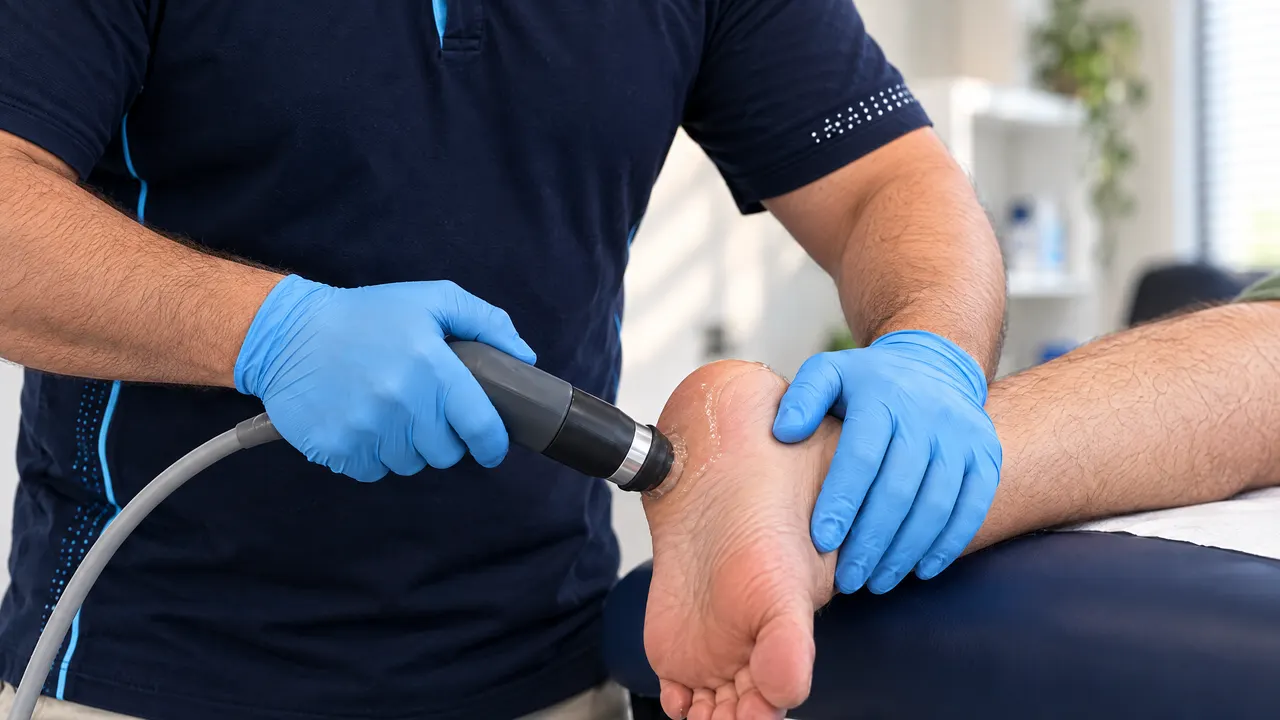
A handpiece is pressed against the skin over the painful area and delivers rapid pulses of acoustic energy into the tissue underneath. "Shockwave" sounds electrical; it isn't. There's no current, no heat and nothing injected.
What the pulses do is mechanical. The tissue is repeatedly loaded and unloaded at speed, and your cells respond to that signal by changing their behaviour: the measurable effects in tendon and bone include a drop in the chemicals involved in transmitting pain, new small blood vessels forming through the treated area, and increased bone-cell activity where that's relevant 1.
In plain terms: it isn't breaking anything down or blasting anything apart. It's provoking a biological response in tissue that has stopped responding on its own.
If you want the longer explanation of how it works and everything it's used for, we've written it up separately in Shockwave Therapy: How It Works and What It Treats.
This is the part that matters most when you're deciding whether to spend your time and money on shockwave.
The strongest evidence, the highest level available, sits behind a specific list: calcific shoulder tendinopathy, tennis elbow, greater trochanteric pain syndrome (the stubborn outside-of-hip pain), plantar fasciitis, and delayed bone healing. Achilles tendinopathy and patellar tendinopathy sit at lower evidence levels than those 1.
And there's a result we'd rather you heard from us than found later. A 2024 Australian sham-controlled trial tested radial shockwave for insertional Achilles tendinopathy, adding it to exercise and education. Its conclusion was that doing so "did not lead to improvements in pain, function or other outcomes compared to sham at 6 or 12 weeks" 2. That's a real finding on a real condition, and it's why we don't offer shockwave as a standard add-on for every sore tendon that walks in.
National guidance reaches the same two-part conclusion on both of the tendon problems it has assessed most closely: for refractory plantar fasciitis 4 and for Achilles tendinopathy 5 alike, shockwave raises no major safety concerns, while the evidence on whether it works is inconsistent. Australia's own public health guidance treats it the same way: something your doctor may suggest when tendon pain hasn't settled, after load management has been given a fair go 3.
So the useful question isn't "does shockwave work?" It's "does shockwave have good evidence for my problem, and have I done the loading work first?" That's a conversation, not a booking form.
We assess before we treat. Shockwave isn't something you book by the session here. The first appointment is an assessment: what hurts, how long it's been going on, what loads make it worse, what you've already tried, and what you're trying to get back to. Then we test the tendon under load, because where it hurts and where the problem sits aren't always the same place.
Loading comes first, not last. Complete rest isn't the fix: long periods of doing nothing tend to make tendon problems worse, and gentle progressive exercise is what encourages the tissue to heal 3. So an exercise programme built for your specific tendon is the foundation of the plan whether or not shockwave ends up being part of it. When shockwave is used, it's used alongside that programme.
You'll get the uncertainty in writing, not just in passing. National guidance asks clinicians to make sure you understand that the evidence for how well shockwave works is uncertain, and to give you that in clear written information before you agree to it 4. We'd do that regardless.
If shockwave is indicated, here's what it feels like. It's an uncomfortable treatment. A typical session in the research delivers somewhere between 800 and 3,000 pulses to the area, and we work within your tolerance as we go 1. We don't numb the area first, and that's deliberate rather than stingy: shock waves applied under local anaesthetic performed no better than placebo at 12 weeks, so numbing the treatment appears to remove the thing that makes it work 1. Most people describe it as intense but manageable, and it's over in minutes.
Sessions are spaced out, and so is the verdict. Most protocols in the literature use around three sessions with roughly a week between them, and the effect is prolonged rather than immediate, which is why it's properly judged at least four months after the course finishes, not at the end of the last session 1. If you feel very little on the day, that isn't a failure.
We don't sell shockwave as a package, because the number of sessions isn't the goal: walking the dog without limping for the first ten minutes is. Getting through a shift on your feet. Getting back to netball, or the run club, or the stairs at work. That's what the plan gets built around, and it's what tells us whether shockwave is earning its place.
Hands-on work has a similar role: manual therapy addresses the surrounding tissue and how the area moves, while shockwave targets one specific degenerative spot. Different jobs, and we haven't found reliable head-to-head evidence putting one above the other, so we won't pretend there is any. We choose between them, and combine them, based on what your assessment shows, not on what you booked.
For genuinely refractory tendon problems, the literature also describes options outside physiotherapy, including corticosteroid injection. Those are a doctor's call and a doctor's procedure, not ours. But if that's the direction your case is heading, we'd rather say so and help you get the right referral than keep treating something that isn't shifting.
You can see everything else we offer on our services page.
Shockwave has a good safety record: the large majority of studies report no significant adverse effects during or after treatment 1. The common effects are temporary: soreness at the treatment site, some redness, occasionally small bruises.
There are clear situations where we won't use it, though. Shockwave isn't appropriate over an active infection, during pregnancy, over a growth plate in a child or adolescent, where a tendon has ruptured completely, or over tissue affected by cancer (including secondary deposits, myeloma and lymphoma). It's also not used where a bleeding or clotting disorder isn't well controlled 1. Tell us about any of these at your assessment, and about any blood-thinning medication you take: they change the plan, and it's better to know before we start.
Some signs are worth getting looked at promptly rather than waiting: real weakness in the tendon, severe pain, pain that isn't improving over several days, or pain that's worst first thing in the morning or after you've been still 3.
Book an assessment at whichever clinic suits you:
996 Old Princes Hwy, Engadine NSW 2233
Shop 11/13 Main St, Mount Annan NSW 2567
22 Sharman Cl, Harrington Park NSW 2567
49 Appin Rd, Appin NSW 2560
All four clinics are reachable on (02) 8111 5633.
Fees vary a lot between clinics, and by how many sessions a course ends up running to, so a single national figure wouldn't tell you anything useful about your own case. What we can tell you is how it works here: you book an assessment, not a shockwave session, and there's no multi-session package to buy up front. If shockwave turns out to be a sensible option for your tendon, we'll talk through what a course would involve (and what it would cost you) before you commit to any of it.
For some conditions, yes: the strongest evidence sits behind calcific shoulder tendinopathy, tennis elbow, greater trochanteric pain syndrome, plantar fasciitis and delayed bone healing 1. For others it's much less convincing: a 2024 Australian sham-controlled trial found that adding radial shockwave to exercise and education produced no improvement in pain or function over sham at 6 or 12 weeks for insertional Achilles tendinopathy 2. National guidance on both plantar fasciitis 4 and Achilles tendinopathy 5 says the same thing in the same breath: safety is not the concern, but the efficacy evidence is inconsistent. It's best understood as something added to a loading programme when that programme alone hasn't been enough, not a standalone cure.
Mostly short-lived ones. Expect some soreness at the treatment site, a bit of redness, occasionally light bruising, for a day or two. The large majority of studies report no significant adverse effects during or after treatment 1. The 2024 Australian trial gives you real numbers for how common the minor stuff is: non-serious effects in 39.5% of the shockwave group compared with 15.8% of the sham group, and no serious adverse events in either 2. The bigger downside isn't a side effect at all; it's that shockwave doesn't help every condition, and some people finish a course without a meaningful change.
It isn't used over an active infection, during pregnancy, over a growth plate in a child or adolescent, where a tendon has ruptured completely, over tissue affected by cancer, or where a bleeding or clotting disorder isn't well controlled 1. If you take blood-thinning medication, that's a conversation to have at your assessment rather than an automatic no.
Most protocols in the research run about three sessions roughly a week apart, with each session delivering somewhere between 800 and 3,000 pulses 1. The actual treatment takes minutes, not hours. The more useful answer is about the result, not the session: the biological effect is prolonged, so effectiveness is judged at least four months after the course finishes rather than on the day 1.
No, and this is one where the intuitive answer is the wrong way round. A completely ruptured tendon is listed as a contraindication to shockwave, not an indication for it 1. Shockwave is aimed at long-standing degenerative tendon pain, which is a different problem from a tendon that has actually torn through. If you've had sudden severe pain, or the tendon feels weak rather than sore, that needs prompt assessment rather than a course of anything 3. Get it looked at, and we'll help you work out where it needs to go.
It's uncomfortable. We'd rather set that expectation plainly than reassure you vaguely. It's intense during application, settles quickly afterwards, and we adjust within your tolerance as we go. We don't use local anaesthetic, and that's clinical rather than convenience: shock waves applied under local anaesthetic were no better than placebo at 12 weeks 1.
How would you like to reach us?
Message us on WhatsAppFor bookings and enquiries. Please don't send medical details. Call (02) 8111 5633Request a call-back
Request sent
Thank you. We'll call you back on the number you gave us.
This is a preview, so nothing was actually sent.