Need urgent care? 24/7 Mobile & After-Hours Emergency Physiotherapy Call (02) 8111 5633 For life-threatening emergencies, always call 000
Jaw

TMJ Dysfunction

5.0 average rating on Google
Registered NDIS Provider
SIRA Registered Provider

You notice it when you yawn, or halfway through a meal: an ache in front of your ear, a click when you open, a jaw that's tight by the end of the day. Maybe you've been told it's stress, or fitted for a mouthguard that helped a bit but not enough. Jaw pain like this is common, usually not serious, and there's more that can be done about it than most people are offered.

What's actually causing it

Your jaw joint (the temporomandibular joint, one on each side, just in front of your ear) is small and does a lot of work, opening, closing and sliding side to side every time you talk, eat or yawn. Trouble there comes from the joint, from the muscles working it, or from both 1.

The muscular side is the part people are least often told about. Spasm in the muscles that close your jaw (the masseter at the angle of your jaw, the temporalis at your temple, and the pterygoids deeper inside) can cause real pain and limit how far you can open. The usual triggers are stress, grinding your teeth, and postural strain 6. Across people diagnosed with a jaw disorder, roughly 45% have a muscle disorder, 41% a disc problem inside the joint, and 30% another joint disorder 11.

Then there's your neck. Jaw pain can refer into the neck, and checking the neck and shoulder muscles for tenderness, trigger points and referred pain is part of a jaw examination 6. That's why a proper assessment looks at how you hold your head over a phone and how you carry a bag, not only at the joint that hurts. Symptoms are also worse when you're stressed 1 and when chewing 7, which is why jaw pain so often flares during a rough few weeks, then settles.
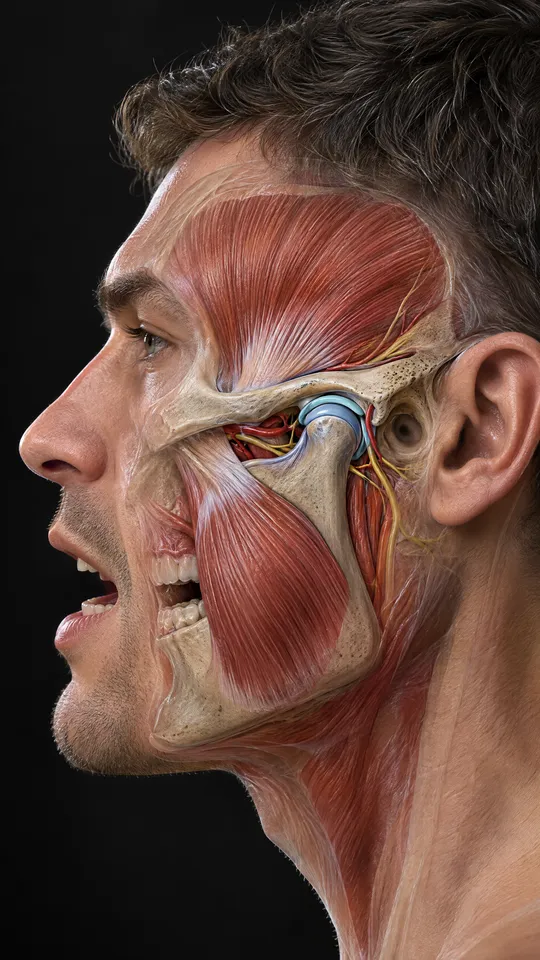

Side of the face showing the jaw joint in front of the ear, its small disc and the chewing muscles

TMJ dysfunction or something else? How to tell the difference

Muscle problem or joint problem.

Muscular jaw pain is usually a dull, tired ache across the cheek or temple, worse after a day of clenching and tender when you press the muscle. Joint problems more often bring mechanical symptoms: clicking, popping or grinding, catching, or the jaw locking open or shut 7. The two overlap constantly, so the assessment checks both.

Wider pain conditions.

Fibromyalgia and other persistent pain conditions are often linked with a jaw disorder 6, worth identifying early, because it changes the plan considerably.

The pattern that isn't a physio problem at all.

Pain or tenderness at the side of your head or on your scalp, especially alongside vision changes like double vision or loss of vision, is not a typical jaw-dysfunction presentation and needs urgent medical attention 7. More on that below.

How it's diagnosed

You probably won't need a scan. A jaw disorder is almost always diagnosed from your history and a physical examination 8. A clinician asks about your symptoms and medical history 1, then feels over the joint just in front of your ear while you open and close, checking for a catch, a click or a pop. They press on the chewing muscles to find the tender ones, and look at how wide you can comfortably open 8.

Scans are for specific questions. An MRI is used when a problem with the disc (the small cushion inside the joint) is suspected, or when treatment isn't working as expected. An X-ray or CT scan can confirm arthritis in the joint 8. Your doctor may also recommend a blood test 1.

How we treat it

The first appointment is an assessment, not a technique: your posture, how your jaw moves and how far you can open, palpation of the joint and surrounding muscles, and a check of the neck muscles for trigger points and referred pain 6. Treatment then usually involves:

  • Supervised jaw exercise and stretching: the best-supported thing we do here. It carries a strong recommendation in the international guideline for jaw pain 2, and produced the largest improvement in physical functioning of any intervention in the review behind it 3. See Exercise Prescription and Conditioning.
  • Supervised postural exercise: also strongly recommended 2, and the direct answer to the neck-and-head-position side of the picture.
  • Therapist-assisted mobilisation and manual trigger point therapy: gentle, guided movement of the joint itself, plus hands-on release of the tight, tender points in the jaw and neck muscles. Both are strongly recommended 2, and both sit among the top three interventions for pain relief in the network meta-analysis 3. See Manual Therapy.
  • Education, reassurance and a home program: the least impressive-sounding item here and not the least useful. Ordinary care built on home exercise, stretching and explanation carries its own strong recommendation 2.

To be straight about it, the strongest single result in that review came from cognitive behavioural therapy with biofeedback or relaxation 3: psychology, not physiotherapy, and not something we deliver. But its conclusion points the same way we do: what helps most for persistent jaw pain are approaches encouraging coping, movement and activity 3. That's the thinking behind our Chronic Pain Management approach, and why you won't be told to simply rest your jaw indefinitely.

Other treatments we may use

Dry needling.

Needling targets the trigger points behind muscular jaw pain. A review of seven trials found it eased pain more than the treatments it was compared with, but the effect was small and the evidence very low quality 12. It's reasonable where muscle tightness is a clear driver, though it wasn't among the guideline's strongly recommended treatments, so we use it as part of a plan, not as the plan. See Dry Needling.

Hands-on work applied directly to the jaw: honestly framed.

Tested on its own, the evidence here is thin. A systematic review screening over 2,700 records found only six suitable trials, 293 people in total, all with risk-of-bias concerns, and rated the quality of evidence very low. Every study showed improvement from where people started, but only two of the six beat what they were compared against 5. So hands-on work earns its place as part of a package, not as a proven standalone fix; we'd rather say that than oversell it.

Exercise, sized accurately.

Exercise therapy reduces pain and improves mouth opening, but the pooled effects are modest, with some confidence intervals close to no effect 4. It helps; it doesn't switch the problem off. The same analysis found exercise added to a splint beat the splint alone 4.

What the evidence doesn't support as strongly.

The clinical guideline recommends against reversible bite splints, low level laser therapy, TENS, botulinum toxin injections and relaxation therapy on its own, and strongly against irreversible oral splints and surgery to remove the joint disc 2. Splints and mouthguards are dentist and orthodontist territory, not ours 1; we don't fit them, and if you've been given one we'll work alongside it. Pain relief medication appears in the health guidance 1,7, but that's a conversation for your GP or pharmacist.

Your recovery path: Reset, Rebuild, Return

Jaw pain is rarely one injury that heals on a schedule, so The Well Motion Recovery Path™ is paced by what your jaw can do, not by a date.

  • Reset: the first few weeks, or the start of a flare. Self-care comes first: soft food, heat or ice, teeth apart 7. We add education, a home program and manual trigger point therapy. Expect the ache to ease before any click does. We move you on once you can chew soft food without the pain building.
  • Rebuild: supervised jaw and postural exercise with therapist-assisted mobilisation, the treatments the guideline tested in people with pain lasting 3 months or more 2. Dry needling may be added. Expect gradual, modest gains 4. We move you on when your jaw does what your usual meals ask of it.
  • Return: eating what you like, yawning and talking through a long day. We check opening and chewing against those tasks. You leave with a home program, a flare plan, and a prompt to see your dentist if you grind at night, the habit linked to relapse 10.

How long it usually takes. It depends on what is driving it. Jaw dysfunction that has not improved after a few weeks can become long-term pain 1. A disc that stays out of place can take longer: in one small 1997 study of 52 untreated people, 59.6% had good resolution at 12 months 13. Arthritis in the joint we plan to manage, with no finish date.

Reducing the risk of flare-ups

No trial has tested whether jaw trouble can be prevented, so these steps follow the risk factors that studies have tracked:

  • Catch the daytime habits. A study followed 2,737 adults for close to three years, and jaw habits such as clenching and grinding were among the few things that predicted who developed a jaw disorder 9. Keep your teeth apart unless you're eating, and skip the gum and pen chewing 7.
  • Take night grinding seriously. In one study of 99 people treated with physio, a quarter had their jaw problem return within six months, and night-time grinding was the habit that predicted it. Daytime habits improved with treatment. Night ones mostly didn't 10. A night mouthguard is listed for people who grind 1, although the international guideline conditionally recommends against reversible bite splints as a treatment for long-standing jaw pain 2. Ask your dentist which applies to you.
  • Deal with stress early. Managing stress and anxiety is first on the Australian government prevention list 1.
  • Keep up your dental visits. New fillings or dentures can leave you with an uneven bite, a recognised cause 1.

When to get it checked properly

Most jaw dysfunction isn't serious and improves with time and the right approach 1,7. Get it looked at rather than waiting it out if:

  • Your jaw locks (open or shut) or catches so you can't move it normally 7
  • You can't eat or drink 7
  • You're getting frequent severe headaches 7
  • There's pain or tenderness at the side of your head or on your scalp, particularly alongside vision changes such as double vision or loss of vision: same-day medical attention, not a physiotherapy appointment 7
  • It isn't settling, and it's started shaping what you eat or how you sleep

None of that is cause for panic, just a reason to have it looked at rather than guess.

Your first appointment

We start by listening: how it began, what makes it worse, and what it's stopping you from doing. Then we examine the area, explain what we find in plain English, and agree a plan with you. Your first visit is 40 minutes at Engadine and 30 minutes at our other clinics.

We see patients at Engadine, Mount Annan, Narellan and Appin, and at home through our mobile physiotherapy service. If you have private health cover, here's how health fund rebates work for physiotherapy.

FAQs

Can a physiotherapist help with jaw pain?

Yes, for the muscular and postural side of it (a substantial part of most cases). Australian government health guidance lists gentle jaw-strengthening exercise as a treatment option and says a physiotherapist can show you which exercises suit you 1; the NHS pathway includes referral to a physiotherapist for jaw exercises and massage 7. The international guideline strongly recommends supervised jaw and postural exercise and therapist-assisted mobilisation 2. What physiotherapy doesn't do is correct an uneven bite or fit you a splint; that's dental work.

What to do when TMJ pain is unbearable?

Short term: soft food, an ice or heat pack, gentle massage of the painful jaw muscles, and finding ways to wind down 7. Then there's what to stop (chewing gum and pen tops, biting food with your front teeth, nail biting, wide yawns) and remembering that apart from eating, your teeth should be apart, not touching 7. If you can't eat or drink, or the red flags above appear, that's a same-day medical issue.

Can jaw pain be a symptom of TMJ disorders?

Yes, pain around the jaw, ear and temple is the most common symptom, usually with clicking, popping or grinding noises, headache around the temples, difficulty opening fully, or the jaw locking 7. It's often worse when you chew and when you're stressed 1,7. Around 45% of people diagnosed have a muscle disorder 11, exactly the part physiotherapy is built to address.

What is the best sleeping position for TMJ?

None of the clinical sources we rely on names a best sleeping position, so any specific recommendation you read is opinion, not evidence. The night-time factor that is well documented is grinding and clenching, linked to stress and anxiety 1; managing that, and keeping your teeth apart during the day 7, is the better-supported thing to work on. If your jaw is worst on waking, mention it at your assessment.

What autoimmune disease is associated with TMJ?

Rheumatoid arthritis is the usual answer; it sits alongside gout and osteoarthritic wear among the joint diseases that can affect the jaw joint 1. That's a GP or rheumatology question, not a physiotherapy one, and we'd work alongside that management, not around it.

If your jaw has been aching, clicking or tightening up for longer than you'd like, an assessment will tell you which part of it is joint, which part is muscle, and which part is coming from your neck, and what to actually do about each.

Book an appointment with the Well Motion team, or head back to the Jaw section if you're still working out what you're dealing with.

Book an Assessment
Ahmed Elsayed, Principal Physiotherapist
Reviewed by Ahmed Elsayed Principal Physiotherapist at Well Motion

References

  1. Temporomandibular joint dysfunction. healthdirect (Australian Government), last reviewed November 2025. https://www.healthdirect.gov.au/temporomandibular-joint-dysfunction
  2. Busse JW, et al. Management of chronic pain associated with temporomandibular disorders: a clinical practice guideline. BMJ 2023;383:e076227. PMID 38101929. https://pubmed.ncbi.nlm.nih.gov/38101929/
  3. Yao L, et al. Management of chronic pain secondary to temporomandibular disorders: a systematic review and network meta-analysis of randomised trials. BMJ 2023;383:e076226. PMID 38101924. https://pubmed.ncbi.nlm.nih.gov/38101924/
  4. Idáñez-Robles AM, et al. Exercise therapy improves pain and mouth opening in temporomandibular disorders: a systematic review with meta-analysis. Clinical Rehabilitation 2023;37(4):443-461. PMID 36263523. https://pubmed.ncbi.nlm.nih.gov/36263523/
  5. Asquini G, et al. Effectiveness of manual therapy applied to craniomandibular structures in temporomandibular disorders: a systematic review. Journal of Oral Rehabilitation 2022;49(4):442-455. PMID 34931336. https://pubmed.ncbi.nlm.nih.gov/34931336/
  6. Maini K, Dua A. Temporomandibular Syndrome. StatPearls (NCBI Bookshelf), StatPearls Publishing; last updated January 2023. https://www.ncbi.nlm.nih.gov/books/NBK551612/
  7. Temporomandibular disorder (TMD). NHS, last reviewed 20 June 2023. https://www.nhs.uk/conditions/temporomandibular-disorder-tmd/
  8. Klasser GD. Temporomandibular Disorders (TMDs). MSD Manual Consumer Version, 2025. https://www.msdmanuals.com/home/mouth-and-dental-disorders/temporomandibular-disorders/temporomandibular-disorders-tmds
  9. Ohrbach R, Bair E, Fillingim RB, et al. Clinical orofacial characteristics associated with risk of first-onset TMD: the OPPERA prospective cohort study. The Journal of Pain, 2013;14(12 Suppl):T33-50. PMID 24275222. https://doi.org/10.1016/j.jpain.2013.07.018
  10. Yang Y, Qin JX, Yao Y, et al. Sleep bruxism is a significant risk factor for the recurrence of temporomandibular disorder: a single-center retrospective study. Journal of Oral Rehabilitation, 2025;52(9):1351-1359. PMID 40317789. https://doi.org/10.1111/joor.13991
  11. Manfredini D, Guarda-Nardini L, Winocur E, Piccotti F, Ahlberg J, Lobbezoo F. Research diagnostic criteria for temporomandibular disorders: a systematic review of axis I epidemiologic findings. Oral Surgery, Oral Medicine, Oral Pathology, Oral Radiology, and Endodontology, 2011;112(4):453-62. PMID 21835653. https://doi.org/10.1016/j.tripleo.2011.04.021
  12. Vier C, Almeida MB, Neves ML, Santos ARS, Bracht MA. The effectiveness of dry needling for patients with orofacial pain associated with temporomandibular dysfunction: a systematic review and meta-analysis. Brazilian Journal of Physical Therapy, 2019;23(1):3-11. PMID 30146108. https://doi.org/10.1016/j.bjpt.2018.08.008
  13. Sato S, Goto S, Kawamura H, Motegi K. The natural course of nonreducing disc displacement of the TMJ: relationship of clinical findings at initial visit to outcome after 12 months without treatment. Journal of Orofacial Pain, 1997;11(4):315-20. PMID 9656907. https://pubmed.ncbi.nlm.nih.gov/9656907/