Soft-tissue work and massage.
Useful as an adjunct: short-term improvement in pain and function for sub-acute and chronic low back pain, on low-quality evidence and with no lasting benefit shown 8. Alongside the programme, not instead of it.
The pattern is usually the same. You wake up stiff across one side of your lower back, and a hot shower loosens it off. Then you stand at a barbecue for an hour, reach up to a top shelf, or arch back to look at something, and it bites. Sitting still makes it worse, and getting out of the chair is the worst part.
It's mostly your back, not your leg, and nobody has given it a clearer name than "lower back pain".
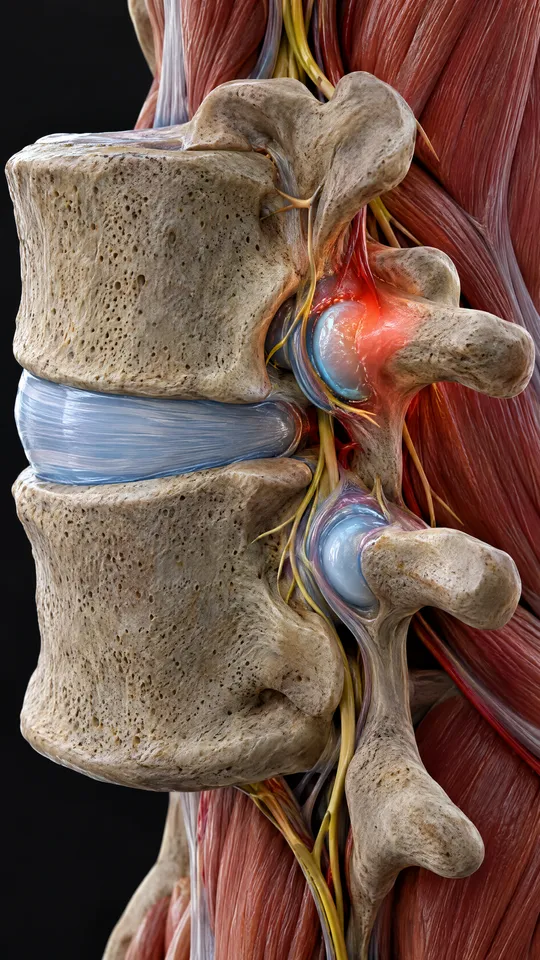
Your vertebrae are joined by small joints called facet joints, and those joints are what let you move and bend your back 2. There's a pair at every level, at the back of the spine, with the disc at the front. The three load as one unit, so a problem in one changes the job the other two do 5. The facets carry roughly 10 to 20% of that load 1, and their share rises when the disc at the same level is worn or dehydrated. Facet wear was once assumed to follow disc wear; it's now clear it can come first 5.
The most common version is facet joint osteoarthritis (ordinary wear in the joint surface) with an estimated incidence of 10 to 15% in adults, rising with age 1. Repeated loading matters too: arching backwards (hyperextension) and repeated bending can put significant strain on the joint capsules 1. Degeneration shows up most at L4-L5 and L5-S1, the levels carrying the most load 1,5. It doesn't take a torn capsule, either: nerve fibres sit in the joint lining as well as the capsule, so inflammation inside the joint can generate pain on its own 5.
What it feels like is fairly specific. Pain sits beside the spine, on one or both sides, and can refer into the buttock, groin or thigh, but back pain dominates over leg pain, with no clear band of numbness and no weakness 1. Referred pain typically stops above the knee 1,5. Stiffness is short-lived, worst in the morning or after sitting still 1. Gentle movement helps; strenuous activity doesn't 1.
A facet joint that stiffens suddenly is one of the things behind a back that has locked up.
The two are easily confused: facet joint pain is hard to tell apart from pain coming from other structures in the lower back 1.
Facet joint pain is back-dominant. Disc problems and nerve-root irritation are more often leg-dominant, with a recognisable band of numbness or pins and needles, sometimes real weakness. If your pain travels past the knee, a non-facet cause is more likely 1, the pattern covered on our sciatica and lumbar disc bulge pages.
Neither a scan nor a hands-on test can prove facet joint pain. Clinical examination "has not been proven to objectify" it, Kemp's test has limited value for ruling it out, and tenderness over the joints correlates only poorly with who responds to facet treatment 1. CT and MRI findings correlate weakly with pain and mainly serve to rule out red flags 1, and some studies found no association at all between facet arthritis on CT and low back pain 5. Scan reports often mention changes that reflect the normal passage of time, not damage 2.
So a facet diagnosis is a working conclusion drawn from your pattern, your movement and how you respond to treatment, not something a scan settles.
Most people with this pattern don't need a scan to get started. Your clinician asks when the pain began, where it sits, what eases it or sets it off, and whether you've had tingling, numbness or pain in your legs 2. Then comes the examination. With facet joint pain, leg strength and reflexes are normal, and the straight leg raise, a test that stretches the nerves running into your leg, is usually negative 1.
The nearest thing to a confirming test is a diagnostic nerve block, where a doctor numbs the small nerves supplying the joint to see whether the pain goes. Even that gives a false positive in 25 to 40% of cases, so some guidelines ask for two separate blocks, each giving at least 80% pain relief 1.
The first job is working out whether this is actually a facet pattern, and what in your week is loading those joints. How you're moving is more changeable than what your scan shows.
How strong is the evidence? A 2021 Cochrane review found physiotherapy produced improvement in the short and intermediate term, with long-term results inconclusive 1. Graded stabilising exercise improved disability and self-efficacy more than simply being told to walk daily, but not pain over the longer term 4. And the finding that matters most: adding radiofrequency denervation to a standardised exercise programme produced no clinically important improvement over the exercise programme alone 5. That's the strongest argument there is for leading with structured exercise, which isn't the same as saying exercise is guaranteed.
Useful as an adjunct: short-term improvement in pain and function for sub-acute and chronic low back pain, on low-quality evidence and with no lasting benefit shown 8. Alongside the programme, not instead of it.
Heat can help 2, and it's cheap and safe to try. The evidence behind this very common practice is limited: moderate evidence that a heat wrap gives a small short-term reduction in pain, and no conclusions can be drawn about cold 9.
Physiotherapists don't prescribe, administer or arrange any of this; what follows is simply what the literature reports. A facet joint injection or medial branch block puts local anaesthetic into or around the joint, sometimes with a steroid added, and its main stated value is diagnostic: finding out whether the pain is coming from the facet joints 3. It's image-guided, usually under 30 minutes, and most people go home shortly after 3. The risks are real: listed complications run from the injection not working, worse pain and a bruised feeling for days through to allergic reaction, seizures from the local anaesthetic, infection around the spine, nerve injury, visual disturbance and blood clot, and some can be serious and may even cause death 3. Intra-articular facet injections show no significant long-term benefit, and several professional bodies recommend against routine use 1. Radiofrequency ablation is called the interventional gold standard, with relief up to around twelve months in well-selected people 1, though its efficacy is debated, with conflicting evidence at three to six months 5. All of it is a GP or pain-specialist conversation.
Also outside what we do. Anti-inflammatories may be used short-term with limited long-term benefit 1,2, and opioids are not usually recommended: limited benefit, and side effects including drowsiness, sedation and addiction 2. Which medicine, if any, is a GP or pharmacist conversation.
Cooled radiofrequency, cryodenervation, endoscopic denervation and multifidus stimulation are described as promising but needing further research, and facet replacement devices are explicitly experimental 1. None of it is something we provide.
Guidance specifically advises against belts, foot orthotics, acupuncture and electrical nerve stimulation for this: none have shown long-term benefit 1.
Facet joint pain usually comes from a worn, irritable joint, not an injury that heals on a clock 1. On The Well Motion Recovery Path™ you move up a phase when your back copes with more, not when a date arrives.
How long it usually takes. No study gives a recovery time for facet joint pain itself. In one small trial of 39 people, all of whom had already had radiofrequency denervation, a six-week stabilisation exercise programme added benefit over education alone 10. Pain lasting past about twelve weeks is classed as chronic 2 and needs a broader plan.
No trial has tested prevention for facet joint pain on its own. The trials are in low back pain generally, and this is what they found:
Most lower back pain settles. Book a proper assessment rather than managing it yourself if:
Call 000 immediately if you lose feeling or movement in your limbs, or have problems controlling your bladder or bowels 2. That's rare, and it isn't what facet joint pain does, but it needs emergency care, not an appointment.
One more checkpoint: pain persisting past about twelve weeks is classed as chronic 2. That's a reason to act at week six rather than week sixteen, and it needs the broader plan our chronic pain management work is built for.
We start by listening: how it began, what makes it worse, and what it's stopping you from doing. Then we examine the area, explain what we find in plain English, and agree a plan with you. Your first visit is 40 minutes at Engadine and 30 minutes at our other clinics.
We see patients at Engadine, Mount Annan, Narellan and Appin, and at home through our mobile physiotherapy service. If you have private health cover, here's how health fund rebates work for physiotherapy.
Most non-specific low back pain settles on its own. The real risk isn't that the joint crumbles (no source supports that); it's that pain persisting past twelve weeks becomes chronic pain, bringing reduced quality of life, difficulty working and staying active, low mood, and reliance on stronger pain medicines 2.
Don't keep loading it into sustained arching or twisting while it's irritable: those are the movements that typically increase the pain 5. Don't take to bed: rest beyond a day or two isn't recommended, and keeping active works better 2. And don't treat a scan finding as the whole explanation: facet changes on imaging correlate weakly with pain, and some studies found no association at all 1,5.
Light exercise such as walking or gentle stretching can reduce pain intensity, while more strenuous activity worsens it 1. Short and regular beats long and punishing.
There isn't a single evidence-backed answer, and we won't invent one. What the evidence does say is that arching the lower back tends to increase facet joint pain 5, so a position that reduces the arch, such as lying with your knees bent, is a reasonable one to try. Comfort varies.
As an adjunct, yes. Massage produces short-term improvement in pain and function for sub-acute and chronic low back pain, though the evidence is low quality and the benefit wasn't seen in the long term 8. It's worth having as part of the plan, just not as the plan.
L4-L5 and L5-S1 carry the most load of any level, and show the highest prevalence of facet degeneration 1,5. The facets' share of that load increases when the disc at the same level is worn or dehydrated 1,5. Add repeated arching backwards, which puts significant strain on the joint capsules, and you have the common recipe 1.
Pain radiating down the leg, often with pins and needles.
Read moreWhat a disc bulge on a scan actually means, and the recovery pathway.
Read moreTailbone pain after a fall, childbirth, or long stretches on a hard seat.
Read morePain from the joint linking spine to pelvis, often mistaken for general back pain.
Read moreNarrowing of the spinal canal, causing leg pain that worsens as you walk.
Read moreAge-related disc wear; a common imaging finding that doesn't always match the pain.
Read moreOne vertebra slipping forward over the one below, sometimes from a stress fracture.
Read moreA back spasm is the muscles of your back tightening suddenly and refusing to let go. It's one of the ways low back pain shows up
Read more
How would you like to reach us?
Message us on WhatsAppFor bookings and enquiries. Please don't send medical details. Call (02) 8111 5633Request a call-back
Request sent
Thank you. We'll call you back on the number you gave us.
This is a preview, so nothing was actually sent.