Need urgent care? 24/7 Mobile & After-Hours Emergency Physiotherapy Call (02) 8111 5633 For life-threatening emergencies, always call 000
Elbow

Ulnar Nerve Entrapment

5.0 average rating on Google
Registered NDIS Provider
SIRA Registered Provider

You wake up with your ring and little fingers numb. You shake it out, it settles, you forget about it. Then it starts happening at your desk too, after the phone's been pinned to your ear, or your elbow's been parked on the armrest for the drive home.

That's ulnar nerve entrapment. At the elbow, where it usually happens, it's also called cubital tunnel syndrome: the "funny bone" nerve being squashed or stretched. It's the second most common compressed nerve in the arm after carpal tunnel syndrome 2,4, affecting an estimated 2 to 6 in every 100 people 2.

What's actually causing it

The ulnar nerve runs from your neck, down the inside of your arm and behind the bony bump on the inside of your elbow (the funny bone). There it passes through a narrow channel, the cubital tunnel, on its way to the ring and little fingers and many of the small muscles that do the fiddly work.

It gets irritated by being squeezed, stretched, or short of blood supply 4. After an old injury the nerve can become tethered, so instead of gliding freely as your elbow moves, it gets tugged every time 4.

The main thing to know: pressure in the cubital tunnel is lowest with the elbow at roughly 40 to 50 degrees of bend, and climbs significantly when it's fully bent or fully straight 9. Ulnar nerve compression tracks how long your elbow spends at the extremes.

What makes it worse:

  • Long stretches with the elbow bent: a phone held to your ear, or work and hobbies that repeatedly bend and straighten it 1,4
  • Sleeping with your elbows bent 1,5
  • Leaning on your elbows on a hard surface: a desk edge, car armrest or workbench 4,5
  • Overhead throwing and other repetitive arm movements 4,5
  • A knock to the inside of the elbow, or an old fracture or dislocation there 1,5

Other factors make the nerve less tolerant: smoking, obesity, diabetes, high cholesterol, rheumatoid arthritis, osteoarthritis, and cysts around the joint 1,5.

Ulnar nerve entrapment symptoms usually start as numbness and tingling in the ring and little fingers and the little-finger side of the back of the hand, sometimes with an ache in the forearm 1,10. The nerve is often tender, and tapping it can send pins and needles into those fingers 1. Later the hand weakens, and in advanced cases the small hand muscles waste and the ring and little fingers start to curl 1,4,5.
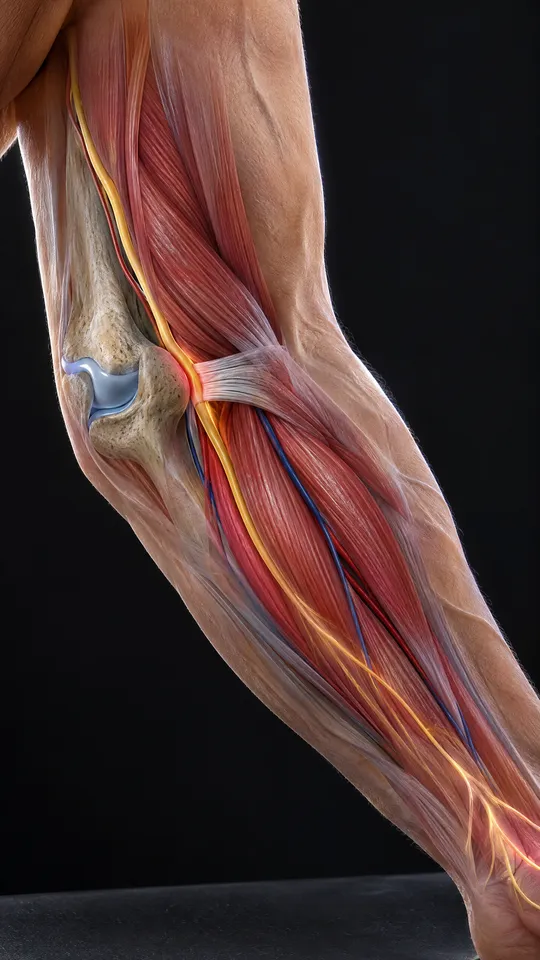

Inner elbow showing the ulnar nerve passing behind the bony point of the elbow and into the forearm

Ulnar nerve entrapment or carpal tunnel syndrome? How to tell the difference

The quickest clue is which fingers go numb. Ulnar nerve entrapment affects the ring and little fingers 1,4. Carpal tunnel syndrome involves a different nerve at the wrist and different fingers. Our carpal tunnel page explains that pattern.

Carpal tunnel is the more common of the two 2,4, and they often travel together: people with ulnar nerve entrapment are often diagnosed with carpal tunnel syndrome at the same time 1. Finding one doesn't rule out the other.

We also check your neck. The ulnar nerve starts from nerve roots at the C8 and T1 levels 4, so irritation there can affect the same fingers. That's standard assessment practice, not a research finding, but a good reason not to assume the elbow.

How it's diagnosed

It starts with your story and a hands-on examination 1 5. A clinician asks about your work, your activities and your medicines, then checks the feeling and strength in your hand and fingers 6. They'll tap over the nerve at the funny bone. A shock into the ring and little fingers suggests an irritated nerve, although that can happen with a healthy one too 6. They'll also watch whether the nerve slips out of its groove as you bend your elbow, and check your neck, because a pinched nerve there can cause similar symptoms 6.

X-rays don't show most causes of the squeeze. They're for spotting bone spurs or arthritis crowding the nerve 6.

How we treat it

First we work out where the nerve is being compressed, how severe it is, and what in your week is causing it. Ulnar nerve entrapment treatment then usually involves:

1
Understanding it, and changing what loads it. It sounds like the soft option; it's the best-evidenced thing here. Education and activity modification carry moderate-strength evidence for mild to moderate cases 2, and as the only treatment, 44% to 66% of people had symptoms resolve over a year 2. We go through your day and find the positions doing the damage.
2
Keeping your elbow out of full bend overnight. A night splint that stops the elbow folding right up is a first-line option 1. Pooled, 89% of people improved with a splint versus 54% after an injection, though the studies varied widely: a direction, not a promise 3. A pillow or rolled-up towel in the crook of the elbow works the same way 5. With night splinting plus activity changes, one group had 82% symptom-free at two years 2.
3
Hands-on treatment where it helps you tolerate the rest. Manual therapy through the elbow, forearm, shoulder and neck can ease symptoms and restore movement. See the honest position below.
4
Sport-specific load management. Overhead throwing is a named risk factor 4. If that's you, our sports physiotherapy work rebuilds throwing volume and mechanics instead of just stopping you.
5
Time, honestly accounted for. Non-surgical care should run at least three months before surgery is considered 1,9. Recovery is real but often slow 2.

Other treatments we may use

Ulnar nerve entrapment exercises (nerve glides).

Gentle movements that help the nerve slide instead of getting tugged, typically once a day, three to five times a week, or as tolerated 5. Stop if one causes intense shooting pain, or if tingling persists after rest, and tell your physiotherapist 5. The evidence for nerve glides and physiotherapy techniques is weak, and one review found too few studies to conclude anything about nerve mobilisation 2.

Ultrasound and laser.

One analysis reported 69% improvement at three months, but in just 32 people 3, and the overall evidence is weak 2. If we use them, it's alongside the plan, not as the plan.

Ice and heat.

Listed for pain relief 5, but none of the systematic reviews behind this page evaluates either. See the FAQ below.

Corticosteroid injection.

Physiotherapists don't prescribe, administer or arrange injections, so this is only what the literature reports. It's listed as an option for mild, intermittent symptoms 1, but the evidence is mixed: one randomised trial found no difference from placebo (30% success), while uncontrolled case series reported 53 to 63% improvement 2. A pooled analysis preferred splinting 3. It's a conversation for your GP.

Your recovery path: Reset, Rebuild, Return

A trapped ulnar nerve is not a torn tissue waiting to knit, so The Well Motion Recovery Path™ runs a little differently here. You move up a phase when your hand copes with more, not when a date comes round.

  • Reset: from the first visit. We find the elbow positions that set your symptoms off and change them, and you keep the elbow out of full bend overnight with a night splint or a rolled towel 1,5. Expect the numbness to come and go at first. We move you on once it is settling instead of spreading.
  • Rebuild: a trial of 6 to 12 weeks, the period one systematic review recommends 2. Nerve glides and manual therapy are added to the positioning, which stays. Expect good and bad days. We move you on when your hand does what your daily tasks ask of it.
  • Return: back to the desk, the tools, the long drive or, for throwers, a graded build through sports physiotherapy. We recheck feeling and grip. You leave with elbow habits and a night set-up to keep using.

How long it usually takes. Often slowly 2. In one trial nearly 90% of people had improved at six months 2. With education and activity changes alone, symptoms took a median of 11 months to plateau 2. That evidence covers mild and moderate cases 2. In severe ones, surgery is considered when this care has not worked 5.

Reducing your risk of it coming back

Changing how you use your elbow has moderate-strength evidence as a treatment for mild to moderate cases 2. It hasn't been tested as prevention, but it's the obvious place to start:

  • Keep your elbow off hard edges. Leaning on it presses on the nerve. Don't rest it on the armrest, don't drive with your arm on the open window, and check your desk chair isn't too low 6.
  • Limit long spells with the arm bent. Bending stretches the nerve around the bone and cuts its blood supply, so break up phone calls and long drives 6.
  • Lighten forceful work. In a Danish study, forceful work raised the odds of ulnar neuropathy by up to 3.85 times, more so in awkward postures. Repetitive movement alone didn't 7.
  • Quit smoking. People with more than 24 pack-years of smoking had over four times the odds, and smoking went with more severe nerve damage on testing 8. Quitting is on the Australian prevention list too 1.

When to get it checked properly

Most mild, intermittent ulnar nerve compression responds to activity changes and night positioning. Don't keep self-managing. Book an assessment if:

  • The numbness has become constant, or feeling in those fingers is fading 1
  • Your hand is getting weak or clumsy: dropping things, struggling with fiddly tasks 1,5
  • The small hand muscles look wasted, or the ring and little fingers are starting to curl 4,5
  • It started after a blow to the inside of the elbow, a fracture or a dislocation 1,5
  • Three months of changing your elbow habits and protecting it overnight hasn't shifted it 1,9

Severe, untreated entrapment risks significant arm and hand weakness as the muscles deteriorate 1. Nerve conduction studies, which test how well the nerve carries signals, are used in more severe cases, and surgery is considered when conservative care hasn't worked 5. Surgery helps only about 70% of people, against over 90% for carpal tunnel release 2, and isn't guaranteed 1. That's an argument for getting it looked at early, not for panicking.

In one trial of conservative care, nearly 90% of people had improved at six months, whichever approach they were given 2.

Your first appointment

We start by listening: how it began, what makes it worse, and what it's stopping you from doing. Then we examine the area, explain what we find in plain English, and agree a plan with you. Your first visit is 40 minutes at Engadine and 30 minutes at our other clinics.

We see patients at Engadine, Mount Annan, Narellan and Appin, and at home through our mobile physiotherapy service. If you have private health cover, here's how health fund rebates work for physiotherapy.

FAQs

What is the best sleeping position for someone with ulnar nerve entrapment?

Any position that stops your elbow folding right up. Sleeping with the arm bent is a named risk factor 1, and tunnel pressure is lowest around 40 to 50 degrees of bend 9. A pillow or rolled-up towel in the crook of your elbow is the simplest fix 5; a night splint preventing full bend does it more reliably 1. If you can't sleep in the splint, tell us. Don't quietly give up.

Does the ulnar nerve heal?

Usually, though not always quickly. In one trial, nearly 90% of people had improved by six months 2; with education and activity changes alone, the median time for symptoms to plateau was 11 months 2. Severity matters: the evidence for conservative care covers mild and moderate cases 2, and in severe entrapment the muscles can deteriorate 1.

How do you release a trapped ulnar nerve?

There's no single manoeuvre. For mild, intermittent symptoms the recommended approach combines physiotherapy, changing how you use your arm at work and in bed, and a night splint, trialled for at least three months 1. Education, activity changes and splinting carry the real evidence 2. Surgical release is the last step, not the first 1.

Is it okay to massage the ulnar nerve?

Gentle hands-on work around the elbow and forearm is reasonable, but the evidence for it is weak 2. What we'd avoid is deep, direct pressure on the nerve in the groove: tenderness there is itself a symptom 1, and nothing in the research supports digging into it. If anything causes intense shooting pain, stop 5.

Should I ice or heat the ulnar nerve?

Both appear in published lists for easing pain 5, but none of the reviews behind this page compares them. Use whichever feels better, as comfort, not treatment, and put your effort into what has evidence: better elbow positions, day and night 2,9.

More Elbow conditions

Elbow

Tennis Elbow

Pain and tenderness on the outside of the elbow, usually worst when you grip something, lift a full kettle, or turn a doorhandle. It builds through repeated load rather than all at once, and you don't have to play tennis to get it.

Read more
Elbow

Golfer's Elbow

The same pattern of overuse, on the inside of the elbow instead. Common in golfers, and just as common in tradies and anyone who grips hard all day.

Read more
Elbow

Cubital Tunnel Syndrome

Cubital tunnel syndrome is compression of the ulnar nerve at the inside of your elbow. It's the second most common nerve compression in the arm, after carpal tunnel syndrome

Read more

If your ring and little fingers have been going numb for more than a few weeks, especially if your hand is starting to feel clumsy, that's worth an assessment rather than another month of hoping it settles.

Book an appointment with the Well Motion team at Engadine, Mount Annan, Narellan or Appin, or head back to the Elbow section of our Injury Finder if you're not yet sure which part of the elbow is the problem.

Book an Assessment
Ahmed Elsayed, Principal Physiotherapist
Reviewed by Ahmed Elsayed Principal Physiotherapist at Well Motion

References

  1. Ulnar nerve entrapment. healthdirect Australia (Australian Government). Last reviewed June 2025. https://www.healthdirect.gov.au/ulnar-nerve-entrapment
  2. Kooner S, et al. Conservative treatment of cubital tunnel syndrome: a systematic review. Orthopedic Reviews (Pavia), 2019;11(2):7955. https://pmc.ncbi.nlm.nih.gov/articles/PMC6589621/
  3. Natroshvili T, et al. Conservative treatment of ulnar nerve compression at the elbow: a systematic review and meta-analysis. Archives of Plastic Surgery, 2023;50(1):70. https://pmc.ncbi.nlm.nih.gov/articles/PMC9902076/
  4. Cutts S. Cubital tunnel syndrome. Postgraduate Medical Journal, 2007;83(975):28-31. https://pmc.ncbi.nlm.nih.gov/articles/PMC2599973/
  5. Cubital tunnel syndrome. Leeds Community Healthcare NHS Trust: Musculoskeletal (MSK) service. Last modified 12 March 2026. https://leedscommunityhealthcare.nhs.uk/our-services-a-z/musculoskeletal-msk/elbow-problems/cubital-tunnel-syndrome/
  6. American Academy of Orthopaedic Surgeons. Ulnar Nerve Entrapment at the Elbow (Cubital Tunnel Syndrome). OrthoInfo. https://www.orthoinfo.org/diseases--conditions/ulnar-nerve-entrapment-at-the-elbow/
  7. Svendsen SW, Johnsen B, Fuglsang-Frederiksen A, Frost P. Ulnar neuropathy and ulnar neuropathy-like symptoms in relation to biomechanical exposures assessed by a job exposure matrix: a triple case-referent study. Occupational and Environmental Medicine, 2012;69(11):773-80. Abstract via PubMed (PMID 22843442). https://doi.org/10.1136/oemed-2011-100499
  8. Frost P, Johnsen B, Fuglsang-Frederiksen A, Svendsen SW. Lifestyle risk factors for ulnar neuropathy and ulnar neuropathy-like symptoms. Muscle & Nerve, 2013;48(4):507-15. Abstract via PubMed (PMID 23424094). https://doi.org/10.1002/mus.23820
  9. Shah CM, Calfee RP, Gelberman RH, Goldfarb CA. Outcomes of rigid night splinting and activity modification in the treatment of cubital tunnel syndrome. Journal of Hand Surgery (American Volume), 2013;38(6):1125-1130. https://pmc.ncbi.nlm.nih.gov/articles/PMC3989882/
  10. Assmus H, Antoniadis G, Bischoff C. Carpal and cubital tunnel and other, rarer nerve compression syndromes. Deutsches Ärzteblatt International, 2015;112(1-2):14-25. https://pmc.ncbi.nlm.nih.gov/articles/PMC4318466/