Need urgent care? 24/7 Mobile & After-Hours Emergency Physiotherapy Call (02) 8111 5633 For life-threatening emergencies, always call 000
Shoulder

Shoulder Dislocation

5.0 average rating on Google
Registered NDIS Provider
SIRA Registered Provider

Your shoulder has been put back in, and you've left hospital with a sling and a note to see a physiotherapist. The pain has eased. The questions haven't: how long in the sling, when you can use the arm, and whether it will happen again. That last one matters most.

If it has only just happened: call us. We assess it and manage it, and get you to hospital when that's what it needs. Don't try to put it back yourself 1.

What's actually causing it

Your shoulder is a ball-and-socket joint, but the socket (the glenoid) is shallow, closer to a saucer than a cup 2. That's what lets your arm move in so many directions. It also means the joint relies on its capsule, ligaments and muscles to keep the ball in place.

Up to 97% of dislocations are anterior, meaning the ball is forced out the front 5. The typical position is the arm out to the side and rotated backwards 5. Think of blocking a ball, a tackle, or a hand thrown out in a fall.

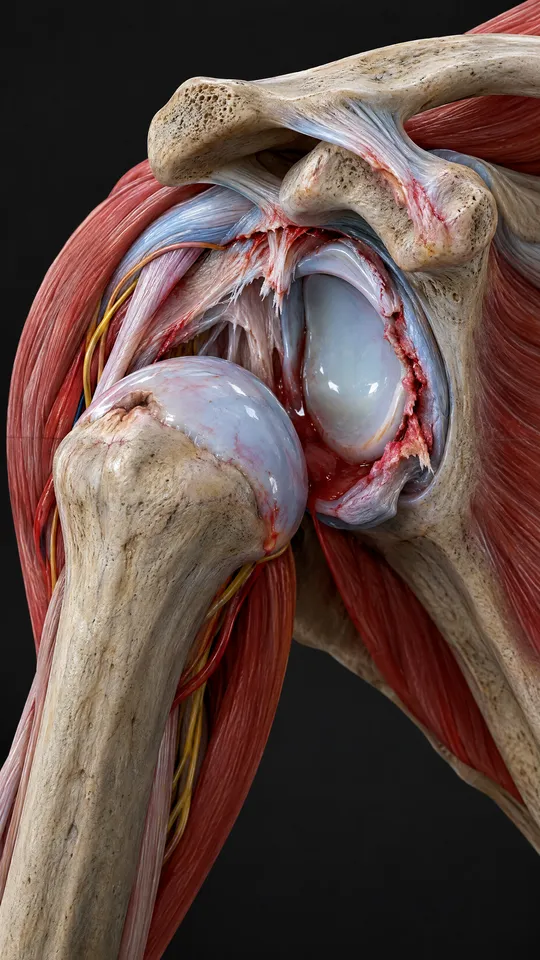
The ball rarely comes out cleanly. It can damage the capsule, ligaments, muscles or bone on the way 2. You may see these names on a scan report 5,10:

  • Bankart lesion: a tear of the labrum, the rim of cartilage around the front of the socket.
  • Hill-Sachs lesion: a dent in the ball where it struck the edge of the socket.
  • Axillary nerve injury: a stretch injury to a nerve that runs around the shoulder.
  • Rotator cuff tear: worth checking for if pain or weakness lingers, especially if you're over 40.

Whether it happens again depends partly on your age and on how well the joint heals 1.

Front of the shoulder showing the ball of the arm bone out of its socket with torn tissue at the front

Dislocated or separated shoulder? How to tell the difference

A dislocated shoulder means the ball has come out of the socket itself 2.

A separated shoulder is a different injury in a different joint. It affects the AC joint at the very top of the shoulder, where the collarbone meets the shoulder blade. It usually comes from landing on the point of the shoulder, and the ball stays in its socket.

A broken bone can happen in the same fall. That's why X-rays are taken to check the ball is back in position and to look for any fracture 2.

How it's diagnosed

A dislocation is diagnosed by examination and an X-ray. The clinician checks the shoulder for tenderness, swelling and a change in shape, feels the pulse at your wrist, and tests the feeling and movement in your arm, because a dislocation can injure an artery or a nerve 8. An X-ray confirms the shoulder is out 1. More X-rays follow once it's back in, to check the position and look for a fracture 2.

Other scans tend to come later. A CT may be ordered if the bone is hard to see on X-ray. An MRI looks at the ligaments, though it's rarely needed on the day 8. You may also be offered a scan to check whether the shoulder has been damaged 1.

How we treat it

Rehab starts once the shoulder has been put back and checked 1,2. From there, rehab runs in phases 9:

1
Protecting it early. A sling is worn for the first few weeks 1, for a period set by your treating doctor or physiotherapist 2. Ice helps in the first 48 to 72 hours, and your elbow, wrist and hand should keep moving from the start 2. What waits: shoulder exercises, and moving the arm up and away from your body, which can bring it out again 2.
2
Restoring movement. From about three weeks, the focus shifts to getting your movement back and starting early strengthening, usually through to week 6 9. We may use manual therapy alongside your exercises to help you regain that movement comfortably.
3
Strengthening and returning to sport. Strengthening the muscles around the shoulder is recommended to reduce the chance of it dislocating again 1. Progressive strengthening runs from about week 6 to week 12, with return-to-sport work after that 9. That's where sports physiotherapy comes in: strength in the positions your sport demands.

To be straight about the research: rehab after a dislocation is standard, recommended care 1,2. But the trial evidence is thin. A 2019 Cochrane review found no randomised trials of rehab after a dislocation 4. The largest trial since then measured shoulder function, and wasn't designed to show whether rehab prevents re-dislocation 6. So we won't promise a result.

Other treatments we may use

Surgery to stabilise the shoulder.

Sometimes surgery is needed to reduce the risk of dislocating again 1. A 2025 review of people aged 15 to 25 after a first dislocation found re-dislocation rates of about 16% after surgery and about 25% without it 3. The authors favoured surgery under 25, but noted there's no data yet on whether it's cost-effective 3. Looked at the other way, roughly three in four young people managed without surgery in that data didn't dislocate again. It's a real decision to talk through with an orthopaedic surgeon, and we can help with the rehab either way.

Sling position.

Some doctors immobilise the arm turned outwards instead of in the usual sling. The evidence is too limited to say that works better, and no trials have compared how long a sling should be worn 4. Follow the timeframe your treating doctor sets 2.

Your recovery path: Reset, Rebuild, Return

Rehab after a dislocation follows The Well Motion Recovery Path™. You move up a phase when the shoulder can cope, not when a week number passes.

  • Reset: the sling period, after the shoulder has been put back 1,2. Ice, the sling, and elbow, wrist and hand exercises 2. Expect a stiff, weak arm when the sling comes off. We move you on once your treating doctor or physiotherapist clears you out of the sling 2.
  • Rebuild: movement comes first, with manual therapy alongside your exercises, then heavier strengthening 9. Expect the shoulder to feel uneasy with the arm out to the side and turned back, the position it usually comes out in 5. We move you on when the arm does what your daily tasks ask of it without pain or a feeling of slipping.
  • Return: work, overhead lifting, or sport through sports physiotherapy. We test strength and control in the positions your work or sport demands. You leave with a strength program to keep up.

How long it usually takes. Recovery usually takes 6 to 12 weeks, and some sports can take 16 weeks or longer 1. After stabilisation surgery your surgeon sets the timeline. A review of 41 studies of one keyhole repair, mostly case series, found 3 to 6 weeks of immobilisation and averages of 5.2 to 6.4 months before return to sport 12.

Reducing the risk of it happening again

Some of this has been tested in trials and some hasn't, so here's what each piece rests on:

  • Age and sex. In a review of ten studies, people aged 40 and under had far higher odds of the shoulder becoming unstable again, and men had about three times the odds of women 7. Neither can be changed, but both are worth knowing.
  • Surgery, if you're under 25. Stabilisation surgery is the one step that pooled studies support for lowering re-dislocation in young adults 3. That's a conversation for an orthopaedic surgeon.
  • Rehab. Strengthening the shoulder is recommended to lower the risk 1. A trial of 482 adults after a first dislocation found that adding a programme of physiotherapy sessions did no better than one session of advice and home exercises with a physio, plus the option to come back, for shoulder function at six months 6. Its main measure was function, not re-dislocation. Re-dislocations were only counted as a complication: 7 of 240 people in the advice group and 3 of 242 in the programme group, too few to show a difference either way 6. A smaller Danish trial of 56 people aged 18 to 39 found that 12 weeks of supervised neuromuscular exercise improved shoulder function more than a home programme 11. The gain fell just short of what the researchers counted as clinically important, fewer than half the supervised group kept up with the sessions, and nobody was followed long enough to count re-dislocations 11.
  • The first weeks. Don't start shoulder exercises straight away, and avoid lifting the arm up and away from your body until your doctor clears it. It can come out again 2.

When to get it checked properly

Call us if you think your shoulder has dislocated. We assess it and manage it, and get you to hospital when that's what it needs. Don't try to put it back yourself 1. In an emergency, call triple zero (000).

Book a physiotherapy assessment if:

  • Your shoulder has been put back and nobody has given you a rehab plan
  • The shoulder feels loose, or like it might slip, during everyday movements or sport
  • It has dislocated more than once 1
  • You're under 25 and weighing up surgery 3
  • You're planning a return to contact or overhead sport

The aim is a shoulder that's back in place, and one you trust again.

Your first appointment

We start by listening: how it began, what makes it worse, and what it's stopping you from doing. Then we examine the area, explain what we find in plain English, and agree a plan with you. Your first visit is 40 minutes at Engadine and 30 minutes at our other clinics.

We see patients at Engadine, Mount Annan, Narellan and Appin, and at home through our mobile physiotherapy service. If you have private health cover, here's how health fund rebates work for physiotherapy.

FAQs

How long does it take to heal a dislocated shoulder?

Usually 6 to 12 weeks, and up to 16 weeks or sometimes longer before returning to some sports 1. In UK rehab guidelines, the return-to-sport phase starts after 12 weeks 9.

How do you treat a dislocated shoulder?

First it's put back in place by a clinician and X-rayed 1,2. Then a sling for a few weeks, early ice and gentle hand, wrist and elbow exercises 2, and graded rehab to strengthen the shoulder 1. Some people also have surgery to lower the risk of it happening again 1,3.

How painful is a dislocated shoulder on a scale of 1 to 10?

There's no reliable number, and we won't invent one. What matters is that it needs to be put back by a clinician, and you shouldn't try to put it back yourself 1. Call us.

Is a dislocated shoulder worse than a broken arm?

They're different injuries, so there's no fair ranking. What's distinctive about a dislocation is the risk of it happening again 1,2. It can also damage bone, which is why X-rays check for fractures 2.

How much force is needed to dislocate your shoulder?

There isn't a set amount. Position matters more: most dislocations happen when the arm is forced out to the side and rotated backwards 5.

More Shoulder conditions

Shoulder

Rotator Cuff Tear

Weakness or pain lifting the arm out to the side, reaching behind you, or sleeping on that shoulder. Often after a fall, or after years of overhead work.

Read more
Shoulder

Frozen Shoulder

Stiffness in every direction, including when someone else moves the arm for you. Comes on gradually and moves through stages.

Read more
Shoulder

SLAP Tear

SLAP stands for Superior Labrum, Anterior to Posterior. The labrum is the rim of cartilage that deepens your shoulder socket. The long head of the biceps tendon attaches to it at the top, and that's where these tears happen

Read more
Shoulder

Biceps Tendon Rupture

A rupture at the shoulder usually follows tendon wear that's been building for a while. Uncommonly, a severely worn tendon gives way altogether

Read more
Shoulder

Biceps Tendinopathy

Biceps tendinopathy is thickening and irritation of the biceps tendon at the front of the shoulder. It often starts without any known injury.

Read more
Shoulder

AC Joint Sprain

Your AC joint is where the far end of your collarbone meets the top of your shoulder blade. A sprain means the ligaments holding that joint together have been stretched or torn.

Read more

Been told to "see a physio" after a dislocation?

Book an appointment at Engadine, Mount Annan, Narellan or Appin. We'll build your plan from the sling to full strength, with an honest view of your risk of it happening again. Not sure it's a dislocation? Start from the Shoulder section of our Injury Finder.

Book an Assessment
Ahmed Elsayed, Principal Physiotherapist
Reviewed by Ahmed Elsayed Principal Physiotherapist at Well Motion

References

  1. Dislocated shoulder. NHS. Page last reviewed 16 September 2026. https://www.nhs.uk/conditions/dislocated-shoulder/
  2. Shoulder dislocation (patient fact sheet). NSW Agency for Clinical Innovation, Emergency Care Institute. Published December 2022. https://aci.health.nsw.gov.au/networks/eci/clinical/ed-factsheets/shoulder-dislocation
  3. Cutteridge J, Dixon J, Garrido P, Peckham N, Smith C, Woods A, Gwilym S. Systematic review and meta-analysis of operative versus non-operative management of first-time traumatic anterior shoulder dislocation in young adults. Shoulder & Elbow, 2025;17(2). PMID 39552694. https://pubmed.ncbi.nlm.nih.gov/39552694/
  4. Braun C, McRobert CJ. Conservative management following closed reduction of traumatic anterior dislocation of the shoulder. Cochrane Database of Systematic Reviews, 2019, CD004962.pub4. https://www.cochranelibrary.com/cdsr/doi/10.1002/14651858.CD004962.pub4/full
  5. Abrams R, Akbarnia H. Shoulder Dislocations Overview. StatPearls (NCBI Bookshelf, NBK459125). StatPearls Publishing. Last updated 8 August 2023. https://www.ncbi.nlm.nih.gov/books/NBK459125/
  6. Kearney RS, Ellard DR, Parsons H, Haque A, Mason J, Nwankwo H, et al. Acute rehabilitation following traumatic anterior shoulder dislocation (ARTISAN): pragmatic, multicentre, randomised controlled trial. BMJ, 2024;384:e076925. PMC10792684. https://pubmed.ncbi.nlm.nih.gov/38233068/
  7. Olds M, Ellis R, Donaldson K, Parmar P, Kersten P. Risk factors which predispose first-time traumatic anterior shoulder dislocations to recurrent instability in adults: a systematic review and meta-analysis. British Journal of Sports Medicine, 2015;49(14):913-922. PMC4687692. https://pubmed.ncbi.nlm.nih.gov/25900943/
  8. American Academy of Orthopaedic Surgeons. Shoulder Dislocation. OrthoInfo. https://www.orthoinfo.org/diseases--conditions/dislocated-shoulder/
  9. Wong C, Jaggi A, Kearney R, Gwilym S. British Elbow and Shoulder Society practice guidelines: Rehabilitation following traumatic anterior shoulder dislocation (post-operative and non-operative care). Shoulder & Elbow, 2026;18(3):604-608. https://doi.org/10.1177/17585732261439731
  10. Gombera MM, Sekiya JK. Rotator cuff tear and glenohumeral instability: a systematic review. Clinical Orthopaedics and Related Research, 2014;472(8):2448-2456. PMID 24043432 (PMC4079862), via PubMed. https://doi.org/10.1007/s11999-013-3290-2
  11. Eshoj HR, Rasmussen S, Frich LH, Hvass I, Christensen R, Boyle E, et al. Neuromuscular exercises improve shoulder function more than standard care exercises in patients with a traumatic anterior shoulder dislocation: a randomized controlled trial. Orthopaedic Journal of Sports Medicine, 2020;8(1):2325967119896102. https://doi.org/10.1177/2325967119896102
  12. Villarreal-Espinosa JB, Reinold MM, Khak M, Shariyate MJ, Mita C, Kay J, Ramappa AJ. Rehabilitation protocol variability following arthroscopic Bankart repair and remplissage for management of anterior shoulder instability: a systematic review. International Journal of Sports Physical Therapy, 2024;19(10):1172-1187. PMID 39371186 (PMC11446737). https://pubmed.ncbi.nlm.nih.gov/39371186/