Graded exercise and conditioning
the backbone of most persistent-pain programs, because it's the part you can keep doing without us. Dosed to your current tolerance and progressed deliberately.
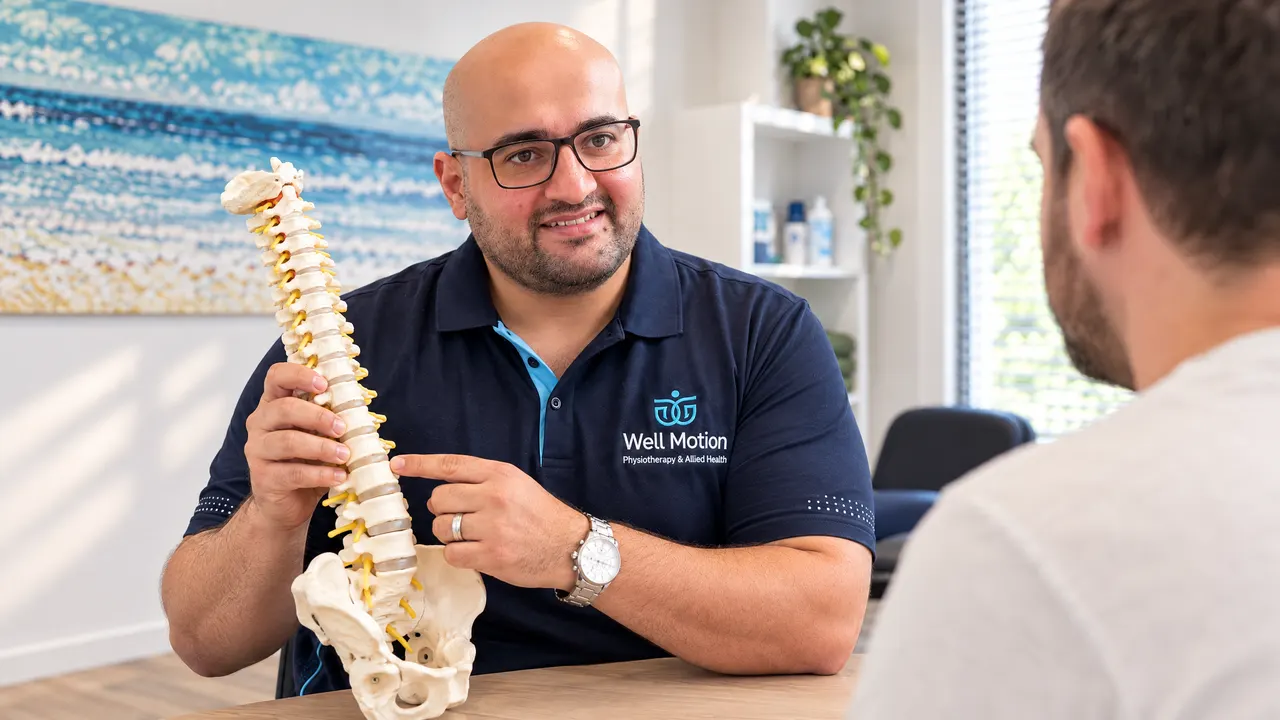
You've had the pain for months. Maybe years. You've had the scan, and either it showed nothing much or it showed something that everyone agreed was "normal for your age". Somewhere along the way you've been told to just manage it, and nobody has explained what managing it is supposed to look like beyond taking it easy and hoping.
That's the situation this service exists for. Pain that has outlasted the injury that started it, or that never had a clear starting point at all, is a different problem from a fresh sprain, and it needs to be approached differently. Not with more of the same passive treatment, and not with a shrug. Our chronic pain management program is run locally, in Sydney's Sutherland Shire at Engadine and further south-west at Mount Annan, Narellan and Appin.
When pain is new, the injured tissue and the pain usually track each other reasonably closely. When pain has been around a long time, that relationship gets looser. The sore area might have settled structurally while the pain hasn't. Sleep, stress, fear of a particular movement and months of avoiding it all end up woven into the picture.
None of that means the pain isn't real or isn't physical. It means the useful question changes. It stops being "what's torn?" and becomes "what's driving this now, and what can we change?"
Those are different questions, and they need a different kind of appointment to answer.
We start by investigating, properly. Your first session is longer on questions than you might expect. How long it's been going on. What it stops you doing. What you've already tried and what happened. How you're sleeping. Which movements you've quietly stopped attempting. Then we look at how you move, where your load tolerance currently sits, and where the restriction and the sensitivity are, which often isn't the same place.
We tell you what we find, in plain English. If there's a mechanical driver we can work on, we'll say what it is. If part of the picture is a nervous system that has become very good at producing pain, we'll explain that too, without dressing it up as something it isn't. You should leave the first session understanding your own situation better than when you walked in.
We set a starting point below your flare-up threshold. This is the part that usually differs from what people have tried on their own. Most people with long-term pain have cycled between doing too much on a good day and doing nothing for the three days afterwards. We work out where your current tolerance sits, start below it, and build from there in steps small enough that the pattern doesn't repeat.
We agree on when we'll check. We don't book an indefinite series of sessions. We set a point, usually a few weeks out, where we reassess against something specific and measurable to you. Walking further. Sitting through a shift. Getting through a night. If it's working we keep going; if it isn't, we change the plan instead of repeating it.
The goal isn't a number on a pain scale. It's whatever the pain has taken off you.
Getting through a full workday without needing to lie down afterwards. Sleeping without waking at two in the morning to reposition. Picking up your grandkids. Going back to the gym without negotiating with yourself first. Driving to Wollongong without planning the stops.
We ask what yours is at the start, because it decides everything else: what we load first, how fast we progress it, and how we know whether the program is working. A plan built around a goal you care about is one you're far more likely to keep doing on the weeks we don't see you.
We're also straightforward about scope. The aim is to reduce your pain and get function back, and for many people that adds up to a substantial change in how the day feels. We don't promise to cure long-term pain, and you should be cautious of anyone who does.
Everything below sits within physiotherapy scope, and what gets chosen depends on your assessment:
the backbone of most persistent-pain programs, because it's the part you can keep doing without us. Dosed to your current tolerance and progressed deliberately.
hands-on mobilisation and soft-tissue work, used to make movement more comfortable so the active work is possible. It opens the window; it isn't the plan.
where the assessment points to specific muscular trigger points contributing to the picture.
understanding what's happening and why a particular movement feels threatening changes how you approach it. This runs through every session rather than sitting in one.
practical planning of your week so a good day doesn't cost you the next three.
Medication and injection-based treatments also exist in the broader care picture for persistent pain. They sit with your GP or a medical specialist; physiotherapists don't prescribe or administer them. If your care involves both, we're happy to work alongside it.
You can see everything else we offer on our services page.
Plenty of people arrive with a diagnosis attached, and the program gets built around it. Long-term lower back and leg pain from sciatica or a lumbar disc bulge is one of the most common versions we see.
If you're still at the stage of working out what's going on, or you've been given a label like fibromyalgia and nobody has explained what it means for your day-to-day, our blog covers physiotherapy for chronic pain and fibromyalgia in more depth than a service page should.
Most persistent pain is worth assessing because you've stopped doing things you'd like to do. That's reason enough. But book sooner rather than later if:
Some symptoms need medical review rather than physiotherapy first: unexplained weight loss, fever alongside the pain, changes to bladder or bowel control, or pain that's severe and unrelenting at night. If any of those apply, see your GP, and see them promptly. If they don't, an assessment here is a reasonable next step.
996 Old Princes Hwy, Engadine NSW 2233
Shop 11/13 Main St, Mount Annan NSW 2567
22 Sharman Cl, Harrington Park NSW 2567
49 Appin Rd, Appin NSW 2560
All four clinics are reachable on (02) 8111 5633.
Yes, though not by treating the sore spot harder or for longer. It means assessing what's driving the pain now (how you move, what your body currently tolerates, how you're sleeping, which movements you've started avoiding), and then building a structured, progressive program around it. Passive treatment on its own tends not to hold up over months. The aim is less pain and more of your life back, not a cure.
Within physiotherapy: graded exercise and conditioning, manual therapy, dry needling, pain education and activity pacing, used in combination, chosen from your assessment rather than applied as a standard package. Beyond physiotherapy, medication and injection-based options exist and sit with your GP or a medical specialist; we don't prescribe or administer them, but we'll work alongside that care where it's part of your plan.
There isn't one. What matters far more than the exercise you pick is the dose and the progression: starting below the level that flares you up, and building in steps small enough that you can keep going. Walking, strength work, hydrotherapy and cycling all work when they're dosed properly, and all of them backfire when they're not. Finding your starting point is most of the job.
We won't quote you a number before we've assessed you, and it's worth being suspicious of anyone who does. What we'll do in the first session is set a reassessment point, usually a few weeks out, with something specific we're checking against. At that point we either keep going because it's working, or change the plan because it isn't. You're not committing to a package.
Not to book with us. You can make a physiotherapy appointment directly. If your GP has referred you as part of a care plan for a long-term condition, bring that paperwork along; those arrangements have their own rules about what's covered, and we'll go through what applies to you before you commit to anything.
Often, yes. Well Motion is a registered NDIS provider and works with WorkCover claims, and long-term pain is a common reason for both. The details differ enough that they have their own pages. See NDIS physiotherapy and WorkCover physiotherapy, or ask us when you book and we'll tell you where you stand.

How would you like to reach us?
Message us on WhatsAppFor bookings and enquiries. Please don't send medical details. Call (02) 8111 5633Request a call-back
Request sent
Thank you. We'll call you back on the number you gave us.
This is a preview, so nothing was actually sent.