Rotator Cuff Tear
Weakness or pain lifting the arm out to the side, reaching behind you, or sleeping on that shoulder. Often after a fall, or after years of overhead work.
Read moreYou were lifting something heavy (a bag of soil, the end of a trailer, a weight you've handled a hundred times) and something at the front of your shoulder gave. A day or two later there's a rounded bulge in your upper arm that wasn't there before. And oddly, the arm still works.
A biceps tendon rupture is a partial or complete tear of one of the tendons that attach your biceps muscle to bone. Most involve the long head of the biceps at the shoulder 6, and that's what this page covers. A rupture at the elbow end is a different injury with a different plan. More on that below.
Your biceps has two tendons at the shoulder end. The long head runs up over the top of the shoulder joint; the short head attaches just in front of it. A shoulder-end rupture is almost always the long one 6, which is why, with the short head still attached, the arm keeps working.
In most people this isn't a strong, healthy tendon snapping out of nowhere. Tendon problems are usually an overuse injury: the tendon is repeatedly strained until tiny tears form, and the shoulder is one of the most common places it happens 1. Most of that recovers without any medical input. Uncommonly, though, severe tendinopathy left untreated can lead to the tendon rupturing 1. If you've had an ache at the front of the shoulder for months beforehand, that's often the backstory, and it's covered on our Biceps Tendinopathy page.
Long head biceps problems often occur alongside other shoulder disorders 4, and the rotator cuff is the usual suspect. More than half of people over 50 have a rotator cuff tear, with or without symptoms 5. So the biceps may not be the whole story.
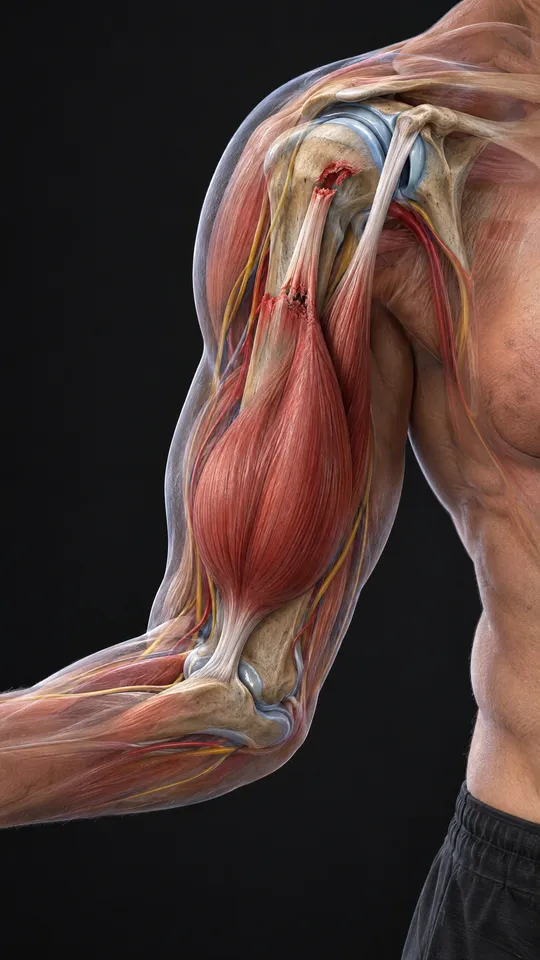
This matters most, because the two are handled in opposite ways.
At the shoulder (proximal rupture). The injury happened at the front of the shoulder, and the biceps muscle has bunched into a bulge in the upper arm. This is the common one. It can usually be managed without surgery 6, and non-surgical care is the standard first step 4.
At the elbow (distal rupture). The injury happened at the crease of the elbow instead. This is the less common injury, and it usually needs surgical repair 6. If that sounds like you, get it assessed promptly at an appointment with us or by your GP. Don't wait to see whether it settles.
And the shoulder around it. If lifting your arm out to the side is weak or painful, or you can't sleep on that side, the problem may be partly in the rotator cuff. Our Rotator Cuff Tear page covers that pattern. We check for it at every assessment for this injury.
A complete tear at the shoulder is usually obvious once someone looks at your arm. The muscle bunches into a bulge, and when you tighten it, it sits closer to the elbow than the biceps on your other side 7. Partial tears are harder to pick. You'll be asked to bend your elbow and tense the biceps, and pain when you do that can point to one 7.
We also check the front of the elbow, because a tear at that end leaves a gap there 7. An X-ray can't show the tendon itself, but it can pick up other causes of shoulder pain. Ultrasound shows the soft tissue, though how useful it is depends a lot on who's doing the scan, and an MRI can show both partial and complete tears 7.
The first job is confirming which end of the tendon has gone and whether anything else in the shoulder is involved. That's done by examining you. Scans can help but aren't always needed 2, and shoulder problems in general tend to be over-investigated 5. From there:
Anti-inflammatory medication and corticosteroid injections. Both are part of the recognised non-surgical approach for this injury 4. They're prescribed or given by a doctor, not by physiotherapists, so that's a conversation with your GP, not with us.
Surgery. Surgery for a shoulder-end rupture is generally for people whose symptoms don't settle with non-surgical care 4. What triggers it is persistent symptoms, not the size of the tear. There are two main options: a tenotomy, where the tendon is released and left to settle, and a tenodesis, where it's reattached lower down the upper arm bone.
The evidence comparing them cuts both ways. A tenotomy carried about two and a half times the risk of a visible Popeye bulge, and scored slightly lower on a shoulder function score at two years 3. Cramping in the muscle and pain at the front of the shoulder have also been reported more often after tenotomy 4. But the same researchers described that two-year difference as clinically irrelevant and recommended either technique 3. Pain, elbow bending strength and forearm strength showed no significant difference 3, and neither did overall function or patient satisfaction 4. One caveat: those trials looked at long head biceps problems generally, not only ruptures 3.
In plain terms, the choice is largely about appearance and preference, not about getting your strength back. If you do have surgery, post-operative rehab is where we come back in.
A ruptured long head of biceps is managed along The Well Motion Recovery Path™. The tendon stays torn, so you step up a phase when the arm copes with more, not when a date comes round.
How long it usually takes. We found no study timing recovery from this rupture without surgery. For shoulder pain in general, about half of people treated conservatively recover within six months 5. After tenodesis, one series of 18 men with no comparison group used a sling for 6 weeks, added resistance from week 12 and allowed usual activity from week 16 8.
Prevention hasn't been put through a trial for this injury, so what follows comes from its recognised risk factors:
Don't wait it out. Book an assessment if:
The reassuring half: people with a shoulder-end rupture generally recover well with timely diagnosis and treatment 6. For shoulder pain in general, most people treated conservatively have recovered within a year 5.
We start by listening: how it began, what makes it worse, and what it's stopping you from doing. Then we examine the area, explain what we find in plain English, and agree a plan with you. Your first visit is 40 minutes at Engadine and 30 minutes at our other clinics.
We see patients at Engadine, Mount Annan, Narellan and Appin, and at home through our mobile physiotherapy service. If you have private health cover, here's how health fund rebates work for physiotherapy.
Usually, yes. After a shoulder-end rupture the arm generally keeps working. Non-surgical care is the first-line treatment 4, and even when surgery is compared, the two techniques show no significant difference in elbow bending or forearm strength 3. The visible change is often bigger than the functional one.
It depends which end. A rupture at the shoulder can usually be treated without surgery, and people generally recover well with timely diagnosis and treatment 6. A rupture at the elbow is more serious and usually needs surgical repair 6.
The torn tendon won't reattach to where it was. What recovers is how well the arm and shoulder work. Non-surgical care, including activity modification and physiotherapy, is usually the first line of treatment for the long head 4. The aim is function around the rupture, not re-growing the tendon.
There's no reliable single timeframe for this injury, and anyone quoting you an exact number of weeks is guessing. As a general guide, about half of people treated conservatively for acute shoulder pain recover within six months, and about 60% within a year 5. Tendon problems in general can take months, or even years, to fully heal 2.
The bulge won't go away by itself, because the tendon doesn't reattach, and cramping in the muscle or pain at the front of the shoulder are recognised problems with this injury 4. But "left alone" isn't the same as managed conservatively; that's the usual first step 4, and it generally goes well when started in good time 6. The other reason to get it looked at is what else might be going on: biceps problems often sit alongside other shoulder disorders 4, particularly in the rotator cuff.
For a shoulder-end rupture, timing is rarely the deciding factor, because most are managed without surgery 6 and surgery is reserved for symptoms that don't settle 4. Time pressure applies mainly to ruptures at the elbow, which usually do need surgery 6. If yours is at the elbow, get it assessed straight away.
Not rest. After a few days of rest, gentle exercise that gradually builds up helps tendons heal, and long periods of complete rest aren't a good idea 2. There's no shortcut, but the right load early is the closest thing to one.
Weakness or pain lifting the arm out to the side, reaching behind you, or sleeping on that shoulder. Often after a fall, or after years of overhead work.
Read moreStiffness in every direction, including when someone else moves the arm for you. Comes on gradually and moves through stages.
Read moreA pinch or catch through one particular part of the range as the arm goes up, often easing once you're past it.
Read moreSLAP stands for Superior Labrum, Anterior to Posterior. The labrum is the rim of cartilage that deepens your shoulder socket. The long head of the biceps tendon attaches to it at the top, and that's where these tears happen
Read moreBiceps tendinopathy is thickening and irritation of the biceps tendon at the front of the shoulder. It often starts without any known injury.
Read moreA dislocated shoulder is the ball at the top of your upper arm bone coming out of its shallow socket. Most often it comes out the front.
Read moreYour AC joint is where the far end of your collarbone meets the top of your shoulder blade. A sprain means the ligaments holding that joint together have been stretched or torn.
Read moreSubacromial bursitis is inflammation of a small, fluid-filled cushioning sac (a bursa) under the bony point at the top of your shoulder
Read more
How would you like to reach us?
Message us on WhatsAppFor bookings and enquiries. Please don't send medical details. Call (02) 8111 5633Request a call-back
Request sent
Thank you. We'll call you back on the number you gave us.
This is a preview, so nothing was actually sent.