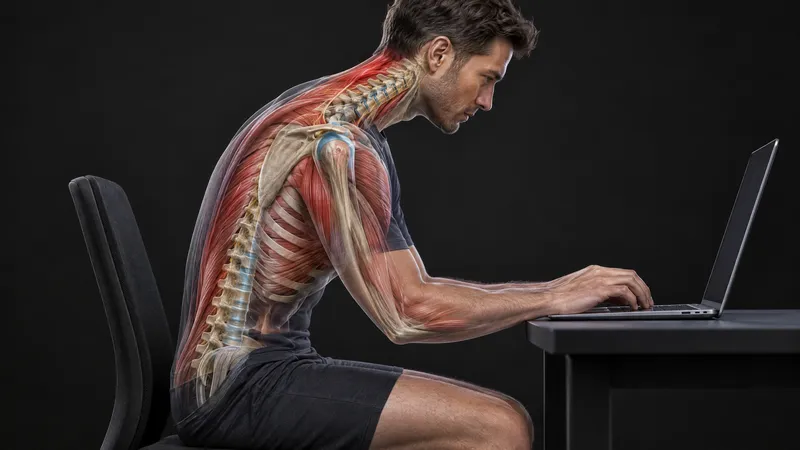
Rounded shoulders, in plain English
Rounded shoulders means your shoulder blades sit further forward and further apart on your ribcage than they otherwise would, with the upper arms rolled slightly inwards. It usually travels with a head that sits forward of the shoulders and a bit more curve through the upper back. Clinically that whole package gets grouped together and called upper crossed syndrome: forward head posture, increased curve in the neck and upper back, and shoulders that sit elevated and drawn forward 7.
There are no clear diagnostic criteria for upper crossed syndrome. It's commonly defined by altered muscle activation and movement patterns around the head, neck, shoulders and back, not by a test 7. It's a useful shorthand for something physios do see. It isn't a disease you've been diagnosed with.
Our state health services do list rounded shoulders among the complications of sustained poor postural habit, alongside back pain, spinal dysfunction and joint degeneration 2. So it isn't nothing. But it is a position, and positions can change.
What's actually causing it
Not one dramatic thing. Hours of small ones.
Better Health Channel puts it simply: bad habits such as slouching and inactivity cause muscle fatigue and tension that ultimately lead to poor posture 2. Sitting for long stretches (at a desk, in a car, operating machinery) carries its own long-term health cost beyond how you look while you're doing it 1.
There's a slow mechanism underneath that. When a posture is held long enough that your endurance muscles hand the job over to muscles built for short bursts, the deeper supporting muscles gradually waste away from lack of use 2. That's what "your posture is getting worse" means in practice. It isn't a moral failing or a deformity. It's a slow loss of capacity in the muscles that were meant to be quietly doing the work.
Which is also why the fix isn't a reminder. It's a load.
Which muscles are tight, which are switched off
The pattern physios look for splits into two groups 7.
Over-active and tight: pectoralis major and minor across the chest, upper trapezius and levator scapulae across the top of the shoulders and neck, sternocleidomastoid down the front of the neck, and the suboccipitals at the base of the skull.
Under-active and weak: the deep neck flexors at the front of the neck, serratus anterior along the ribs, the rhomboids between the shoulder blades, and the middle and lower trapezius down the back.
That's the map, and it's useful for deciding where to start. But carry a caveat: the same review describes those muscles as weakened, stretched and restrained, and defines the pattern by altered muscle activation and movement, not by strength alone 7. In other words, a muscle testing weak might be held back as much as weak. It might just not be getting the invitation.
Posture and pain aren't as linked as you've been told
This is where we part company with most of what you'll read on this topic.
A systematic review of 15 studies did find that adults with neck pain had more forward head posture than adults without it (a mean difference of 4.84 degrees) and that forward head posture correlated with pain intensity and disability in adults and older adults 5. That sounds decisive until you look at the confidence interval, which ran from 0.14 to 9.54 degrees. It only just clears zero. And in adolescents there was no significant difference at all, and no association with most neck pain measures 5. The authors' own words: despite claims that forward head posture may be related to neck pain, "this relation seems to be controversial" 5.
A separate study went further. Forty-three volunteers, craniovertebral angle measured from profile photographs, and no significant difference in forward head posture between the people with neck pain and the people without, nor any significant correlation between posture and pain scores or disability 6. The authors concluded their findings "cannot support a clinically applicable association" between the two 6.
What did separate the two groups in that study is the most useful sentence in this whole article: the people with neck pain had restricted range of motion and slower neck movements 6.
Not how their neck looked in a photo. How it moved.
So is it worth doing anything about?
Yes, for better reasons than the ones usually given.
Leading physiotherapy researchers have argued for a shift away from "correct" posture and towards helping people sit, stand and move more easily 8. People come in different shapes and sizes, with natural variation in their spinal curves, so a particular alignment can't be treated as inherently pathological 8; the same authors warn that pain is often blamed on relatively normal variations despite the lack of strong evidence 8.
That reframe matters, because it changes the goal. You're not chasing a photograph. You're building a neck and upper back that can hold a position, change position, and tolerate a long day, which is what the evidence says differs between people with and without symptoms 6.
And it's why the advice you've been given probably didn't work. Better Health Channel says it directly: good posture feels effortless, which is why traditional suggestions like throwing your shoulders back and sticking out your chest may feel uncomfortable too. Listen to your body instead 2.
Holding yourself in a "correct" position is just a different sustained posture. It's the sustaining that was the problem.
What actually works
Exercise. Not as a slogan, as the thing with the most evidence attached.
A 2024 systematic review and meta-analysis screened 4,625 records down to 22 included studies and found therapeutic exercise significantly improved forward head angle, rounded shoulder angle and thoracic kyphosis angle, all at p=0.001 4. Strength work, stretching, shoulder-based exercises and comprehensive whole-region programmes all showed benefit.
Two qualifiers on that. The authors hedge their own conclusions: "it appears that" these approaches "may be effective", and 12 of the 22 included studies came from Google Scholar rather than indexed databases, which is a real methodological weakness 4. It's the best evidence available on this question. It isn't the last word.
What it does tell you is that there's no single magic exercise, and that a programme covering the whole region beats a favourite stretch. That's what exercise prescription and conditioning is for: working out which of those muscles are under-doing it in your case, loading them progressively, and adjusting as you get stronger, not handing you a page of pictures.
Where hands-on work fits
A randomised controlled trial put 60 women with neck pain and this exact posture pattern into three groups: stabilising exercises plus manual therapy, stabilising exercises alone, or home exercises as a control, over six weeks 3.
Both exercise groups beat the control group. The group that also got manual therapy did better than exercise alone on head posture, pain and function, with effect sizes of 0.432, 0.533 and 0.565: small to moderate, not dramatic 3.
Two things that trial does not show. It reported no significant between-group difference for shoulder angle specifically. And it was a single trial of 60 women whose own authors concluded only that manual therapy "can be used as a supplementary method to the stabilizing intervention," and that more research is needed 3.
So that's how we use it. Manual therapy as a supplement that can make the exercise work more comfortable and more productive (easing off the tight chest and upper traps so the weaker muscles get a fair go) rather than as the treatment itself.
Doing this where you sit
One practical note. Well Motion is a mobile service: we come to you, across the Sutherland Shire, Macarthur and Western Sydney. You can check the full list of service areas we cover.
For this particular problem that matters. A desk posture assessment done at your own desk, in your own chair, with your real monitor height and keyboard distance, is a different conversation from describing your setup from memory in a clinic room. Same goes for working out where a few sets of exercises will fit into your day.
Alongside that, the simplest advice in the government guidance still stands: build more physical activity into your work day, take the stairs, and take regular breaks 1. Interrupting the sitting matters more than perfecting it.
When to get it looked at properly
Most of the time rounded shoulders are a comfort and capacity issue, not an alarm. Get an assessment rather than continuing to self-manage if:
- Neck or shoulder pain has stuck around for more than a few weeks despite changing what you're doing.
- You've got pins and needles, numbness or weakness running into an arm or hand.
- Your neck has lost movement: you can't check a blind spot, or turning to one side is clearly more restricted than the other. That restriction is the finding that separated people with neck pain from people without it 6.
- Headaches have become a regular part of your working week.
- Something about the shape has changed noticeably and recently, rather than gradually over years.
If ongoing neck symptoms are the main thing you're dealing with rather than the shape of your shoulders, our neck pain page is the better starting point.
FAQs
Can you actually fix rounded shoulders?
You can change them, yes: a meta-analysis of 22 studies found therapeutic exercise significantly improved rounded shoulder angle 4. But it's worth loosening the word "fix." This is a common adaptation to how you spend your days, not a pathology that must be corrected, and natural variation in posture is normal from person to person 8. A realistic goal is a body that moves well and tolerates a long day, with the position shifting as a by-product. That's what a structured exercise programme is built to do.
How long does it take to correct rounded shoulders?
We won't give you a date, because nobody can. What we can give you is the window the research used: the trial we rely on ran a six-week supervised intervention with a one-month follow-up, and measured real change across it 3. So six weeks of consistent, supervised work is a defensible expectation for seeing something shift, not a guarantee, and not a finish line.
What is the best exercise for rounded shoulders?
There isn't one. That's the finding, not a dodge. The 22-study review found benefit across strength exercises, stretching, shoulder-based exercises and comprehensive whole-region programmes 4, which means the useful question is which of those you need, in what order. Given the tight group runs across the chest and upper traps and the under-active group sits between and below the shoulder blades 7, a programme usually has to do both jobs at once. Working out your version of that is what an exercise prescription session is for.
Can you correct years of bad posture?
The evidence on exercise producing measurable change came from adult populations who had been living in these patterns for a long time 4, so the years themselves aren't the obstacle. It helps to change the target, though. The goal isn't undoing your history; it's expanding what your body can comfortably do from here, which is where physiotherapy researchers have argued the focus should go 8.
Can an older person correct their posture?
Age changes the picture, but it doesn't rule anyone out. The review of 15 studies found forward head posture correlated with pain and disability in both adults and older adults, while showing no association at all in adolescents 5, so if anything, this is a question that matters more with age, not less. The same evidence for exercise applies 4. Pace, starting load and how a programme is supervised are what change.
What are four signs of poor posture?
The Australian government health guidance frames these as complications of sustained poor posture rather than signs to self-diagnose from, which is a fairer framing: back pain, spinal dysfunction, joint degeneration, and rounded shoulders themselves 2. A potbelly is listed alongside them 2. If you want a more useful self-check than any of those, try this: how far can you comfortably turn your head each way, and does one side clearly lose out? Restricted movement is what distinguished people with neck pain from people without it in one study 6.