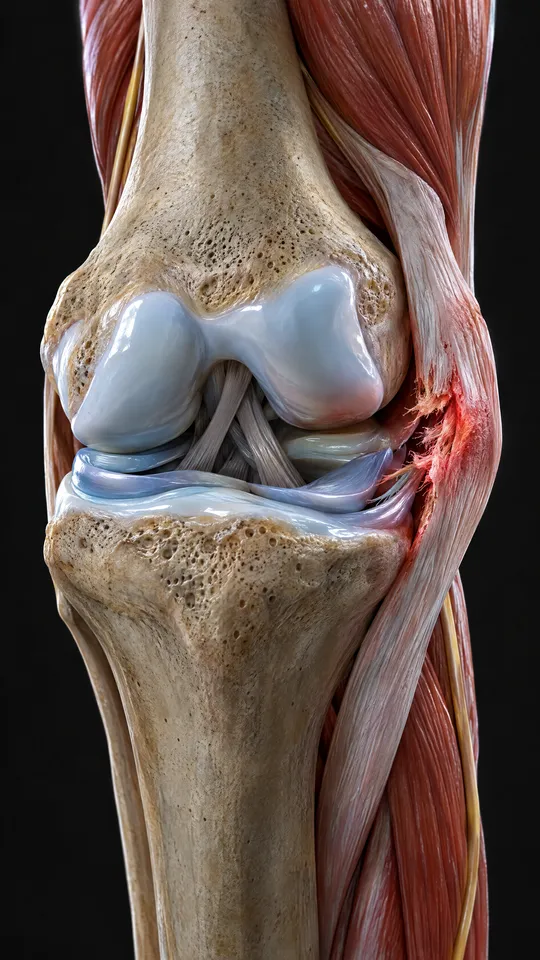
What's actually causing it
The medial collateral ligament is a major stabiliser on the inner side of your knee. It resists forces that push the knee inwards or twist it 6. Most MCL injuries follow an impact to the outside of the knee, which forces exactly that 5. A sudden twist or excessive force can also stretch it past what it can take. Torn ligaments bleed into the knee, and that's where the swelling, pain and looseness come from 3.
A sprain means a ligament has been torn or twisted (different from a strain, which is an overstretched or torn muscle 4). So "MCL sprain" and "MCL tear" describe the same injury, graded differently:
| Grade | What's happened 12 | How it feels |
|---|
| I | A few fibres torn; under 5 mm of opening | Tender inside the knee, sore under sideways force, but the joint feels solid |
| II | Partial tear; 5–10 mm of laxity | More pain and swelling, plus noticeable looseness |
| III | Complete rupture; over 10 mm of laxity | The knee opens inwards under sideways force, and pain may be mild: it can hurt less than a Grade II |
One cohort of young athletes lost a median of 13.5 days to Grade 1 injuries and 29 days to higher grades: a rough guide only, since they were US military-academy students aged around 18 to 24, mostly male, playing sports like wrestling and judo 7. More generally, most sprains feel better after about two weeks, running is best avoided for up to eight weeks, and severe sprains can take months 4.