Need urgent care? 24/7 Mobile & After-Hours Emergency Physiotherapy Call (02) 8111 5633 For life-threatening emergencies, always call 000
Head

Tension Headaches

5.0 average rating on Google
Registered NDIS Provider
SIRA Registered Provider

It usually starts mid-afternoon, on a day you've been at the desk since eight. A dull band of pressure around both sides of your head, a tight, tender patch at the base of your skull, and shoulders sitting somewhere up near your ears. It isn't bad enough to stop you working, so you don't stop. You take something, you get through, and it turns up again on Thursday.

That pattern is the most common headache there is. It's also the one most often treated at the wrong end: the head, rather than the neck, the shoulders and the daily habits that keep setting it off.

What's actually causing it

Honestly? Nobody can point to one thing. Health authorities describe tension headaches as multifactorial (a mix of genetic, biological and environmental factors) and state openly that the exact cause isn't known 1. The NHS adds one reassuring point: a tension headache is not a sign of an underlying condition 3.

Where the sources part ways is on muscle tension itself. One government reference states that tension headaches occur when the neck and scalp muscles become tense or contract 2. Another states the opposite just as plainly: that these headaches are not caused by muscle contractions, but that muscle tension can make the pain worse 1. A third doesn't list posture as a cause at all 3.

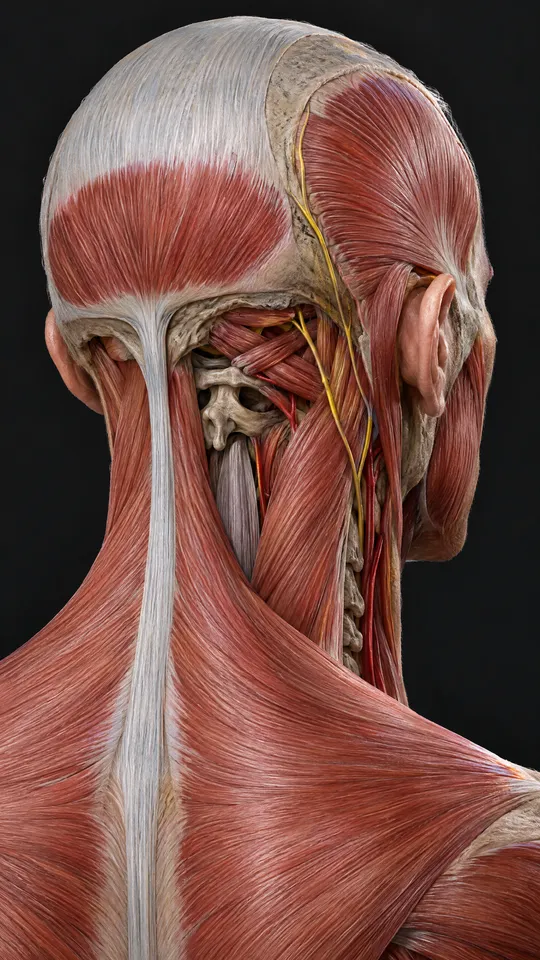
Back of the head and neck showing the scalp tendon sheet, the muscles at the back of the skull and the neck muscles

Do tension headaches come from the neck?

Partly, and the honest answer depends on which source you read. What all of them agree on is that the neck and shoulders are involved somewhere. The pain is typically worse in the scalp, the temples or the back of the neck, and often in the shoulders too 2. On examination the nervous system is normal, but tender points in the neck and shoulder muscles are a common finding 2. Sore neck and shoulders are listed alongside the headache itself as part of the picture 1.

What that means in practice: treating the neck and shoulders is reasonable, supported and often helpful, but a tension headache is not simply a neck problem, and anyone promising to fix "the cause" outright is claiming more than the evidence does.

A separate condition, cervicogenic headache, is driven by the neck itself, and the research treats it as a different entity with its own management 6. If your headache is one-sided, clearly triggered by neck movement or position, and travels from the back of the head forward, that's the page worth reading next.

Sore neck with a headache: why they turn up together

For a lot of people this isn't two problems, it's one experience, and it makes more sense treated as one. Holding your head in a single position for a long stretch without moving is a recognised trigger: typing, computer work, fine detail work with your hands 2. So is sleeping with your neck in an awkward position 2. Poor posture at work, at home or while driving, and eye strain from long periods of reading or screen use, sit on the trigger list too 1.

None of that causes a headache in isolation. But it does explain why the headache and the sore neck so often arrive on the same afternoon, and why treating only the headache tends not to change the pattern. If your day is mostly screen-based, our page on text neck covers the postural side in more detail.

What sets one off

The common triggers are all unremarkable, which is why they get missed: stress, anxiety or low mood; not enough sleep; poor posture at work, at home or driving; bright or noisy environments; eye strain from long reading or screen use; smoking; dehydration; and caffeine withdrawal 1. Sleep problems and caffeine appear on the NHS list too 3.

Most people have more than one running at once. That's usually the useful finding: not which single trigger is to blame, but which two or three stack up on the days you get a headache.

When they're happening most days

Tension headaches that turn up nearly every day are their own pattern, and they're managed differently. For chronic tension-type headache, the strongest guideline-grade review on headaches associated with neck pain recommends low-load endurance neck and shoulder exercise, or relaxation training with stress-coping therapy, or multimodal care that combines spinal mobilisation, neck exercises and postural correction 6. Note how much of that isn't hands-on treatment. If headaches have been part of most weeks for months, our chronic pain management approach is built for that longer-running picture.

Tension headache or migraine? How to tell the difference

This is the distinction that most changes what you should do next, and the two do get confused.

Tension-type headacheWorth checking for a different headache type
WhereBoth sides of the head, face or neck 3One-sided or throbbing pain 3
What it feels likePressing or tightening: a band or vice around the head, dull rather than pulsing 2,3Throbbing or pulsing 3
Other symptomsUsually no nausea or vomiting 2; the affected area may feel tender to touch 3Nausea or vomiting, sensitivity to light or noise 3
Can you keep going?Usually yes: daily activity doesn't make it worse 3Activity often makes it worse 3
How long30 minutes to seven days 2,3Varies

If your headaches look more like the right-hand column, that's worth raising with your GP. It may be a different type of headache that responds to different treatment 3. The third possibility, a headache coming from the neck joints themselves, is covered on our cervicogenic headache page.

How it's diagnosed

There's no scan or blood test for a tension headache. It's diagnosed by talking with you and examining you 1. The UK guideline says a brain scan shouldn't be ordered just for reassurance once tension-type headache is diagnosed 8. A mild to moderate headache with no other symptoms, which settles with home treatment within a few hours, may need no testing at all 2.

If yours are regular, expect to keep a headache diary for at least eight weeks: how often they come, how long and how bad, what comes with them, what you took and what might have set them off 8. Tests are for pain that doesn't go away 1. A referral to a neurologist (a brain and nerve specialist) follows if the cause is unclear or the usual measures aren't working 1 3.

How we treat it

Assessment comes first, and it's mostly about pattern rather than pathology: where the pain sits, how long it lasts, what your days look like, how your neck and shoulders move and where they're tender. From there:

  • Manual therapy: hands-on joint mobilisation and soft-tissue work through the neck, upper back and shoulders. There's moderate-quality evidence that manual therapy reduces pain intensity specifically in tension-type headache 4, and in a network meta-analysis manual therapy combined with exercise was the most effective option for reducing how often headaches occurred 7.
  • Exercise prescription: the most consistently supported part of the whole approach. For episodic tension-type headache, the recommendation is low-load endurance exercise for the deep neck and shoulder-blade muscles 6, unglamorous, repeatable work rather than anything heavy.
  • Posture and workstation habits: practising better positioning when reading or working, moving the neck and shoulders regularly during computer work, and changing your pillow or sleeping position where that's part of it 2. Postural correction is also one of the components in the multimodal care recommended for chronic tension-type headache 6.
  • Working out your own pattern: triggers, sleep, stress and workload. The research is explicit that psychosocial and behavioural factors need to be part of the picture, not an afterthought 4.

What the evidence honestly supports. A meta-analysis of physiotherapy interventions for headache found a statistically significant reduction in tension-type headache pain, and the authors then state plainly that those reductions do not reach clinically relevant effect sizes, that 19 of 26 appraised trials carried a high risk of bias, and that the overall level of evidence is low 5. A broader umbrella review reached a similar place: exercise could be effective, but on moderate-to- limited quality evidence, and manual therapy's evidence is more limited still 4. The network meta-analysis findings apply to the short term only 7.

So: worth doing, most useful when exercise is part of it, and not a cure. We'd rather tell you that before you book than after.

Other treatments we may use

Heat, rest and simple self-care.

Government health sources list rest, a heat pack and massaging the neck as reasonable first steps 1, and specifically suggest a low, firm pillow plus heat or cold packs when neck pain and headaches come together 3. This isn't trial-grade evidence. It's low-risk, low-cost self-care that's easy to try and easy to stop.

TENS (transcutaneous electrical nerve stimulation).

In the network meta-analysis, TENS combined with physiotherapy was the most effective option for reducing headache intensity compared with no treatment, at moderate confidence, but in the short term only 7. It's included here because the finding is real, not because it replaces the two approaches above. Worth raising at your assessment if it interests you.

Relaxation and stress-coping approaches.

For chronic tension-type headache specifically, relaxation training with stress-coping therapy is one of the recommended options 6. Regular exercise, yoga or meditation, biofeedback and cognitive behavioural therapy all appear on the mainstream management list 1. Some of that sits outside physiotherapy. Where it's the right fit, we'll say so and point you in the right direction rather than stretch our scope.

Medication: what the literature says, and what we don't do.

Over-the-counter pain relief is the usual first line 1,2,3, and amitriptyline is sometimes used preventively for frequent headaches 3. Physiotherapists don't prescribe or administer medication. Those conversations belong with your GP or pharmacist. The one thing worth knowing regardless: taking pain-relief medicines more than two to three times a week 1, or more than three days a week 2, can itself start causing headaches. It's a common and frustrating trap.

Your recovery path: Reset, Rebuild, Return

A tension headache is not an injury that heals, so The Well Motion Recovery Path™ is about changing a pattern. You move up a phase when your headaches shift, whatever the calendar says.

  • Reset: the first visits. Assessment, a headache diary 8, and manual therapy with heat and simple self-care 1. Expect the headaches to keep turning up at first. We move you on once an episode settles more easily and you know your triggers.
  • Rebuild: the longest phase. Exercise prescription for the deep neck and shoulder-blade muscles, with posture and workstation changes 6. Expect dull, repeatable work. We move you on when the headaches get in the way of your day less often.
  • Return: full days at the desk and a normal night's sleep. We check the diary against where you started 8. You leave with a home program and a plan for flare-ups.

How long it usually takes. A single headache lasts 30 minutes to seven days 2,3. Changing the pattern takes longer. One small trial in people with neck pain and tension headache found lower headache impact scores after 6 weeks of manual therapy and stabilisation exercise, with no later follow-up 11. The strength training trial above ran for 20 weeks 9. Some people learn to manage these headaches without clearing them.

Reducing the risk of flare-ups

A few things have been tested in trials for cutting how often these headaches turn up:

  • Strengthen your neck and shoulders. In a trial of 573 office workers, one hour a week of neck and shoulder strength training for 20 weeks roughly halved how often headaches came and how bad they were, compared with no training. It didn't matter how the hour was split up 9.
  • Ask about acupuncture if they're frequent. A Cochrane review of 12 trials found about half of people having acupuncture at least halved their headache days, against 43% with sham needling 10. The UK guideline suggests up to 10 sessions over 5 to 8 weeks for chronic tension-type headache 8.
  • Keep the diary going. The guideline uses it to check whether a change is working, not only to make the diagnosis 8.
  • Move at the desk, and watch the caffeine. Regular neck and shoulder movement during computer work is standard advice 2. So are enough sleep and water, and too much caffeine or too little can both set a headache off 1. This last group hasn't been trialled the same way.

When to get it checked properly

Most tension headaches aren't a sign of anything sinister 3. These are the things that should prompt an actual assessment rather than another week of managing it yourself.

Seek urgent medical care for a headache that comes on suddenly and severely; a headache with vomiting, confusion, neck stiffness, fever, a change in vision or a seizure; a headache after a head injury; a headache that's worse when you lie down or cough; one that has been progressively worsening over weeks; a morning headache with persistent nausea; or any new or different headache during pregnancy 1.

Book in with your GP if you have jaw pain when eating, blurred or double vision, a sore scalp, or numbness or weakness in your arms or legs 3, or if your headache is one-sided and throbbing, comes with nausea or light sensitivity, or stops you doing normal things 3.

Come and see us when the headaches are recurring, your neck and shoulders are part of it, you're reaching for pain relief more than two or three times a week 1, or the pattern hasn't shifted despite you doing the sensible things. None of that is an emergency. It's just the point where working it out with someone beats guessing on your own.

Your first appointment

We start by listening: how it began, what makes it worse, and what it's stopping you from doing. Then we examine the area, explain what we find in plain English, and agree a plan with you. Your first visit is 40 minutes at Engadine and 30 minutes at our other clinics.

We see patients at Engadine, Mount Annan, Narellan and Appin, and at home through our mobile physiotherapy service. If you have private health cover, here's how health fund rebates work for physiotherapy.

FAQs

How to get rid of a tension headache?

For the headache in front of you: rest, a heat pack, massaging the neck, and something to drink if you've been short on fluids 1. If neck pain is part of it, a low, firm pillow and heat or cold packs are specifically suggested 3. For the pattern rather than the episode, that's where neck and shoulder exercise, hands-on treatment and sorting out your triggers come in, and physiotherapy is named among the standard management options 1. The one thing to avoid is leaning on pain relief more than two to three times a week, which can start generating headaches of its own 1.

What are the common causes of tension headaches in the base of the skull?

That location is typical rather than unusual. The pain of a tension headache is often worst in the scalp, the temples or the back of the neck, and frequently in the shoulders as well 2. On examination, tender points are commonly found in the neck and shoulder muscles 2. Holding your head in one position for long stretches (screen work, detailed handwork) and sleeping with your neck at an awkward angle are both recognised triggers 2. So base-of-skull pain usually points at the neck and shoulders, which is the part we can actually assess and work on.

I've had a tension headache for 3 days. Is this normal?

It's within the usual range. A tension headache lasts anywhere from 30 minutes to seven days 2, and health services describe them as lasting at least 30 minutes but sometimes several days 3. So three days isn't a red flag by itself. What would change the answer is any of the escalation signs above: sudden severe onset, vomiting, confusion, neck stiffness, fever, vision changes, or a headache that's steadily worsening 1,3. And if three-day headaches are becoming routine rather than a one-off, that's the pattern worth assessing.

How do I tell if my headache is from stress?

There's no test for it, but the shape of the headache is a reasonable guide. A stress-related tension-type headache typically sits on both sides of the head, face or neck, feels like something pressing on or tightening around your head, and the area may be tender when touched 3. Stress, anxiety and low mood sit at the top of the recognised trigger list 1. The practical answer is to track it for a few weeks. Most people find their headache days line up with particular workloads, sleep patterns or deadlines. And where stress is the main driver, relaxation training with stress-coping therapy is one of the specifically recommended options for chronic tension-type headache 6.

More Head conditions

If the same headache keeps arriving on the same kind of day, it's worth working out why rather than managing it one afternoon at a time.

Book an assessment, or browse the rest of the Head section of our Injury Finder to see what else might fit what you're experiencing.

Book an Assessment
Ahmed Elsayed, Principal Physiotherapist
Reviewed by Ahmed Elsayed Principal Physiotherapist at Well Motion

References

  1. Tension headache: causes, symptoms and treatment. healthdirect (Australian Government). Last reviewed May 2025. https://www.healthdirect.gov.au/tension-headache
  2. Tension headache. MedlinePlus, US National Library of Medicine (NIH). Reviewed 27 October 2025. https://medlineplus.gov/ency/article/000797.htm
  3. Tension headaches. NHS (United Kingdom). Page last reviewed 1 August 2025. https://www.nhs.uk/conditions/tension-headaches/
  4. Varangot-Reille C, Suso-Martí L, Romero-Palau M, et al. Exercise and manual therapy for the treatment of primary headache: an umbrella and mapping review. Physical Therapy, 2022. https://doi.org/10.1093/ptj/pzab308
  5. Luedtke K, Allers A, Schulte LH, May A. Efficacy of interventions used by physiotherapists for patients with headache and migraine: systematic review and meta-analysis. Cephalalgia, 2016. https://doi.org/10.1177/0333102415597889
  6. Varatharajan S, Ferguson B, Chrobak K, et al. Are non-invasive interventions effective for the management of headaches associated with neck pain? An update of the Bone and Joint Decade Task Force on Neck Pain and Its Associated Disorders by the OPTIMa Collaboration. European Spine Journal, 2016. https://doi.org/10.1007/s00586-016-4376-9
  7. Jung A, Eschke RC, Struss J, et al. Effectiveness of physiotherapy interventions on headache intensity, frequency, duration and quality of life of patients with tension-type headache: a systematic review and network meta-analysis. Cephalalgia, 2022. https://doi.org/10.1177/03331024221082073
  8. National Institute for Health and Care Excellence. Headaches in over 12s: diagnosis and management. NICE clinical guideline CG150, 2012, last updated June 2025. https://www.nice.org.uk/guidance/cg150/chapter/Recommendations
  9. Andersen CH, Jensen RH, Dalager T, et al. Effect of resistance training on headache symptoms in adults: secondary analysis of a RCT. Musculoskeletal Science and Practice, 2017;32:38-43. https://doi.org/10.1016/j.msksp.2017.08.003
  10. Linde K, Allais G, Brinkhaus B, et al. Acupuncture for the prevention of tension-type headache. Cochrane Database of Systematic Reviews, 2016;(4):CD007587. https://doi.org/10.1002/14651858.CD007587.pub2
  11. Park SH, Oh YJ, Lee MM. Improving function and quality of life in patients with chronic neck pain, tension-type headache, and forward head posture: the role of eyeball exercise and cervical stabilization programs. Medical Science Monitor, 2024;30:e944315. PMID 38889104. https://doi.org/10.12659/MSM.944315