Hands-on treatment.
Early massage is contraindicated because of the bleeding risk into healing tissue 3. Past that window, manual therapy is a reasonable adjunct alongside active rehabilitation, never the whole plan.
There are two versions of this story. In the first, you pushed off hard and something snapped at the back of your lower leg, sharp enough that you stopped on the spot. In the second, nothing happened at all: your calf just felt tight after runs, then during them, and three weeks on it still hasn't come good.
Both are calf strains. Different muscles, different behaviour, different timelines, which is why a generic "two weeks and you're right" answer is worth so little.
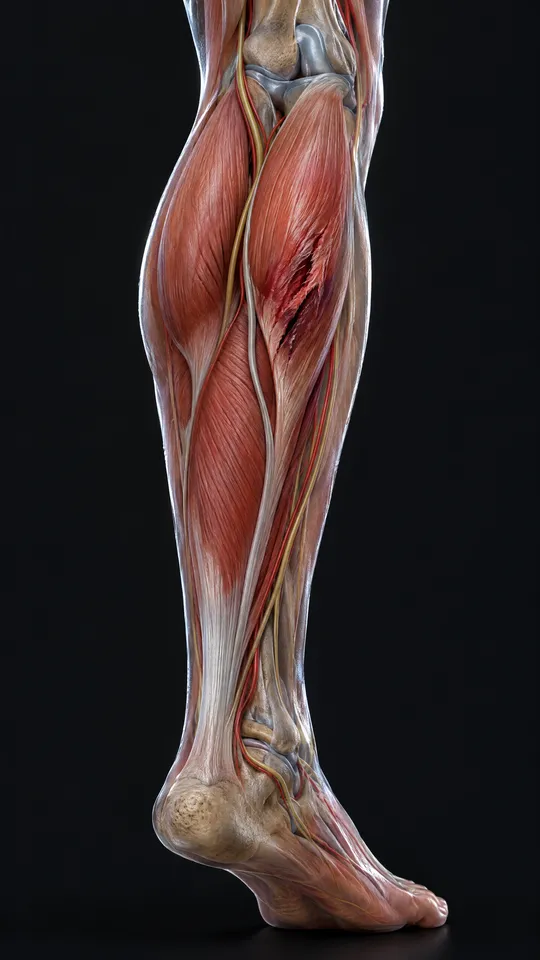
Your calf is three muscles (gastrocnemius, soleus and the small plantaris) whose flat sheets of tendon merge to form the Achilles 3. A strain is one of them stretched past what it tolerates, or torn 1.
The gastrocnemius is the one you can see: high risk because it crosses two joints, knee and ankle, and is packed with fast-twitch fibres built for speed 3. The soleus sits underneath, crosses only the ankle, and is mostly slow-twitch endurance muscle, on paper low risk 3, yet the one most often injured 4.
Grades describe how much damage there is. A "tear" isn't a separate injury from a "strain". It's the same injury further along the spectrum:
| Grade | What it feels like | Return to play 2 |
|---|---|---|
| 1 (mild) | Sharp pain during or after activity; you may still keep going | 10 to 12 days |
| 2 (moderate) | Sharp pain, can't continue, significant pain walking | 16 to 21 days |
| 3 (severe) | Severe immediate pain, often where muscle meets tendon; heavy bruising | Around 6 months if surgery is required |
One caveat matters more than the table: those figures come from a gastrocnemius fact sheet 2. Most calf strains are soleus injuries 4, and the soleus doesn't follow the same script.
This is the question the page is here to answer, because it changes what recovery looks like.
| Gastrocnemius | Soleus | |
|---|---|---|
| How it starts | Suddenly: the classic "tennis leg", knee straightening as the foot is pulled up 3 | Gradually, over days to weeks 3 |
| Where it hurts | Inner calf belly, or where muscle meets tendon 3 | Often the outer calf 3 |
| Swelling and disability | Often immediate and obvious 3 | Generally mild 3 |
| What provokes it | The moment itself, then weight-bearing | Walking or jogging 3 |
| More common in | Rugby, ballet, basketball, sprinting 6 | Distance running, Australian Football, football 6 |
There's a simple test behind this. With the knee bent, the soleus becomes the main muscle producing the push-off; with the knee straight, the gastrocnemius takes over 3. So a bent-knee calf raise loads your soleus and a straight-leg one loads your gastrocnemius. Which position brings on your symptoms is a useful clue.
Two caveats. Both muscles were injured together in 17% of calf strains in one study 3, so it isn't always one or the other, and soleus injuries stay vague until examined a few days in 6.
For the anatomy itself, see our guide to whether your calf pain is soleus or gastrocnemius. If the pain sits along the shin bone instead, start with shin splints.
Most calf strains are diagnosed from your story and a hands-on examination 3. Expect to be asked how it happened and whether you've hurt that calf before 6. Then the clinician feels along the whole length of the muscle for the tender spot, any swelling or a gap, and checks how much stretch the calf tolerates and how it copes with calf raises 3 6. One quick test, the Thompson test, checks that the Achilles tendon hasn't ruptured completely 3.
If a scan is ordered, it'll be an ultrasound or an MRI. Either can confirm the strain, show which muscle is injured and how much of it is involved 3.
Early massage is contraindicated because of the bleeding risk into healing tissue 3. Past that window, manual therapy is a reasonable adjunct alongside active rehabilitation, never the whole plan.
The evidence conflicts, and we'd rather say so. Australian guidance recommends icing for 20 minutes with a covered icepack early on 1,2. A British Journal of Sports Medicine editorial states just as plainly that there's no high-quality evidence for ice in soft-tissue injuries, and that it may even interfere with tissue repair 8. Reasonable for comfort, then, not a healing accelerant.
Compression with a bandage or tape helps limit swelling and bleeding in the first few days 8. Crutches and a heel wedge early on are temporary supports while loading builds 3.
It should be restricted in the first 24 to 72 hours, because the antiplatelet effect increases bleeding 3, and it may also affect longer-term tissue healing 8. That's a decision for your GP or pharmacist. Well Motion physiotherapists don't prescribe medication.
Useful for an early picture of the damage, but they won't tell you your timeline. No imaging classification is agreed to best estimate prognosis, which varies even among injuries that look severe 6. How fast you regain function predicts more 6, and scan findings weren't associated with the risk of doing it again 5.
We work through a calf strain using The Well Motion Recovery Path™. You step up a phase when the calf passes the test for it, not when a date comes round.
How long it usually takes. NHS guidance says up to eight weeks, depending on severity 7. The authors of a 2006 ultrasound study of 22 men with gastrocnemius tears put a return to previous activity at about 4 to 12 weeks 10. That is one small group with no comparison, and it did not include soleus strains.
There's little research on preventing calf strains, and no single programme suits every sport 6. What is known is who gets them again, and what expert sports clinicians do about it:
Some calf symptoms aren't a muscle problem. Get seen straight away if:
Book a proper assessment with us if:
If you can't take weight through the leg after hours, on a weekend or a public holiday, and you have none of the signs above that need a doctor or an ambulance, our after-hours emergency physiotherapy can come to you. Call (02) 8111 5633.
Most calf strains are none of that. Depending on severity, getting back to everything may take up to eight weeks 7.
We start by listening: how it began, what makes it worse, and what it's stopping you from doing. Then we examine the area, explain what we find in plain English, and agree a plan with you. Your first visit is 40 minutes at Engadine and 30 minutes at our other clinics.
We see patients at Engadine, Mount Annan, Narellan and Appin, and at home through our mobile physiotherapy service. If you have private health cover, here's how health fund rebates work for physiotherapy.
Longer than most people are told. In elite Australian Football, soleus injuries averaged 25.4 days to return to play against 19.1 for gastrocnemius 4, though that difference didn't reach statistical significance, so it's an observed trend, not a proven rule. Soleus made up 84.6% of those injuries and 91.4% of re-injuries 4.
Often yes: gentle walking helps a healing muscle after the first few days 7. Avoid long distances and prolonged standing, and use crutches early if needed 7. If you can't take weight through the leg, get it assessed.
Not early on: massage is on the "no" list for the first 48 to 72 hours 1,2 because it can increase bleeding into injured tissue 3. Past that stage it has a reasonable place alongside active rehab. So it isn't a flat yes or no. It depends on timing.
Gently, and not straight away. Exercises should move into some discomfort but stay short of pain, starting knee-bent, then knee-straight to increase the stretch 7.
Yes, the right exercise. Cycling, swimming and walking are good for the healing muscle 7; running sports are out until full stretch and strength return 7. How fast you progress depends on what you can do 6, not on a date.
A sleeve may feel supportive, and there's nothing wrong with wearing one, but we found no evidence sleeves prevent calf strains, and clinicians are clear a universal prevention program for this injury may not exist, so what works has to be individualised 6. Compression for swelling in the first few days is a separate thing, and part of standard early care 8.
Get re-examined instead of waiting longer: how fast your function improves is the most useful prognostic information available 6, so a stall tells you something. It isn't just bad luck. Worth ruling out: the wrong muscle blamed, more damage than first thought 3, or a stuck load plan. If the leg is red, swollen and tender, see a doctor the same day 1.
An ache along the inside edge of your shin that builds through a run and eases with rest, usually after a jump in training load or a change of shoes or surface.
Read more
How would you like to reach us?
Message us on WhatsAppFor bookings and enquiries. Please don't send medical details. Call (02) 8111 5633Request a call-back
Request sent
Thank you. We'll call you back on the number you gave us.
This is a preview, so nothing was actually sent.