A brace.
Physio care sometimes includes a brace 1. Like most options outside the combined approach, the evidence behind it is low quality 4.
You set off for a walk around the block or a lap of the shopping centre. Ten minutes in, your legs start to ache, burn or feel heavy. You stop and lean on a rail or a trolley, and within a minute or two it eases. Then you start walking again, and so does the pain.
If that pattern sounds familiar, especially if you're over 50, spinal stenosis is worth ruling in or out.
Your spinal cord and the nerves branching off it run through a tunnel formed by your vertebrae, called the spinal canal. In spinal stenosis, that tunnel narrows and can put pressure on the nerves inside it 1. It can happen in the neck too, but this page is about the lower back, where it's most common 1.
Most often, the narrowing comes from age-related wear and tear or arthritis in the spine 1. Anyone can develop it, but the chance goes up with age 2. Younger people can have it if they were born with a narrower canal or have injured their spine 2. A disc prolapse can also narrow the canal, and rarely a tumour is the cause 1.
Why position changes everything. It usually feels like a burning pain or ache down the buttocks and legs, often with back pain too 1,2. Symptoms typically build when you stand or walk upright 2. Bending forward "opens up" the spinal column and gives the nerves more room 2. That's why sitting down or leaning on a trolley brings relief.
About your scan. Imaging doesn't always line up with how bad your symptoms are, and some people with stenosis on a scan have no symptoms at all 1. A report tells you what the canal looks like. It doesn't tell you how far you'll be able to walk.
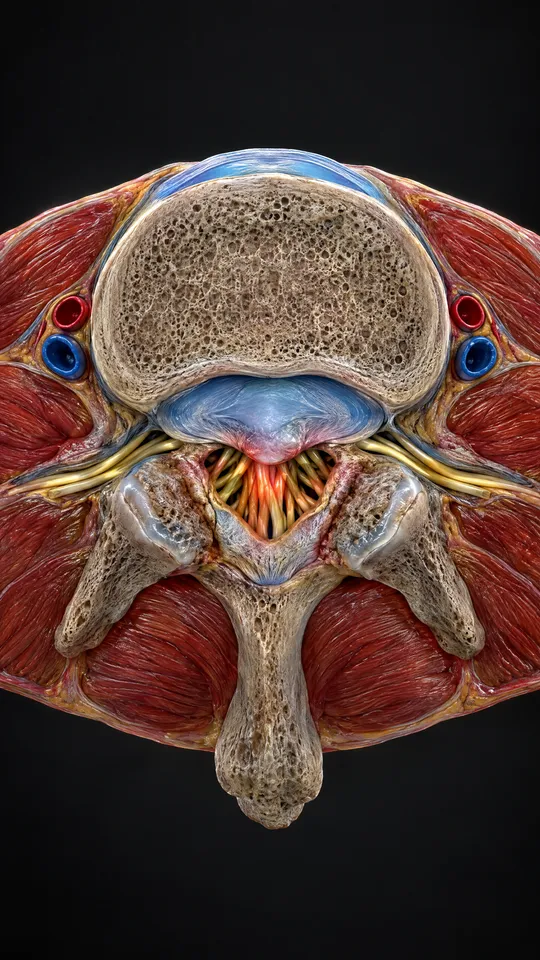
It starts with your own account. You'll be asked exactly where the pain is, whether it travels, what it feels like and when it began 2. Then comes the examination: how far you can move, the sensation, strength and reflexes in your legs, your balance, and how you walk 2. One check is particular to stenosis. Does bending backwards bring your symptoms on, and does bending forwards ease them 2?
You may then be sent for an X-ray, CT or MRI 1. Treat the scan as one piece of evidence. Imaging alone won't decide whether your stenosis needs treatment 2.
We start with your pattern: how far you can walk, what eases it, and what you want to get back to.
The honest bit. A clinical practice guideline recommends offering this combined, non-drug care first. It's a conditional recommendation based on evidence ranging from very low to moderate quality 5. The moderate-quality evidence is for the combined approach in the short term 4. Exercise alone, and most other non-surgical treatments, have only low or very-low-quality evidence 4. That makes a structured physio plan the best-supported place to start, but not a guaranteed fix.
Physio care sometimes includes a brace 1. Like most options outside the combined approach, the evidence behind it is low quality 4.
A stick or walker lets you lean forward as you walk 1, which is the position that eases the nerves. It isn't giving in. It's often the simplest way to walk further.
Both are among the treatment options 1, but physiotherapists don't prescribe or give them. Worth knowing: the 2022 review found epidural steroid injections were not effective here 4. Your GP can talk you through what suits you.
Most people are advised to try other treatments first 1. A review comparing surgery with non-surgical care had very little confidence either way and found no clear benefit from surgery. Side effects occurred in 10 to 24% of surgical cases, and none were reported for non-surgical care 3. That review only covered studies up to 2015. Whether surgery is right for you is a conversation to have with a surgeon.
The narrowing in spinal stenosis comes with age 1, so the aim is to manage it well. The Well Motion Recovery Path™ sets the order, and you move up a phase on how far you can walk, not on a date.
How long it usually takes. The best supported program ran for 6 weeks, with benefit measured between 1 week and 3 months 4. That rests on one trial of 259 people 4. Stenosis can gradually get worse 1, so the home plan carries on. After surgery, your surgeon sets the timeline.
The narrowing itself comes with age and can't always be prevented 1, and no trial has tested how to head off flare-ups. Each of these goes after something known to drive symptoms:
Book a proper assessment rather than managing it on your own if:
Go to your nearest emergency department if you have back pain along with any of these 1:
Those signs need same-day emergency care, not a booking. If you're unsure whether something is urgent, healthdirect's free helpline is 1800 022 222. Otherwise, a proper assessment and a plan you can follow is the place to start.
We start by listening: how it began, what makes it worse, and what it's stopping you from doing. Then we examine the area, explain what we find in plain English, and agree a plan with you. Your first visit is 40 minutes at Engadine and 30 minutes at our other clinics.
We see patients at Engadine, Mount Annan, Narellan and Appin, and at home through our mobile physiotherapy service. If you have private health cover, here's how health fund rebates work for physiotherapy.
Symptoms can gradually get worse over time, but how narrow your canal looks on a scan doesn't decide how you'll feel 1. In the trials reviewed, non-surgical care had no reported side effects, and surgery showed no clear advantage 3. There's no reliable figure for how any one person's stenosis will progress, and we won't guess.
There's no official list, but a few things follow from how stenosis works. Don't push through long spells of standing or walking upright while symptoms build 1,2. Don't let a scan report decide how active you can be 1. Don't stop moving, because exercise is part of the treatment 1. And don't ignore the emergency signs above 1.
Walking and standing upright typically make symptoms worse, and leaning forward or sitting eases them 1,2. That doesn't mean you should stop walking. A walking aid lets you lean forward as you go 1, and a combined physio programme has improved walking distance 4. Shorter walks with planned rests usually get you further than one long, painful push.
No research we've found names a single best position. Bending forward opens up the spinal canal 2, so some people find lying on their side with their knees bent, or on their back with a pillow under their knees, more comfortable. It's worth trying, but comfort varies.
Pain radiating down the leg, often with pins and needles.
Read moreWhat a disc bulge on a scan actually means, and the recovery pathway.
Read moreStiffness from the small joints at the back of the spine, worse arching back.
Read moreTailbone pain after a fall, childbirth, or long stretches on a hard seat.
Read morePain from the joint linking spine to pelvis, often mistaken for general back pain.
Read moreAge-related disc wear; a common imaging finding that doesn't always match the pain.
Read moreOne vertebra slipping forward over the one below, sometimes from a stress fracture.
Read moreA back spasm is the muscles of your back tightening suddenly and refusing to let go. It's one of the ways low back pain shows up
Read more
How would you like to reach us?
Message us on WhatsAppFor bookings and enquiries. Please don't send medical details. Call (02) 8111 5633Request a call-back
Request sent
Thank you. We'll call you back on the number you gave us.
This is a preview, so nothing was actually sent.