TFCC Injury (Triangular Fibrocartilage Complex)
Pain on the little-finger side of the wrist, often after a fall onto an outstretched hand, racquet sports, or repeated twisting and loading. Usually managed conservatively first.
Read moreIt's 3am and your hand has woken you up again. Numb, buzzing, not quite yours, so you hang it over the side of the bed and shake it out until the feeling comes back. By morning it seems fine. Then you're holding a steering wheel or a screwdriver, and the tingling creeps back into your thumb and the next two fingers.
That night-time pattern is one of the most recognisable presentations in hand physiotherapy.
The carpal tunnel is a real, physical space in your wrist. The wrist bones form the floor, a band of tissue called the transverse carpal ligament forms the roof, and through the middle run the tendons that bend your fingers, along with the median nerve 2: "a narrow passageway with just enough room for your tendons and nerves to pass through" 1.
That nerve does two jobs: sensation across part of the hand, and power to some of the small muscles, including the thumb's 1,2. Squeeze it and you get both halves of the problem: numbness and weakness.
Here's why resting it over a weekend rarely fixes anything. Normal pressure inside the tunnel ranges from 2 to 10 mm Hg 4. In people with carpal tunnel syndrome it averaged 32 mm Hg with the wrist straight, and about three times that with the wrist bent 3. And that pressure doesn't just sit there. It obstructs the veins draining the tunnel, which increases local swelling (oedema), which raises the pressure further, which compromises the nerve's own blood supply. The cycle feeds itself, so it's more than a single squeeze 4. Over time the nerve's insulating myelin sheath and axon develop lesions, and the surrounding tissue becomes inflamed 4.
One caveat: the mechanisms behind median nerve compression are complex and, in the literature's own words, "as yet are not fully understood" 4.
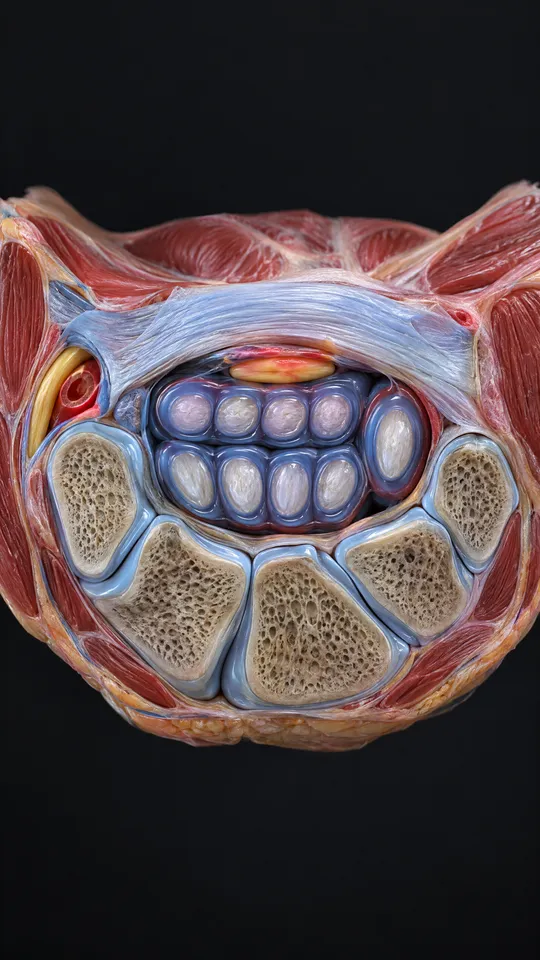
Numb fingers aren't automatically carpal tunnel, and the most useful clue is which fingers. The median nerve supplies the thumb, forefinger, middle finger and half the ring finger, which means "the little finger and half of the ring finger are unaffected" 2. If your little finger is tingling too, that distribution doesn't fit. Worth saying so at your assessment.
A diagnosis isn't made on symptoms alone either: tests are used to rule out other conditions that can drive the same picture, rheumatoid arthritis and an underactive thyroid among them 1.
If what you have is an ache that worsens with use rather than numbness, our Repetitive Strain Injury (Wrist) page covers a different problem in the same area. The Hand section of our Injury Finder lists the rest.
Carpal tunnel syndrome can often be diagnosed from your history and a hands-on examination, with no further tests 9. We tap or press over the median nerve at your wrist to see if it sets off tingling in your fingers, and hold your wrists bent to see whether the numbness comes on 9. We also test the feeling in your fingertips with light touch, and check the muscles at the base of your thumb for weakness or wasting 9.
Nerve conduction studies measure how well the nerve carries its signal through the tunnel. They're used in some cases to show how severe the compression is and to help guide treatment 1 9. X-rays are mainly for a wrist that's been injured or has bone changes 1.
The first job is working out what's driving the compression: which fingers are involved, how the night pattern behaves, and what else is contributing. Injury, overuse, arthritis, diabetes, thyroid problems and pregnancy are all recognised contributors 1,2. Some of those belong with your GP rather than with us, and we'll say so when that's the case.
Two caveats. The evidence supports conservative treatment in mild-to-moderate cases; severe cases are usually treated surgically 6. And the 2025 review's authors state plainly that "further research is needed to assess the long-term efficacy and cost-effectiveness of these interventions" 5. The evidence is good, but it isn't settled.
Shockwave therapy. Showed a significant benefit versus control in the 2025 network meta-analysis (SMD −1.03; 95% CI −1.86 to −0.20) 5. That's one synthesis without a long track record behind it. Worth discussing, not a first move.
Soft-tissue work and mobilisation. Mobilisation, massage and yoga have shown positive effects on symptoms 7, though the evidence for soft-tissue techniques is "limited" 6.
Taping. A 2023 meta-analysis of 13 studies found only "a weak effect on functionality and pain", with no significant superiority over other physiotherapy techniques or an untreated control for symptom severity, strength or nerve conduction 8. If we use it, it's a complementary tool, not the treatment.
Electrotherapy on its own. Assessments of electrotherapy used alone "have shown no conclusive results about their effectiveness" 6. We'd rather say so plainly.
Things that exist in the evidence but aren't ours to give. Corticosteroid, dextrose 5% and platelet-rich plasma injections all appear in the research base and ranked competitively for pain relief 5,6. They're outside a physiotherapist's scope of practice, so we don't prescribe or administer them. If they're worth considering, that's a conversation with your GP or a specialist.
The overall position, stated by the reviewers themselves: no single best technique or combination has been established 6.
Carpal tunnel syndrome is a squeezed nerve, not a torn tissue, so The Well Motion Recovery Path™ starts by easing the pressure on it. You move up a phase on what your hand can do, not on a date.
How long it usually takes. There is no single figure. One review found change after as little as two weeks of manual therapy in mild to moderate cases 7. A Cochrane review of 29 splinting trials found low-certainty evidence that 6 months of wear may beat 6 weeks 12. After surgery, grip strength usually returns by about 2 to 3 months, and complete recovery may take up to a year 9.
Some of the risk is built in: the size of your carpal tunnel is partly inherited 9. The rest has been studied more than most people expect:
Most carpal tunnel syndrome isn't an emergency. Some of it can't wait. Call us the same day if you have 1:
Outside of those, book an assessment rather than managing it yourself if:
The blunt version, from Victorian government health guidance: "You cannot work through carpal tunnel syndrome... You can suffer permanent damage if the cause is not addressed" 2.
That's a reason to get it looked at, not a reason to panic. Caught while it's mild to moderate, this is a condition with good conservative options 5,6,7. The mistake is waiting until the weakness has set in.
We start by listening: how it began, what makes it worse, and what it's stopping you from doing. Then we examine the area, explain what we find in plain English, and agree a plan with you. Your first visit is 40 minutes at Engadine and 30 minutes at our other clinics.
We see patients at Engadine, Mount Annan, Narellan and Appin, and at home through our mobile physiotherapy service. If you have private health cover, here's how health fund rebates work for physiotherapy.
Yes. Physiotherapy is listed among the standard non-surgical treatments by both Australian government health sources 1,2, a 2025 meta-analysis of 49 trials ranked manual therapy highest of eleven conservative treatments for pain relief 5, and a 2022 review found it comparable to surgery for pain and function 7. The caveat: long-term efficacy hasn't been properly assessed yet 5.
There's no date on a calendar, but there is a direction of travel. Left untreated, symptoms can worsen and lead to permanent damage, with the hand muscles weakening 1. The research splits mild-to-moderate cases, where conservative treatment is recommended, from severe cases, which usually go to surgery 6. So it's less about how long it's been than what stage it's reached.
Often improved substantially without surgery; for mild-to-moderate cases that's the recommended starting point 6. But "cured" is stronger than the evidence supports: no best technique or combination has been established 6, and long-term outcomes are unassessed 5.
Usually because something changed the amount of room inside the tunnel. Recognised causes include wrist or arm injury, repetitive overuse (including vibrating tools), tendinitis, a cyst or growth in the tunnel, diabetes, an underactive thyroid, arthritis, carrying extra weight, a congenitally narrow tunnel, and pregnancy, where fluid retention is the driver and symptoms usually settle after the birth 1,2. It's most common between 40 and 60, and in women 1,2, though sometimes no obvious cause is found at all 1.
Don't try to push through it: "You cannot work through carpal tunnel syndrome... You can suffer permanent damage if the cause is not addressed" 2. Practically: don't carry on unchanged with the activity overloading your hands and wrists 1, don't leave night symptoms unmanaged when a splint is a straightforward first step 1,2, and don't wait for grip weakness before getting assessed 1. And skip the hand exercise routine picked off the internet: the useful version is built around what your assessment shows.
Pain on the little-finger side of the wrist, often after a fall onto an outstretched hand, racquet sports, or repeated twisting and loading. Usually managed conservatively first.
Read moreWrist pain that started with a fall onto an outstretched hand and hasn't settled. Scaphoid fractures are commonly missed on an early X-ray, so it's taken seriously even when imaging looks clear.
Read moreAche, weakness or burning that builds through the day at a keyboard or on the tools. We see it across desk workers, tradies and new parents.
Read moreA wrist sprain means a ligament, one of the tough bands holding your wrist bones together, has been stretched or torn. It usually happens during sport, a sudden movement or a fall
Read moreTrigger finger is a finger or thumb that catches, gets stuck bent, or straightens with a click or snap
Read moreA ganglion cyst is a benign (non-cancerous) collection of fluid on a joint or tendon. It's the most common lump on the hand, usually on the back of the hand or wrist
Read moreWith mallet finger, the tip of your finger stays bent and you can't straighten it yourself
Read more
How would you like to reach us?
Message us on WhatsAppFor bookings and enquiries. Please don't send medical details. Call (02) 8111 5633Request a call-back
Request sent
Thank you. We'll call you back on the number you gave us.
This is a preview, so nothing was actually sent.