Manual therapy.
Hands-on joint mobilisation and trigger point work were optional extras in the trial program, not its core 1. Manual therapy can make exercise easier. It doesn't replace it.
Often it isn't the walk that bothers you. It's the deep squat, the low couch, the long drive or the stairs, when a deep, pinching pain starts at the front of your hip or in your groin. Maybe someone has now put a name to it: femoroacetabular impingement, or FAI. This page explains what that means, and what the evidence says about settling it.
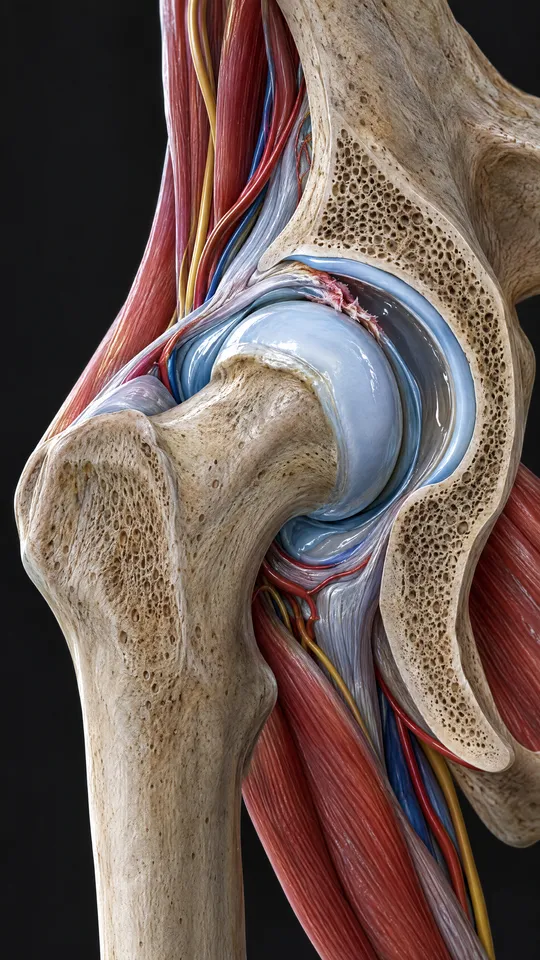
Your hip is a ball-and-socket joint: the top of your thigh bone sits in a cup in your pelvis, rimmed by a ring of cartilage called the labrum 6. In FAI, ball and socket make contact too early as your hip bends 2.
Two bone shapes cause this 2:
Some have both. Repeated early contact can damage the joint cartilage and the labrum, which is where the symptoms come from 6.
Why these shapes develop isn't fully understood. Family tendency and a lot of high-impact sport during the teenage years (ice hockey, basketball, football) may both be involved 9. The muscles around the hip are also often weak in people with FAI syndrome 2. That's one reason exercise can help even though it doesn't change the bone.
Keep this in mind: cam and pincer shapes are common in people with no hip pain at all 2,9. An international consensus endorsed by Sports Medicine Australia is clear that a hip shape on a scan isn't FAI syndrome on its own 2. The symptoms and examination have to fit too.
In active people, inner-thigh (adductor) problems, inguinal problems and pubic-related problems can all cause groin pain 10. Our groin strain and osteitis pubis pages cover two of those.
Signs that point more towards the hip joint itself 2:
No single test confirms FAI. The most-used impingement test can be positive in other hip problems too 2, so the diagnosis rests on symptoms, examination and imaging together 2.
The main test is quick. Your knee is brought up towards your chest, then turned in towards the opposite shoulder. If that brings on your hip pain, the impingement test is positive 6.
Scans fill in the rest. An X-ray shows whether the bones have the shape seen in FAI, a CT scan shows that shape in finer detail, and an MRI shows the labrum and the joint cartilage 6. Sometimes a doctor injects numbing medicine into the hip joint as a test: if the pain eases for a while, the joint is the likely source 6. No single result settles it, though. Symptoms, examination and imaging all have to line up 2.
First, the evidence. In a UK trial of 348 people, a physiotherapist-led program and hip arthroscopy (keyhole surgery) both improved hip-related quality of life. At 12 months surgery was ahead by a margin just above the smallest difference patients notice, and side effects were more common after surgery 3. An Australian trial found the same pattern, with no difference in cartilage health on MRI 4.
So physio is a reasonable place to start, and a surgical opinion is a real next step if it isn't enough. What that physio looks like:
Hands-on joint mobilisation and trigger point work were optional extras in the trial program, not its core 1. Manual therapy can make exercise easier. It doesn't replace it.
In one small study, a hip brace slightly changed how people moved but didn't reduce pain or improve outcomes after four weeks 11. A later small trial was more promising, but its authors called for more research 12.
Short-course anti-inflammatories were part of the trial program, and a steroid injection into the hip was an option when pain was too severe to exercise 1. Those are medical decisions. Well Motion physiotherapists don't prescribe or give them.
Arthroscopy reshapes the bone and repairs or trims the labrum 6. Its extra benefit at 12 months was modest 3, and it isn't known whether any treatment prevents later hip arthritis 2. Surgery is done by an orthopaedic surgeon, not by us. We can help with your rehab afterwards.
Care for hip impingement follows The Well Motion Recovery Path™. The bone shape stays as it is, so you move up a phase on what your hip tolerates, not on a date.
How long it usually takes. The physio program in the UK trial ran 12 to 24 weeks 3. No meaningful change after 12 weeks or more is a reason to seek a specialist opinion 1. If you have arthroscopy, your surgeon sets the timeline. In reviews of case series with no comparison groups, 85.4% of patients returned to sport over a mean of 6.6 months 13, and return to work took 115 days on average 14.
There's little you can do to prevent the bone shape itself 6, and no trial has tested ways of preventing flare-ups. What the research does show:
None of this is cause for alarm. People treated for FAI syndrome often improve and return to their usual activities, while untreated symptoms will probably worsen 2.
We start by listening: how it began, what makes it worse, and what it's stopping you from doing. Then we examine the area, explain what we find in plain English, and agree a plan with you. Your first visit is 40 minutes at Engadine and 30 minutes at our other clinics.
We see patients at Engadine, Mount Annan, Narellan and Appin, and at home through our mobile physiotherapy service. If you have private health cover, here's how health fund rebates work for physiotherapy.
Only surgery changes the bone shape. For symptoms, conservative care, rehabilitation and surgery are all recognised treatments 2. Physio-led care and arthroscopy both help, with surgery modestly ahead at 12 months 3,4.
Usually hip or groin pain with certain movements or positions, sometimes reaching the thigh, buttock or back. Stiffness, clicking, catching, locking or giving way can come with it 2.
The bone shape doesn't change without surgery, but symptoms can improve. People in both major trials improved meaningfully with physio-led care 3,4. We won't promise it disappears.
Deep hip bending, especially combined with crossing the leg or turning it inwards 1. Squatting, prolonged sitting and vigorous sport are common triggers 2,6.
No source we found says walking harms an impinging hip. The movements the trial program advised cutting back were deep bending, crossing the leg and turning the hip inwards 1. Let pain guide how far you go, and ask your physio to fit it into your program.
Pain on the outside of the hip, usually worst lying on that side and on stairs. Often called trochanteric bursitis.
Read moreTight, sore hip flexors at the front of the hip. Common in runners, tradies and anyone whose day is mostly seated, and it deserves a better answer than "just stretch more."
Read moreA hip socket that's shaped differently from the start. For parents of a child who's been diagnosed, and for adults managing it long-term.
Read moreHip osteoarthritis is a long-term condition that affects the whole joint (cartilage, bone, joint lining, ligaments, tendons and muscles), not just "worn cartilage".
Read morePiriformis syndrome is when the piriformis, a muscle deep in your buttock, puts pressure on the sciatic nerve. It usually affects one side
Read moreGluteal tendinopathy is irritation of the tendons that attach two of your buttock muscles, gluteus medius and gluteus minimus, to the bony point on the outside of your hip. You may also hear it called greater trochanteric pain syndrome, or GTPS.
Read moreA snapping hip is a snap you can hear or feel as the hip moves. It's usually a tendon or band of tissue flicking over a bony point
Read moreThe labrum is a rim of cartilage around your hip socket. It helps absorb shock, spread pressure and keep the joint stable
Read more
How would you like to reach us?
Message us on WhatsAppFor bookings and enquiries. Please don't send medical details. Call (02) 8111 5633Request a call-back
Request sent
Thank you. We'll call you back on the number you gave us.
This is a preview, so nothing was actually sent.