Simple self-management, early on.
Protection, rest, ice, compression and elevation is the standard first response 1. An ice pack wrapped in a tea towel for about 10 minutes at a time, repeated every few hours, is the usual guidance 5.
It hurts on the outside of the hip, over the bony point you can feel through your skin. Lying on that side wakes you up, stairs are worse than flat ground, and standing on that leg to pull a sock on is when you notice it most. You've probably been told it's bursitis. That's the name almost everyone uses, and it's worth knowing it's usually not quite what's going on.
A bursa is a small, fluid-filled sac that protects a tendon where it rubs across bone. You have one over the bony bump at the top of your thigh bone: the greater trochanter. When it's irritated, you get pain on the outer side of the hip, tenderness to touch, and a joint that won't move through its full range 1.
The usual trigger is overload, not a single injury: repeating the same movement at work, in a hobby or in sport, over and over. Direct injury can do it, and so can conditions like gout and rheumatoid arthritis 1.
The name is misleading. Bursitis means inflammation, but three of the four classic signs of it are uncommon in outer hip pain, with pain the only regular one 11. When researchers have looked, the bursa is seldom inflamed in isolation, and the more likely primary cause is the gluteal tendons themselves, where the muscles on the side of your hip attach onto that bony point 2. A bursa can be irritated alongside it. It's just usually not the whole story.
That changes the treatment. If the tendon is the tissue under strain, loading it gradually is what helps, and that's a very different plan from resting and waiting for a sac of fluid to settle.
Outer hip pain of this kind is recorded in about 1.8 of every 1,000 general practice patients a year 8. It's most common in middle age, and strongly associated with being female 7 9. The evidence on carrying extra weight is mixed. In a study of 3,026 adults aged 50 to 79, the link with body mass index disappeared once knee osteoarthritis, low back pain and tenderness down the outer thigh were taken into account 7. A smaller Australian study of women found no difference in body mass index, but did link the condition to weight carried around the hips 10.
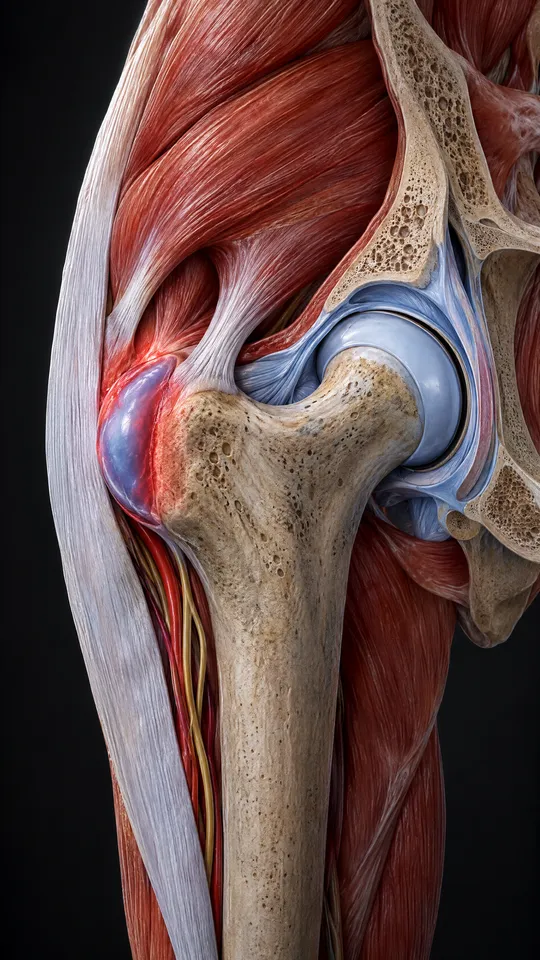
There's no single test that confirms it 9, and several different problems can produce pain around the hip. The ones a clinician will want to rule in or out 2 9:
One test earns its place: standing on the painful leg alone. Pain within 30 seconds of single-leg standing on that side has been reported with a positive predictive value of 100% 9. Even so, no single test is enough. Accuracy comes from combining findings, which is what an assessment is for.
You usually won't need a scan to be told what this is. Outer hip pain is diagnosed from your history and a physical examination, with the clinician pressing over the bony point of the hip to see whether it's tender 1 6. When an X-ray, ultrasound or MRI is ordered, it's mainly to rule other injuries or conditions out 1 6.
If infection or gout looks possible, your GP may draw a little fluid from the area with a needle and send it off for testing, and may order a blood test too 5.
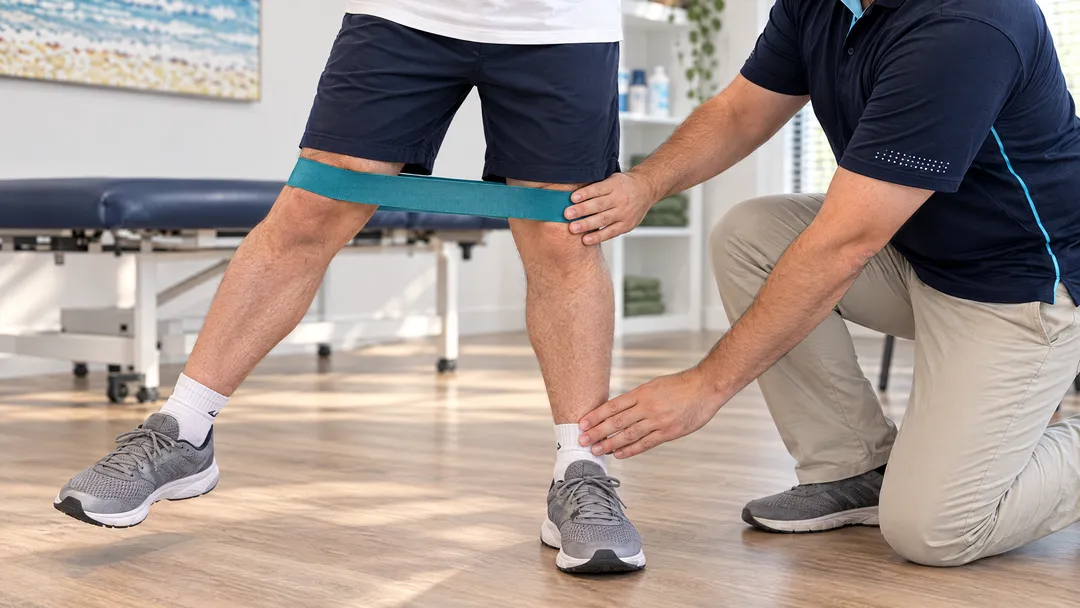
The strongest evidence here points one way. An Australian trial took 204 people aged 35 to 70 with more than three months of outer hip pain, all with gluteal tendon problems confirmed on MRI (the pattern described above). Education plus exercise, 14 sessions over 8 weeks, outperformed both a single corticosteroid injection and a wait-and-see approach. At 8 weeks, 51 of 66 reported real improvement, against 38 of 65 given the injection and 20 of 68 who waited 3. A 2024 systematic review strongly recommended exercise as first-line treatment 4.
In practice that means:
The limits are worth knowing too. That 2024 review pooled only six trials and 733 patients, and its own wording is that exercise "slightly" reduces pain and disease severity in the long term, not substantially. It closes by noting the results rest on few trials and a moderate number of patients 4. The direction of the evidence is consistent, and no serious adverse events were reported 4; the volume of it isn't large.
Protection, rest, ice, compression and elevation is the standard first response 1. An ice pack wrapped in a tea towel for about 10 minutes at a time, repeated every few hours, is the usual guidance 5.
Over-the-counter pain relief, including ibuprofen, is commonly used 1,5. Medication isn't something physiotherapists prescribe; your GP or pharmacist is the right person to ask.
A medical procedure, not something Well Motion physiotherapists administer. In that Australian trial the injection did work, but education and exercise beat it at 8 weeks, and still beat it at 52 weeks on how much better people said they were 3. Worth knowing both halves: at 52 weeks the two groups' pain scores were no different (2.1 versus 2.3) 3. Injections also carry real, if uncommon, risks: joint infection, and rarely tendon rupture 1.
Two of the six trials in the 2024 review compared exercise against shockwave therapy 4. The review doesn't report exercise as superior to it, and we won't claim otherwise in either direction. It's a reasonable option to discuss for stubborn tendon pain; you can read what it involves on our shockwave therapy page.
Outer hip pain is mostly a loading problem, so The Well Motion Recovery Path™ is built around what your hip can tolerate. You step up a phase when the hip copes with more, whatever the calendar says.
How long it usually takes. Recent cases should settle within a few weeks 5. Pain that has lasted over three months takes longer: the Australian trial ran its programme for 8 weeks 3. That is one trial, in people with tendon problems confirmed on MRI, so your timeline may differ.
Nobody has run a trial on preventing outer hip pain before it starts. The nearest tested evidence comes from people who already have it:
Plenty of outer hip pain settles with sensible self-management. Book an assessment with us instead of carrying on alone if 5:
See your GP if you have a high temperature, or feel hot, cold or shivery 5.
And if it's been going on for months, get it properly assessed. That's the group where waiting it out has the poorest track record 3.
None of that means something is badly wrong. It means the cause hasn't been pinned down yet, and the sooner it is, the more straightforward the plan usually gets.
We start by listening: how it began, what makes it worse, and what it's stopping you from doing. Then we examine the area, explain what we find in plain English, and agree a plan with you. Your first visit is 40 minutes at Engadine and 30 minutes at our other clinics.
We see patients at Engadine, Mount Annan, Narellan and Appin, and at home through our mobile physiotherapy service. If you have private health cover, here's how health fund rebates work for physiotherapy.
Pain on the outer side of the hip, tenderness over the bony point you can feel there, and a hip that won't move through its full range comfortably 1. It's typically worst lying on that side and on stairs. A common clinical finding is pain coming on within 30 seconds of standing on that leg alone 9.
Often, yes: bursitis can usually be treated at home and should settle within a few weeks 5. The exception is pain that's already been there for months. Among the Australian trial's participants (all with more than three months of outer hip pain), only 31 of 60 in the wait-and-see group improved even after a full year 3. Early cases often resolve; long-running ones frequently don't, without a plan.
Overusing the joint: repeating the same movement at work, in a hobby or in sport. Direct injury can also do it, as can gout and rheumatoid arthritis 1. For outer hip pain specifically, the clearest associations are being female, being middle-aged, and having low back pain or knee osteoarthritis 7 9.
For long-standing cases, the evidence is that many people simply stay sore. The wait-and-see group in the Australian trial is close to that scenario: 20 of 68 improved at 8 weeks, 31 of 60 at 52 weeks 3. They did improve over the year, far less reliably than the people given education and a programme. We won't claim anything about lasting damage from waiting, because nothing we've cited supports it.
Most people asking this are thinking of an injection. The trial that compared them head to head found the opposite: at 8 weeks, education plus exercise produced both the higher success rate (51 of 66 versus 38 of 65) and the lower pain score (1.5 versus 2.7 out of 10) 3. The fastest route and the best-supported route turn out to be the same one.
Tight, sore hip flexors at the front of the hip. Common in runners, tradies and anyone whose day is mostly seated, and it deserves a better answer than "just stretch more."
Read moreA hip socket that's shaped differently from the start. For parents of a child who's been diagnosed, and for adults managing it long-term.
Read moreHip osteoarthritis is a long-term condition that affects the whole joint (cartilage, bone, joint lining, ligaments, tendons and muscles), not just "worn cartilage".
Read morePiriformis syndrome is when the piriformis, a muscle deep in your buttock, puts pressure on the sciatic nerve. It usually affects one side
Read moreIn FAI, the ball and socket of your hip meet too early as it bends, because one or both have an unusual shape, called cam or pincer
Read moreGluteal tendinopathy is irritation of the tendons that attach two of your buttock muscles, gluteus medius and gluteus minimus, to the bony point on the outside of your hip. You may also hear it called greater trochanteric pain syndrome, or GTPS.
Read moreA snapping hip is a snap you can hear or feel as the hip moves. It's usually a tendon or band of tissue flicking over a bony point
Read moreThe labrum is a rim of cartilage around your hip socket. It helps absorb shock, spread pressure and keep the joint stable
Read more
How would you like to reach us?
Message us on WhatsAppFor bookings and enquiries. Please don't send medical details. Call (02) 8111 5633Request a call-back
Request sent
Thank you. We'll call you back on the number you gave us.
This is a preview, so nothing was actually sent.