The Cyriax release.
A manoeuvre described in the physiotherapy literature for TOS 3. We may use it alongside exercise, but as with the rest of conservative care, there's no agreement on what the best program is 3.
You reach up to hang out the washing, or to brush your hair, and within a minute your arm is heavy and buzzing with pins and needles. Some nights it wakes you, usually when your arm has ended up above your head. The tingling doesn't sit neatly in one or two fingers. It seems to wander across the arm and hand.
That pattern is worth taking seriously, because it can point to thoracic outlet syndrome (TOS).
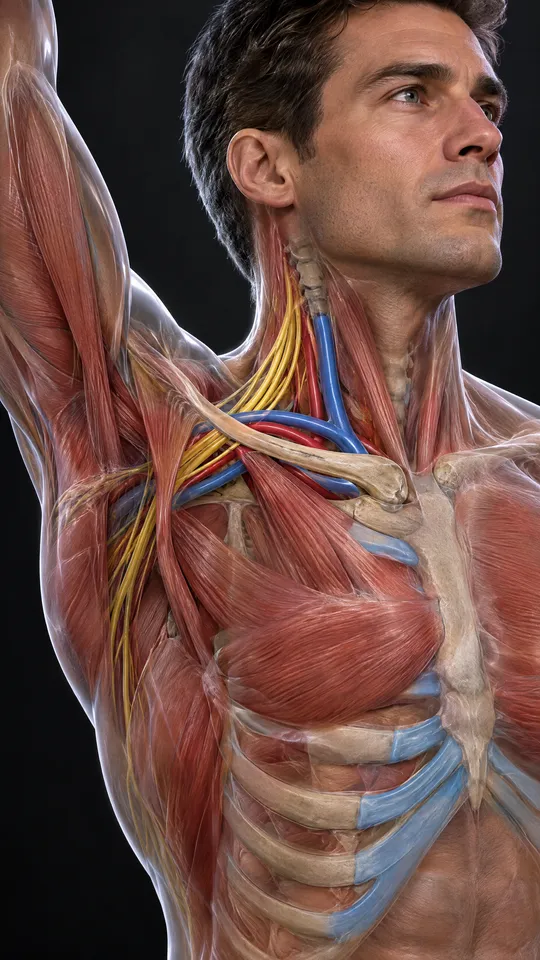
The thoracic outlet is the gap between your collarbone and your first rib. Squeezed through it are the brachial plexus (the bundle of nerves that runs from your neck to supply your arm) and the main artery and vein to the arm.
There are three tight spots along that route where compression tends to happen 6:
Most people with TOS have the nerve form. It's more common in women (about 70% of those affected), typically between their 20s and 40s 1.
Some people are born with less room in the outlet: an extra "cervical" rib (present in roughly 0.5 to 1.5% of people), an unusually shaped first rib, extra muscle slips or fibrous bands 1. But those variations are common in people who never have symptoms. Fewer than 10% of people who have them go on to develop neurogenic TOS 1. What usually tips it over is a trigger (a whiplash-type injury that snaps the neck into extension, or repetitive strain) layered on top of that anatomy 1.
Posture, large breasts, repetitive arm work (builders and swimmers, for example) and significant muscle gain from bodybuilding are also recognised contributors 2.
When the blood vessels are involved instead, it looks different: swelling, heaviness or a bluish tinge when the vein is compressed; a pale, cold hand when the artery is 6.
A caveat: TOS is uncommon, with estimates of around 2 to 3 new cases per 100,000 people a year 4, and prevalence figures vary widely because the definition of TOS itself is disputed 6.
Arm pain with pins and needles has several possible sources, and TOS is easy to confuse with them. The conditions most often mistaken for it are a pinched nerve in the neck (cervical radiculopathy), cervical disc disease or arthritis, rotator cuff tendinitis, carpal tunnel syndrome and narrowing of the spinal canal 1.
A few features lean towards TOS 1:
And there's no single test that rules TOS in 1,6. Two common clinical tests pick up most true cases, but roughly half of people without TOS also test positive on either one alone (more still if they have a pinched neck nerve or carpal tunnel) 1. No scan confirms TOS either; imaging is used to rule out other causes 1. Diagnosis rests on the whole picture, not one positive test.
This is mainly a clinical diagnosis, because no single test or scan can rule thoracic outlet syndrome in 1. You'll be asked about any old neck injury, such as whiplash, and about work or sport that keeps your arms overhead or repeats the same movement 1. Your arms, chest and neck are checked 2, and the base of your neck and front of your shoulder are pressed for tenderness 1. In the elevated arm stress test you hold both arms up in a 'surrender' position and open and close your fists for three minutes, to see if symptoms come on 1.
Scans are there to rule other things out 1: a chest X-ray for an extra rib, nerve conduction studies for a nerve trapped elsewhere, an MRI of the neck for a compressed nerve root 1.
The first job is working out whether this really is TOS, and where the squeeze is happening, from your symptom pattern, what provokes it, and a cluster of tests rather than any single one 1,6. If something needs ruling out with imaging, we'll point you to your GP.
TOS treatment targets the specific compression sites, which differs from routine neck or shoulder physiotherapy 1. Depending on what we find, that can include:
Physiotherapy is the accepted first-line treatment 1,2,3. But there's no multicentre randomised trial for treating neurogenic TOS 4, and one review couldn't establish whether conservative treatment beats no treatment at all, or which type works best 5. Reported success rates also disagree: one review found long-term relief and return to work in 59 to 88% of people managed without surgery 1; another found physiotherapy helped in only 27 to 59% 4. Reasonable evidence for trying it first. Not settled evidence.
A manoeuvre described in the physiotherapy literature for TOS 3. We may use it alongside exercise, but as with the rest of conservative care, there's no agreement on what the best program is 3.
Medicines for pain, muscle relaxation, circulation or clot risk are part of medical care 2. Botulinum toxin injection into the scalene muscles has been tested, and in a randomised trial it did no better than placebo for pain, pins and needles or function 1. Surgery (removing the first rib and releasing a scalene muscle) is reserved for people who don't respond to conservative care, with improvement reported in 56 to 89% across observational studies 1. It carries real risks, including a collapsed lung in about 5% of cases 1, and people with the nerve form tend to benefit less from one common approach 4. None of these are within a physiotherapist's scope of practice. That's a conversation with your GP or a specialist.
Thoracic outlet syndrome is a squeeze on nerves or blood vessels, not a tissue injury that heals on a schedule. So on The Well Motion Recovery Path™ you move up a phase on what your arm can do.
How long it usually takes. There is no agreed timeframe, and no multicentre randomised trial of treatment 4. One review reports relief lasting beyond 12 months in 59 to 88% of people managed without surgery 1. Mild cases, and those treated early, tend to improve most 1. In the first randomised trial, in people who had not responded to conservative care, surgery gave better arm function at three months than continuing it 8.
Prevention hasn't been tested for thoracic outlet syndrome, so these follow the causes and triggers that are documented:
Most TOS is not an emergency. Some of it is.
Call 000 if you have sudden breathlessness, sharp chest pain that's worse when you breathe in, or you're coughing up blood 2.
See a GP the same day (or call healthdirect on 1800 022 222) if one arm has throbbing or cramping pain with swelling, redness and warmth. That can be a blood clot, which can be life-threatening if not treated quickly 2.
Get a medical review soon if your hand turns blue, grey or pale, or feels persistently cold 2,6. On brown or black skin, colour changes can be harder to see 2.
Book an assessment rather than managing it yourself if:
None of this is a reason to panic. How soon treatment starts does affect outcomes 1. The point of getting it looked at is to start sooner, not because the worst is likely.
We start by listening: how it began, what makes it worse, and what it's stopping you from doing. Then we examine the area, explain what we find in plain English, and agree a plan with you. Your first visit is 40 minutes at Engadine and 30 minutes at our other clinics.
We see patients at Engadine, Mount Annan, Narellan and Appin, and at home through our mobile physiotherapy service. If you have private health cover, here's how health fund rebates work for physiotherapy.
Usually in one arm: pins and needles (often worse at night), an arm that tires easily, pain and swelling, a cold hand, and skin on the hand turning blue, grey or pale 2. Headaches are also common in the nerve form 1.
Many people improve substantially, but the numbers vary a lot. One review reports long-term relief and return to work in 59 to 88% of people managed without surgery 1; another reports benefit from physiotherapy in 27 to 59% 4. That gap exists largely because no large randomised trial has settled the question 4. Earlier treatment is associated with better outcomes 1.
In long-standing or severe nerve-related TOS, symptoms can progress to weakness and wasting of the hand muscles 1. With the blood-vessel forms, the concern is clotting 2. How often untreated TOS worsens, the research doesn't say, which is a reason to get it assessed rather than assume either way.
Avoid sleeping with your arms overhead. Sleeping on the side that isn't affected, or on your back with a pillow under each arm, is the usual advice 3. Overhead arm positions at night are a known trigger 1, and pins and needles are often worse at night 2.
Overhead arm work such as hanging washing or brushing hair, driving with your arms unsupported, repetitive strain and sleeping with an arm overhead 1. Sports with repetitive overhead arm movement or heavy lifting carry higher risk too 7.
Stiff, aching, recurring neck pain that builds through the day at a desk or on the tools.
Read moreNeck pain, stiffness or headache that started after a car accident, often a day or two later.
Read moreYou've woken with your head stuck tilted to one side, and a spasm that won't let you straighten it. Infants too.
Read morePain, numbness, tingling or weakness travelling from your neck down into your shoulder, arm or hand.
Read moreA headache that starts in the neck joints and muscles rather than in your head.
Read moreAching at the base of your neck and between your shoulder blades after hours looking down at a screen.
Read more
How would you like to reach us?
Message us on WhatsAppFor bookings and enquiries. Please don't send medical details. Call (02) 8111 5633Request a call-back
Request sent
Thank you. We'll call you back on the number you gave us.
This is a preview, so nothing was actually sent.