Need urgent care? 24/7 Mobile & After-Hours Emergency Physiotherapy Call (02) 8111 5633 For life-threatening emergencies, always call 000
Elbow

Golfer's Elbow

5.0 average rating on Google
Registered NDIS Provider
SIRA Registered Provider

You've had a big week: tiling, hanging doors, a long session at the range, or a job that has you gripping something for eight hours straight. Now there's a nagging ache on the inside bony point of your elbow, running into your forearm. It bites when you lift a full kettle, and it isn't going away.

That's golfer's elbow. Most people who have it have never held a golf club.

What's actually causing it

The forearm muscles that curl your wrist and fingers and turn your palm down all anchor onto one small bony point on the inside of your elbow, through a shared tendon. Every time you grip, twist, pull or lift, it takes load, and enough of that without enough recovery changes the tendon 1.

The word most people expect here is "inflammation". But in most people with elbow tendinopathy the tendon is not inflamed or swollen 1; what's changed is the quality of the tendon tissue. That's why icing and resting takes the edge off without resolving it.

The drivers are ordinary: gripping, writing, lifting, pulling and twisting 2. In a large general-population study, repetitive movements and forceful activities were each independently associated with medial epicondylitis, and so were smoking and obesity 3. High cholesterol, a high-fat diet and diabetes also affect tendon health 2, part of why two people doing identical work end up with different elbows.

Day to day that means tenderness on the inside of the elbow, difficulty gripping, and trouble twisting things like a jar lid 2.
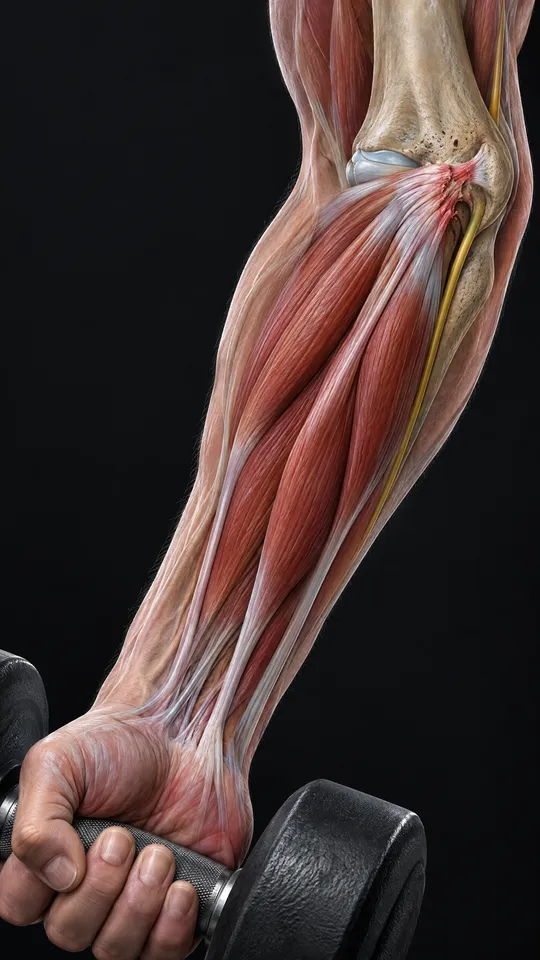
Inner elbow and forearm showing the forearm flexor muscles joining one tendon on the inner elbow bone

Golfer's elbow or tennis elbow? How to tell the difference

The simplest version: golfer's elbow is on the inside of the elbow, tennis elbow is on the outside. Both are overuse tendinopathies and both come from gripping.

Golfer's elbow is also the rarer of the two. In a population sample of nearly 4,800 working-age adults, definite medial epicondylitis affected 0.4% against 1.3% for the tennis-elbow version 3, a Finnish study from 2006, so it's the best available anchor, not an Australian statistic. If you've assumed golfer's elbow, tennis elbow is statistically more likely.

Two other things get mistaken for it, and both change the plan:

  • Ulnar nerve irritation at the elbow. Pins and needles, numbness or altered sensation in the arm or fingers isn't part of golfer's elbow; it's a reason to get seen instead of self-managing 1, and points towards the ulnar nerve rather than the tendon.
  • Pain referred from the neck. In one small study of 102 patients with cervical radiculopathy, just over half also had medial epicondylitis, mostly at C6 and C7 5. That's a single retrospective chart review with no control group: an association worth screening for, not a proven cause. It's one reason a proper assessment looks at your neck too.

How it's diagnosed

Golfer's elbow is diagnosed in the room, from your history and an examination 2 6. A clinician asks about the elbow, then checks your movement and strength 2. The telling test is simple. You rest your forearm on a table, palm up, and try to curl your wrist upwards while they hold it down. Pain at the inside bony point of the elbow confirms it 6.

Imaging comes later, if at all. If the pain hasn't gone after six weeks of treatment, your doctor may consider an X-ray or ultrasound 1.

How we treat it

The first job is working out which of the above you have, and what in your week is loading that tendon. From there, treatment usually involves:

1
Load modification rather than shutdown. For roughly the first six weeks, avoid what provokes the pain: pain means the tendon is being irritated, and pushing through can cause ongoing problems 1. That isn't stopping: it's changing how you grip, reducing the weight you carry and taking breaks 2.
2
Gentle, pain-free movement early. Published patient guidance describes a specific stretch: stand an arm's length from a wall, sore arm closest, palm flat with fingers pointing down, press gently and hold 30 seconds, three times, once a day 1. Never into pain; that's the part people get wrong.
3
Progressive strengthening, in the right order. Once your wrist moves with little or no pain, isometric strengthening comes next (loading the tendon without moving the joint 1) before building into fuller strength work. That's what changes the tendon, and what our exercise prescription and conditioning work is built around.
4
Back to work sooner, not later. You don't need to be symptom-free to return to work, and going back as soon as you reasonably can helps recovery 2. For most tradies that's a conversation about modified tasks, not time off.

One honest caveat, because it's how we work. A large evidence synthesis of exercise therapy for tendinopathy (204 studies) found exercise safe, beneficial and acceptable to patients, but framed its own results as resting on "generally low and very low-quality evidence" 4. Combining concentric and eccentric strengthening may help most, though the credible interval crosses zero, so that isn't settled 4. Loading is still the best-supported thing we have; it just isn't as proven as the internet implies.

Other treatments we may use

Manual therapy.

Hands-on work through the forearm, elbow and, where the assessment points there, the neck and shoulder can settle symptoms and restore movement, so you tolerate loading sooner. None of the sources here tests soft-tissue work for golfer's elbow specifically. The broader evidence only suggests exercise plus another conservative treatment may add a small benefit, on low-quality evidence 4. We use manual therapy alongside loading, not instead of it.

Dry needling.

Same position. Dry needling can help with muscle tightness and pain around an irritable tendon while the strengthening program does the real work. No study cited here demonstrates it for medial epicondylitis in particular, and we're not going to claim otherwise.

Braces and elbow supports.

Widely recommended, often with a product link attached. The evidence is thinner than the marketing: they may help in the short term, but overall there is limited evidence to support their use 2. A properly fitted brace is listed among first-six-week measures 1, so not useless, just not the treatment.

Corticosteroid injection.

Physiotherapists don't prescribe, administer or arrange injections, so this is only what the literature says. A steroid injection improves pain initially, but will not prevent the problem returning and may even do harm 1. Current evidence shows limited benefit here and possible detriment to tendon health 2; injections don't cure it, they help with pain 2.

Your recovery path: Reset, Rebuild, Return

Golfer's elbow moves through The Well Motion Recovery Path™ at the pace the tendon sets. You go up a phase when your grip and wrist can take more, not when a week number comes round.

  • Reset: the opening weeks. Load modification first 1,2, the pain-free wall stretch 1, and manual therapy or dry needling where they help you tolerate movement. Expect the ache to ease before your grip feels reliable. We move you on once your wrist moves with little or no pain 1.
  • Rebuild: this phase has no set length. Isometric holds come first 1, then concentric and eccentric strength work 4 through exercise prescription and conditioning. Expect uneven progress. If a session flares the elbow, we drop the load back and keep going. We move you on when everyday gripping, lifting and twisting no longer set it off.
  • Return: full duties on the tools, in the gym or at the range. You can be back at work on modified tasks well before this 2. We test the grip and pulling tasks your week asks for. You leave with a strength program to keep up.

How long it usually takes. There is no reliable average. Published guidance sets a review point at six weeks: if the elbow has not improved by then, get it reassessed 1,2. Complete healing can take months 1. Both figures come from patient guidance, not from a study that followed golfer's elbow through to recovery.

Reducing your risk of it coming back

Prevention hasn't been trialled for golfer's elbow, so these go after the causes research has pinned down:

  • Cut the force first. In a study of 1,757 workers in repetitive jobs, forceful work nearly doubled the odds of golfer's elbow. Repetition on its own didn't 7. Use two hands on tools, or wear gloves 1, and reduce the weight you carry 2.
  • Check your gear. A racquet that's too heavy, too tightly strung or too small in the grip is a named cause, and so is poor golf technique 6. Grip tape or padding on your clubs is on the NSW prevention list 1.
  • Break up long gripping jobs. Hammering and bricklaying are known triggers 6. Take breaks from work that keeps your elbow and wrist moving, and keep your elbows slightly bent when you lift 1.
  • Look at smoking and weight. Both affect tendon health, along with high cholesterol and diabetes 2.

When to get it checked properly

Most golfer's elbow settles with load management and progressive strengthening. Stop self-managing and get it assessed if:

  • Your symptoms haven't improved within about six weeks, or they're getting worse 2. At that point imaging such as an X-ray or ultrasound may be considered 1
  • You've got pins and needles, numbness or changed sensation in the arm or fingers 1
  • There's abnormal swelling, redness and heat, or you feel feverish 1
  • The colour of the arm or hand changes: going blue or white 1

If yours hasn't budged, the usual reasons are unglamorous: the provoking load never changed, the strengthening never progressed past the early stage, or healing is being slowed by something systemic like smoking, diabetes or cholesterol 2,3. All three are workable.

Your first appointment

We start by listening: how it began, what makes it worse, and what it's stopping you from doing. Then we examine the area, explain what we find in plain English, and agree a plan with you. Your first visit is 40 minutes at Engadine and 30 minutes at our other clinics.

We see patients at Engadine, Mount Annan, Narellan and Appin, and at home through our mobile physiotherapy service. If you have private health cover, here's how health fund rebates work for physiotherapy.

FAQs

What should you not do with golfer's elbow?

Don't push through pain in the early weeks: pain is the signal you're irritating the tendon, and continuing can cause ongoing problems 1. Equally, don't stop everything and wait it out. Modify, don't abandon: change how you grip or lift, reduce the weight you carry, take regular breaks 2. And don't rush to an injection before you've tried loading properly.

Does golfer's elbow go away on its own?

Often, yes: most elbow tendinopathy settles by itself 1. That doesn't make doing nothing the fastest route: complete healing can take months 1, and the checkpoint is six weeks. If it hasn't improved by then, or it's worse, get it looked at 2.

How long does golfer's elbow take to heal?

There's no reliable average, and anyone quoting you one is guessing. The evidence supports a structure (roughly six weeks settling irritation and moving pain-free, then a review point if it hasn't improved 1,2) and a total that can run to months 1.

Does a cortisone shot help golfer's elbow?

Short-term it can reduce pain. Longer-term the evidence is unflattering: an injection improves pain initially but will not prevent the problem returning and may even do harm 1, and current evidence shows limited benefit with possible detriment to tendon health 2. Injections don't cure it, they manage pain 2. Physiotherapists don't prescribe or give injections; this is information for a conversation with your GP, not a recommendation from us.

Can I still lift weights with golfer's elbow?

Usually yes, with changes. In the first six weeks avoid what clearly increases the pain 1; for most people that means loaded gripping, heavy pulling and anything with the wrist flexed hard. Once your wrist moves with little or no pain, isometric strengthening is the next step 1, building towards combined concentric and eccentric work 4.

Should I massage my golfer's elbow?

It can feel good and help you tolerate your exercises, which is worth something. But none of the sources here shows massage fixes medial epicondylitis on its own, and loading is what changes the tendon 1. Part of the plan, not the plan.

More Elbow conditions

Elbow

Tennis Elbow

Pain and tenderness on the outside of the elbow, usually worst when you grip something, lift a full kettle, or turn a doorhandle. It builds through repeated load rather than all at once, and you don't have to play tennis to get it.

Read more
Elbow

Cubital Tunnel Syndrome

Cubital tunnel syndrome is compression of the ulnar nerve at the inside of your elbow. It's the second most common nerve compression in the arm, after carpal tunnel syndrome

Read more

If the inside of your elbow has been sore for weeks and the advice you've been given is "rest it", that's worth a second opinion: rest alone is not the treatment.

Book an assessment with the Well Motion team, or head back to the Elbow section of our Injury Finder if you're not yet sure which part of the elbow is actually the problem.

Book an Assessment
Ahmed Elsayed, Principal Physiotherapist
Reviewed by Ahmed Elsayed Principal Physiotherapist at Well Motion

References

  1. Elbow tendinopathy (tennis and golfer's elbow): patient fact sheet. Emergency Care Institute, NSW Agency for Clinical Innovation. Published July 2022, reviewed to August 2027. https://aci.health.nsw.gov.au/networks/eci/clinical/ed-factsheets/elbow-tendinopathy
  2. Golfers elbow. NHS inform (NHS 24, Scotland: MSK Clinical Advisory Group). Last updated 28 July 2026. https://www.nhsinform.scot/illnesses-and-conditions/muscle-bone-and-joints/arm-shoulder-and-hand-problems-and-conditions/golfers-elbow/
  3. Shiri R, Viikari-Juntura E, Varonen H, Heliövaara M. Prevalence and determinants of lateral and medial epicondylitis: a population study. American Journal of Epidemiology, 2006;164(11):1065-74. Retrieved from PubMed. https://doi.org/10.1093/aje/kwj325
  4. Cooper K, Alexander L, Brandie D, et al. Exercise therapy for tendinopathy: a mixed-methods evidence synthesis exploring feasibility, acceptability and effectiveness. NIHR Health Technology Assessment, 2023;27(24):1-389. Retrieved from PubMed. https://doi.org/10.3310/TFWS2748
  5. Lee AT, Lee-Robinson AL. The prevalence of medial epicondylitis among patients with C6 and C7 radiculopathy. Sports Health, 2010;2(4):334-6. Retrieved from PubMed. https://doi.org/10.1177/1941738109357304
  6. Liebert PL. Medial Epicondylitis (Golfer's Elbow). MSD Manual Professional Edition, reviewed November 2025. https://www.msdmanuals.com/professional/injuries-poisoning/sports-injury/medial-epicondylitis
  7. Descatha A, Leclerc A, Chastang JF, Roquelaure Y. Medial epicondylitis in occupational settings: prevalence, incidence and associated risk factors. Journal of Occupational and Environmental Medicine, 2003;45(9):993-1001. Abstract via PubMed (PMID 14506342). https://pmc.ncbi.nlm.nih.gov/articles/PMC4850209/