Need urgent care? 24/7 Mobile & After-Hours Emergency Physiotherapy Call (02) 8111 5633 For life-threatening emergencies, always call 000
Foot

Morton's Neuroma

5.0 average rating on Google
Registered NDIS Provider
SIRA Registered Provider

You get your boot off at the end of a shift and the burning between your toes finally eases. Through the day it's a shooting or stabbing pain in the ball of your foot, and the odd feeling that there's a pebble under there you can't shake out. Some days two of your toes go numb.

That combination (burning or shooting pain between the toes, a pebble-under-the-foot feeling, and shoes that make it worse) is the classic picture of a Morton's neuroma 1. Despite the name, it isn't a tumour or a growth.

What's actually causing it

Small nerves run between the long bones of your forefoot to supply your toes. A Morton's neuroma is a thickening of the tissue around one of them, after that nerve has been irritated or damaged 1. The change is scarring and wear around the nerve, which is why some clinicians say "interdigital neuritis" (an irritated nerve between the toes) describes it better than "neuroma" 6. You're not dealing with a lump that needs removing. You're dealing with a nerve that's being squeezed.

The squeeze happens where the nerve runs under the ligament that crosses your forefoot, most often between the third and fourth toes 6. One proposed reason: the nerve there is thicker and less mobile than its neighbours, so it has less room to move out of the way 6.

What loads it up is consistent: tight, pointy or high-heeled shoes; running, jumping or other sport that drives weight through the front of the foot; and other foot problems, including flat feet, high arches, bunions and hammer toes 1.

Around here, it's often work rather than sport. A safety boot with a narrow toe box, worn through a full shift on hard floors, squeezes the front of the foot for eight or ten hours at a time.

It's around five times more common in women than men, with an average age around 50 at the time of surgery 6. Being well under that doesn't rule it out.
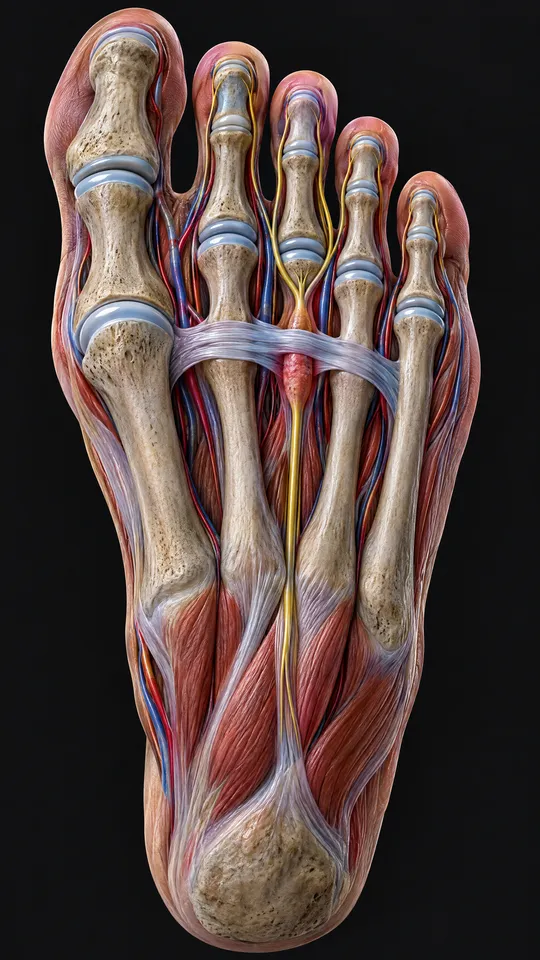

Sole of the forefoot showing a thickened nerve between the third and fourth toes

Morton's neuroma, or something else? How to tell the difference

Several conditions sit in almost exactly the same spot. The clinical list of things that can be mistaken for a Morton's neuroma includes 6:

  • Intermetatarsal bursitis: an irritated fluid-filled sac between the long bones of the forefoot.
  • A stress fracture in one of those bones: a bone problem, not a nerve one.
  • Freiberg's infraction: damage to the rounded head at the end of one of those bones.
  • An unstable or inflamed toe joint at the ball of the foot.
  • Arthritis in the joints of the forefoot.
  • Less commonly, a soft-tissue lump such as a lipoma or a ganglion.

What points towards the nerve is the character of the pain: shooting, stabbing or burning between two toes, sometimes tingling or numbness, and that pebble feeling 1. If yours is more of a general ache across the ball of the foot, our Metatarsalgia page is the better place to start.

Sorting them out is hands-on: squeezing the forefoot across its width, feeling for a painful click between the metatarsal heads, and stretching the nerve to see whether that reproduces your symptoms 3.

And the scan question. A thickened nerve on an ultrasound is not a diagnosis on its own. When researchers scanned 96 feet belonging to volunteers with no forefoot symptoms at all, 54% showed a thickened nerve between the toes 4. Their conclusion: clinical examination is still the gold standard 4. If imaging is needed, ultrasound is about as sensitive as MRI and likely the more cost-effective choice 5. It supports the examination. It doesn't replace it.

How it's diagnosed

This is diagnosed with hands, not a scanner. Your clinician examines the foot 1, and that examination is still regarded as the gold standard 4. One thing we feel for is Mulder's click. The forefoot is squeezed across its width while the gap between the bones is pressed, and a neuroma can give a painful click you can feel 6. In one study, feet with that click were more likely to show a thickened nerve on ultrasound 4.

A scan is for when the examination leaves doubt. An ultrasound finding is unreliable unless it's matched against the examination 4. Ultrasound and MRI are about equally sensitive, each picking up roughly 90 per cent of neuromas later confirmed at surgery 5. If you need more than first-line care, a GP can refer you to a foot specialist 1.

How we treat it

1
Assessment first, scan second. What changed in your footwear, hours on your feet or training before it started, and whether the squeeze and nerve tests reproduce your pain 3. That examination is what the diagnosis rests on 4.
2
Hands-on treatment of the foot and ankle. One of the two treatments the best available review rates as having the strongest evidence for reducing pain 2. But it rests on a single trial with a very wide confidence interval, so the real effect could be large or close to nothing 2. A reasonable place to start, not a guarantee. The trial's approach mobilised and manipulated the joints of the foot and ankle twice a week for three weeks 2.
3
Taking load off the nerve. Wide, comfortable shoes with a low heel and soft sole, less running and jumping while it's irritable, and no tight, pointy or thin-soled shoes 1. Usually that means work footwear as well as training shoes.
4
Foot and toe strengthening. Working the toe flexors and the small muscles inside the foot. We can't point to a trial for it: none of the non-surgical treatments studied in the main review was an exercise programme 2.
5
Getting you back to your sport, through sports physiotherapy, if running, court sport or jumping set it off. A graded return, not stopping and hoping.

Other treatments we may use

Metatarsal pads and soft insoles.

Standard first-line self-care 1. On the evidence, the main review found no studies of how orthoses affect foot function in this condition, and the one trial of wedged insoles showed no significant effect on pain 2. Timing matters too: once symptoms have run for several months and the nerve is well enlarged, insoles and shoe changes become comfort measures rather than a fix 6. Worth trying early.

Shockwave therapy.

We offer it, and for this condition we wouldn't lead with it. Pooled results for pain and for treatment success weren't statistically significant, with confidence intervals wide enough to include no benefit 2. We'd rather tell you than sell it to you.

Injections and surgery.

Steroid or alcohol injections and foot surgery are real options, generally for very severe symptoms or when other treatments haven't worked 1. They're done by your GP or a specialist, never by a physiotherapist. Steroid injection did beat the comparison treatments for pain, but by a small average margin 2, and in one study around 30% of neuromas treated with one went on to surgery 7. If you're heading that way, we'll say so and help you get the referral.

Your recovery path: Reset, Rebuild, Return

A Morton's neuroma is a squeezed nerve, not an injury that heals on a schedule, so The Well Motion Recovery Path™ is about calming the nerve, then building up what your foot can take. You move up a phase on what the foot tolerates, not on a date.

  • Reset: the first weeks. Roomier shoes, a metatarsal pad or soft insole and less impact 1, alongside hands-on treatment. Expect good and bad days that follow your footwear. We move you on once an ordinary day in sensible shoes no longer sets it off.
  • Rebuild: foot and toe strengthening, with time on your feet added back in steps. Expect the odd flare when the load goes up. That tells us to hold, not to stop. We move you on when the foot does what your daily tasks ask of it.
  • Return: a full shift in work boots for some people, running or court sport for others. We test that task in the footwear you will wear for it. You leave with a footwear plan.

How long it usually takes. It varies, and no treatment is an established gold standard 2. In one study, shoe changes and padding eased symptoms in about a third of cases, after 4.5 months on average 6. Orthopaedic patient guidance, not trial data, says surgery may be recommended if symptoms have not improved within 3 to 6 months 9. That decision sits with your GP or a specialist 1.

Reducing the risk of flare-ups

No trial has tested how to prevent Morton's neuroma or its flare-ups. Each of these goes after a recognised cause instead:

  • The toe box. Tight, pointy shoes are a listed cause 1. A review of footwear for this condition says shoes should be long enough and broad across the toes 6.
  • Heel height and sole. High heels add to the compression on the nerve 6. The same review recommends a flat heel and an outer sole that's thick enough and not too bendy 6. Thin soles are on the list to avoid 1.
  • Running and jumping. Sports that put pressure on the feet are another cause 1. Cut back on impact while the foot is irritable 1.
  • Time. One study in that review found shoe changes and padding eased symptoms in about a third of cases, after 4.5 months on average. Past that point, or once the neuroma is larger than 5 to 6 mm, they don't seem to do much 6. If two weeks of looking after it yourself hasn't helped, get it checked 1.

When to get it checked properly

See your doctor, or book an assessment, if 1:

  • The pain is severe, or it's stopping you doing normal activities.
  • It's getting worse, or it keeps coming back.
  • It hasn't improved after two weeks of treating it yourself.
  • You have tingling, numbness or weakness in the foot.
  • The pain started after a recent foot injury, or after foot or ankle surgery.

None of that means something is badly wrong. The first steps are often ones you can start yourself 1. But it does tend to worsen over time 1, and the longer it runs, the less the simple measures achieve 6. Getting it looked at early keeps your options open.

Your first appointment

We start by listening: how it began, what makes it worse, and what it's stopping you from doing. Then we examine the area, explain what we find in plain English, and agree a plan with you. Your first visit is 40 minutes at Engadine and 30 minutes at our other clinics.

We see patients at Engadine, Mount Annan, Narellan and Appin, and at home through our mobile physiotherapy service. If you have private health cover, here's how health fund rebates work for physiotherapy.

FAQs

How do you fix Morton's neuroma?

There's no single proven fix. The usual first steps are wider, low-heeled, soft-soled shoes, a metatarsal pad or soft insole, and less running and jumping for a while 1. Of the treatments studied, hands-on mobilisation and steroid injection have the strongest evidence for reducing pain, but no gold standard has been established 2. Injections and surgery sit with your GP or a specialist 1.

Can Morton's neuroma go away on its own?

Symptoms can often be eased with things you do yourself 1. But it often gets worse over time 1, and the thickening around the nerve is a structural change 6, so easing the symptoms isn't the same as reversing it. If two weeks of self-treatment hasn't helped, get it checked 1.

How do you shrink Morton's neuroma naturally?

Nothing we found evidence for shrinks it naturally. Conservative care works on the symptoms and the pressure on the nerve, and no non-surgical treatment has high-quality evidence as a gold standard 2. The one size reduction we can point to followed a course of alcohol injections, a medical procedure, not a natural remedy 8. But it doesn't have to shrink for you to feel much better.

What happens if Morton's neuroma is left untreated?

It often gets worse over time 1. For some people the pain reaches the point where they're anxious about walking, or even putting the foot down 6. There's a timing cost too: after several months, once the nerve has enlarged, footwear changes and insoles become comfort measures rather than a fix 6.

More Foot conditions

Foot

Plantar Fasciitis

Sharp heel pain that's at its worst on your first few steps out of bed, settles once you get moving, then comes back after sitting or a long day on your feet.

Read more
Foot

Lisfranc Injury

Pain, swelling or bruising across the middle of your foot after a fall, an awkward landing or a twist, and a midfoot that still doesn't want to take your weight.

Read more
Foot

Turf Toe

Turf toe is the sporting name for a sprain of the big toe joint: the structures underneath get overstretched or torn when the toe is forced upwards.

Read more
Foot

Metatarsalgia

Metatarsalgia is a general term for pain around the joints at the base of your toes, a group of conditions rather than a single one. Which one you have changes what helps.

Read more
Foot

Stress Fracture (Foot)

A stress fracture is a fine crack in a bone from repeated loading without enough recovery between efforts, not a one-off injury. In the foot and lower leg it's the most common form of hairline fracture, usually from jogging or running.

Read more
Foot

Cuboid Syndrome

Cuboid syndrome is pain on the outer midfoot, thought to come from a subtle disruption of the joint between the cuboid (a small bone on the outside of your foot) and your heel bone. The exact mechanism hasn't been worked out.

Read more
Foot

Tarsal Tunnel Syndrome

Tarsal tunnel syndrome is compression of the tibial nerve as it runs behind your inner ankle, under a band of tissue called the flexor retinaculum.

Read more
Foot

Heel Spur

A heel spur (calcaneal spur) is a small outgrowth of bone on the heel bone. It can form on the underside or at the back.

Read more
Foot

Bunion

A bunion (hallux valgus) is a bony lump at the big toe joint that forms when the big toe leans towards the other toes. Around 23% of adults have one.

Read more

If the burning between your toes has started deciding which shoes you wear and how far you'll walk, book an appointment at Engadine, Mount Annan, Narellan or Appin.

We'll examine the foot properly, work out what's squeezing that nerve, and build a plan around the hours you actually spend on your feet. Not sure it's the nerve at all? Start from the Foot section of our Injury Finder.

Book an Assessment
Ahmed Elsayed, Principal Physiotherapist
Reviewed by Ahmed Elsayed Principal Physiotherapist at Well Motion

References

  1. Morton's neuroma. NHS (United Kingdom). Page last reviewed 12 June 2025. https://www.nhs.uk/conditions/mortons-neuroma/
  2. Matthews BG, Hurn SE, Harding MP, Henry RA, Ware RS. The effectiveness of non-surgical interventions for common plantar digital compressive neuropathy (Morton's neuroma): a systematic review and meta-analysis. Journal of Foot and Ankle Research, 2019;12:12. PMID 30809275. https://doi.org/10.1186/s13047-019-0320-7
  3. Pitcher M, Moulson A, Pitcher D, Herbland A, Cairns MC. Diagnostic Accuracy of Subjective Features and Physical Examination Tests for Morton Neuroma: A Systematic Review. Foot & Ankle Orthopaedics, 2024;9(4). https://doi.org/10.1177/24730114241291055
  4. Symeonidis PD, Iselin LD, Simmons N, Fowler S, Dracopoulos G, Stavrou P. Prevalence of interdigital nerve enlargements in an asymptomatic population. Foot & Ankle International, 2012;33(7):543-7. PMID 22835390. https://doi.org/10.3113/FAI.2012.0543
  5. Bignotti B, Signori A, Sormani MP, Molfetta L, Martinoli C, Tagliafico A. Ultrasound versus magnetic resonance imaging for Morton neuroma: systematic review and meta-analysis. European Radiology, 2015;25(8):2254-62. PMID 25809742. https://doi.org/10.1007/s00330-015-3633-3
  6. Colò G, Rava A, Samaila EM, et al. The effectiveness of shoe modifications and orthotics in the conservative treatment of Civinini-Morton syndrome: state of art. Acta Biomedica, 2020;91(4-S):60-68. https://pmc.ncbi.nlm.nih.gov/articles/PMC7944831/
  7. Markovic M, Crichton K, Read JW, Lam P, Slater HK. Effectiveness of ultrasound-guided corticosteroid injection in the treatment of Morton's neuroma. Foot & Ankle International, 2008;29(5):483-7. Abstract via PubMed (PMID 18510900). https://doi.org/10.3113/FAI-2008-0483
  8. Hughes RJ, Ali K, Jones H, Kendall S, Connell DA. Treatment of Morton's neuroma with alcohol injection under sonographic guidance: follow-up of 101 cases. American Journal of Roentgenology, 2007;188(6):1535-9. Abstract via PubMed (PMID 17515373). https://doi.org/10.2214/AJR.06.1463
  9. Morton's Neuroma. OrthoInfo, American Academy of Orthopaedic Surgeons (AAOS). https://www.orthoinfo.org/diseases--conditions/mortons-neuroma/