Engadine
996 Old Princes Hwy, Engadine NSW 2233
You've had the same tight, tender spot under your shoulder blade for four months. A massage settles it for a day. Stretching buys you an hour. Someone at your gym in Engadine told you to try dry needling, and now you're working out whether it's worth booking.
Dry needling is useful for certain kinds of muscular pain, and our physiotherapists are trained in it and use it regularly. It isn't a treatment on its own, and we won't sell it to you as one. It works best when it's chosen from what your assessment shows, and used to make the rest of your rehabilitation possible 1. We offer dry needling in Engadine and at our three clinics further south-west, which puts it in suburban Sydney and a long way from the city centre.
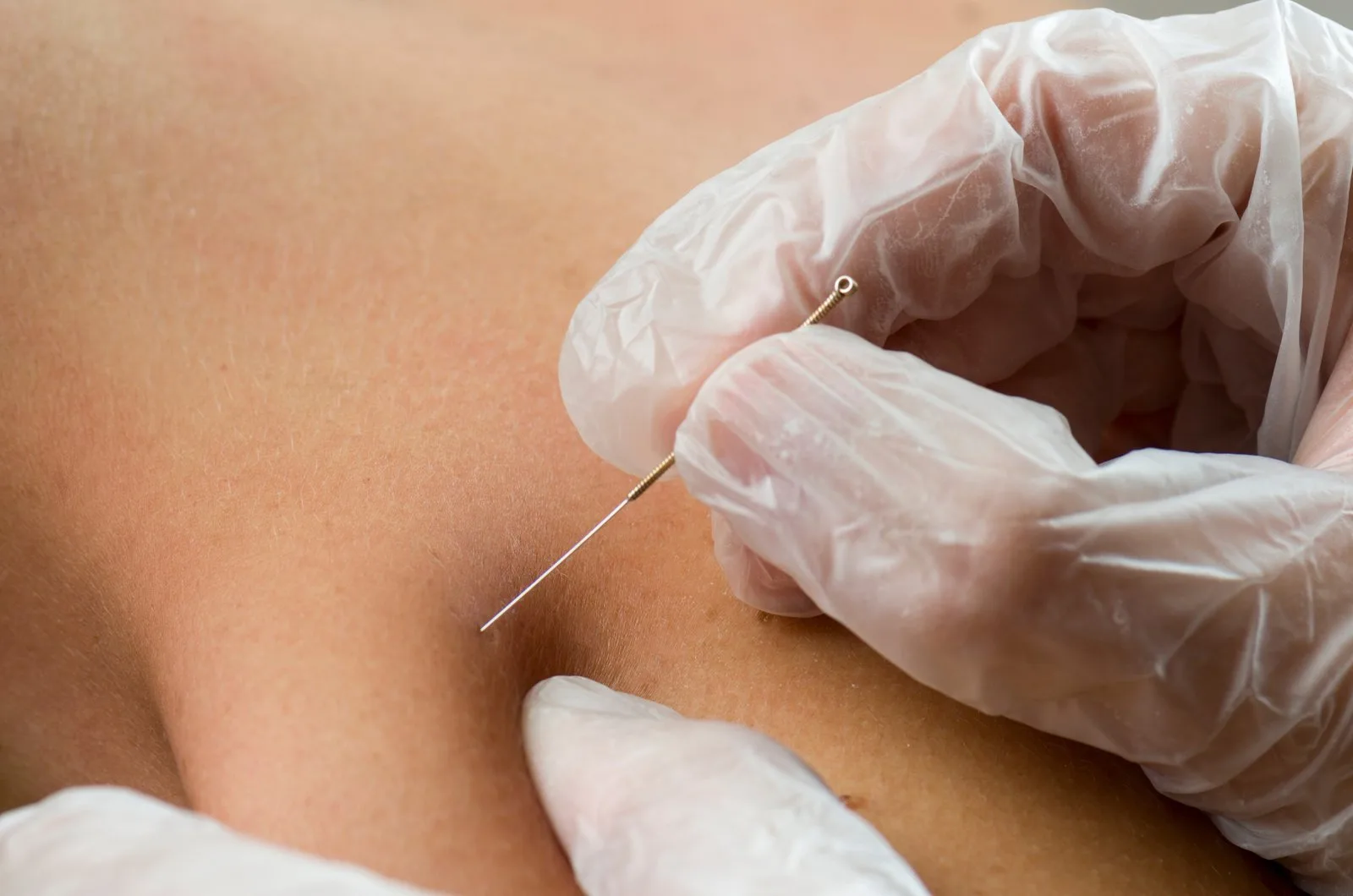
A trigger point is a small, irritable knot in a taut band of muscle. You can usually find it with a thumb: it's the spot that makes you wince, and it often refers pain somewhere else entirely. Dry needling is a skilled technique that uses a thin filiform needle to penetrate the skin and stimulate those underlying trigger points 1.
It's called "dry" because no medicine is injected; the needle carries nothing and isn't doing anything chemical. Physiotherapists don't prescribe or administer injections at all; if medication is part of the answer for you, that conversation belongs with your GP or a specialist.
What the needle does instead is mechanical and neurological. Placing it into the taut band can produce a brief involuntary flick (a local twitch response), after which the band often releases some of the tension it was holding 1. The stimulation also activates analgesic and autonomic reflexes, which is part of why an area can feel different in a way that isn't only about the knot itself 2.
There's a second explanation that fits people who sit or stand in one position all day. The smallest muscle fibres switch on first and switch off last, so under a long, low-level load they never really get a break, and that's thought to be where some trigger points start 1.
Both point the same way. Needling can change what a muscle is doing today. What stops it going straight back is changing the load that put it there.
The literature describes it as an option across myofascial pain, muscle strains, osteoarthritis, tendinopathies and plantar heel pain, and as part of a multimodal approach for neck pain 1,2. At our clinics it tends to come up for:
That's where the technique is most often useful, not a menu you order from. What gets used on the day comes out of the assessment.
A word on the evidence before you book. Dry needling reduces pain more than sham treatment does, but the benefits are short-term and the research behind them is low-to-moderate quality 1. More encouragingly, the same literature reports quicker improvement in symptoms and function when needling is done alongside an appropriate rehabilitation plan, compared with either exercise alone or needling alone 1. That's how we use it.
Dry needling isn't something you book by itself here. It's a technique your physiotherapist may choose during a standard physiotherapy appointment, so the session starts the way every session at Well Motion starts.
We assess first. We'll talk through what's been bothering you, how long it's been going on, what makes it better or worse, and what you're trying to get back to. Then we look at how the area moves and where the restriction sits, which often isn't where you feel the pain.
Then we decide whether needling is the right tool. If we find a specific, reproducible trigger point contributing to your symptoms, dry needling is likely to be part of what we use that day. If the picture is a stiff joint, an irritated nerve or a strength problem, we'll say so and use something better suited. Nothing happens without your say-so.
The needling itself takes a few minutes, not the whole session. You'll usually feel a dull ache or a brief cramp-like flick as the muscle responds, and we check in as we go. There's nothing gained from pushing through something that hurts.
We finish with what makes the change last. Releasing a trigger point opens a window, and what you do in that window is what holds the result. You'll leave with specific movement or loading work to do between sessions, and a clear sense of what should feel different by next time.
The reason we don't sell dry needling as a package of sessions is that it was never the goal. It's one tool for getting to the goal.
Getting through a shift without your neck locking up by mid-afternoon. Playing a full game on Saturday instead of coming off at half time. Driving from Narellan to the city and back without your lower back tightening the whole way. Picking up a grandchild without bracing first. Those are what we build a plan around, and every technique we use gets kept or dropped on whether it's moving you toward them.
It's also why the answer to "how many sessions will I need?" is that it depends on how you respond. Some people get a clear, lasting change after one or two treatments. Others get more from a different combination of work, and we change course. We'd rather tell you that than commit you to a fixed number of appointments before we know anything.
Dry needling sits inside our broader manual therapy toolkit and is rarely used alone. It targets one specific tight point in a muscle, which is a narrower job than mobilising a joint through its range; the two are often used in the same session for different parts of the same problem. Dynamic cupping therapy is another hands-on option we may use with it.
The pairing that matters most is with exercise prescription and conditioning. Needling changes what a muscle is doing today; loading it properly changes what it can tolerate next month. Together they do something neither does alone 1.
You can see the full range of what we offer on our services page.
Dry needling is available with our physiotherapists at:
996 Old Princes Hwy, Engadine NSW 2233
Shop 11/13 Main St, Mount Annan NSW 2567
22 Sharman Cl, Harrington Park NSW 2567
49 Appin Rd, Appin NSW 2560
All four clinics are reachable on (02) 8111 5633.
A thin needle is placed into a tight, tender point in a muscle to change how that muscle is holding tension. The muscle often gives a brief involuntary twitch and then releases some of it, and the stimulation triggers pain-relieving and autonomic reflexes in the area 1,2. It's called "dry" because no medicine is injected. What it does best is make the active part of your rehabilitation possible; it isn't the plan on its own.
Most of what people describe comes from the muscle responding rather than the needle going in: a dull ache, or a brief cramp-like flick as the taut band releases 1. Some soreness in the treated area afterwards is common and usually settles within a day or two 3.
The most common are mild: post-needling soreness and bruising, reported in roughly 19 to 36% of treatments. Serious adverse events are rare, documented at between 0.01% and 0.87% per treatment 3. It isn't appropriate for everyone: needle phobia, an infection in the area, vascular disease, the first trimester of pregnancy and a compromised immune system are all reasons we'd use something else instead 1. We screen for that before anything happens, and saying no to it is always fine.
Some people feel tired, a bit lightheaded or unusually relaxed for a short while afterwards. That isn't a sign something has gone wrong; needling stimulates autonomic reflexes as well as pain-relieving ones, and those are the systems governing things like heart rate and blood pressure 2. Soreness in the treated muscle is common too 3. Tell us if it happens; it's useful information for next time.
Expect the treated area to feel sore or bruised for a day or so, and judge your activity by that rather than pushing straight through it 3.
They do different jobs, and they're often used in the same session. Dry needling targets one specific tight point inside a muscle. Hands-on manual therapy works more broadly: across a region of soft tissue, or mobilising a joint through its range. Neither is a better version of the other. The useful question is which one your assessment points to today. Sometimes that's both.
How would you like to reach us?
Message us on WhatsAppFor bookings and enquiries. Please don't send medical details. Call (02) 8111 5633Request a call-back
Request sent
Thank you. We'll call you back on the number you gave us.
This is a preview, so nothing was actually sent.