Frozen Shoulder
Stiffness in every direction, including when someone else moves the arm for you. Comes on gradually and moves through stages.
Read moreYou can still drive. You can still carry the shopping. But somewhere around shoulder height the arm stops. Not a wall of pain exactly, more a hollow weakness, like it has stopped taking instructions. Sleeping on that side stopped being an option weeks ago.
Maybe it started with a fall onto an outstretched hand. Maybe it crept up after years of overhead work. Either way, the plan so far might be rest, something anti-inflammatory, and a suggestion to get an injection.
There's a more useful answer, and it starts with working out which part of the cuff has stopped doing its job.
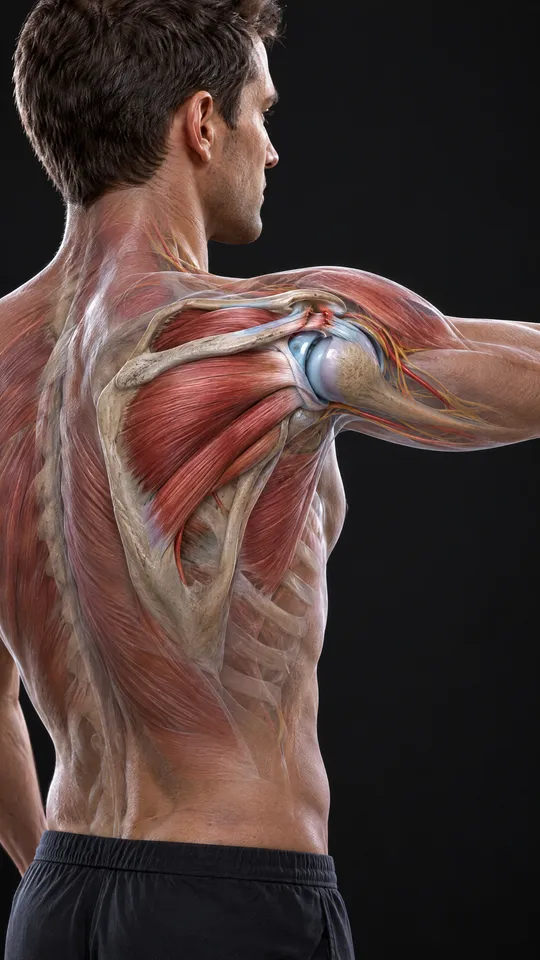
Four muscles run from your shoulder blade and wrap around the top of the upper arm bone. Their job isn't power. It's control: holding the ball centred in its shallow socket so the bigger muscles have something stable to pull against.
One of them, supraspinatus, sits over the top of the joint and works with the deltoid to lift your arm out to the side 2. The cuff also works as balanced pairs of opposing pulls: force couples 2. That explains the symptom that brought you here: once a large tear disrupts that balance, the deltoid has lost its stable fulcrum, so full overhead movement may not be available no matter how hard you push 9.
Tears happen two main ways, and they're different problems: age-related degeneration of the tendon, often with repetitive stress from years of overhead load, or a single traumatic event, typically a fall onto an outstretched arm 6. Your dominant side and heavy overhead work both raise the risk 6, and so do smoking and carrying extra weight 1.
Worth knowing now: a partial-thickness tear can become full-thickness over time 1. Not a reason to panic, a reason to treat what's loading it instead of working around it.
These three get used interchangeably. They're related but distinct 1, and they don't respond to the same plan.
A rotator cuff tear shows up as weakness, not just pain. Pain sits in the shoulder and the upper arm, it's worse lying on that side at night, and it bites during anything overhead: washing or brushing your hair 1. Which direction is weak points to which part is torn: inwards suggests the front of the cuff, outwards the back 2.
Shoulder impingement feels more like a pinch or catch through one arc as the arm goes up, often easing once you're past it, with strength largely intact.
Frozen shoulder is stiff in every direction, including when somebody else moves the arm for you. That's the giveaway: a torn cuff usually lets someone lift your arm passively; a frozen shoulder won't.
Often there's no scan involved at all 1. You'll be asked what the pain is like, what eases it or sets it off, and how active you are 1. Then the shoulder gets examined: where it's tender, how far it moves in each direction, and how strong the arm is in different positions 6. Your neck may be checked too, in case a pinched nerve there is behind the pain 6.
If imaging is needed, an X-ray usually comes first. It can't show the cuff. Its job is to rule out other causes of shoulder pain, such as arthritis 1 6. An ultrasound or MRI can show where a tear is and how big it is 6.
The first job is working out what's torn and how much, usually physically rather than with a scan: in many cases further tests aren't needed 1. We test strength direction by direction, because which movement is weak tells us which part of the cuff is involved 2. From there:
Being straight about the research: in a trial of 708 patients, a supervised progressive exercise program was not superior at 12 months to a single best-practice advice session plus self-management 4. Worth saying out loud on a physiotherapy website. The value is in the right plan (the right movements, loaded properly, for your particular tear), not the number of appointments. That trial did exclude full-thickness tears requiring surgery and significant shoulder trauma 4.
Corticosteroid injection. Commonly offered, and worth understanding before you accept one. It's prescribed and administered by a doctor, not by physiotherapists. The largest relevant trial found it provided no long-term benefit at 12 months 4. It may still have a place for short-term symptom control; it isn't a repair, and it isn't a plan.
Anti-inflammatory medication. A recognised part of standard care 1, and it can make the early weeks more bearable. Also outside physiotherapy scope: a conversation with your GP, not with us.
Surgery. For mostly small degenerative tears of the supraspinatus tendon, a Cochrane review of nine trials found repair probably provides little or no improvement in pain at 12 months versus exercise-based care, improving function by around six points on a 0 to 100 scale; the authors were uncertain whether that is clinically meaningful 3. Check the scope before applying it to yourself: it may not hold for traumatic tears, large tears involving the front of the cuff, or younger people 3. Surgery is a real option for some tears, just not the default the word "tear" makes it sound.
The current clinical practice guideline on rotator cuff assessment and rehabilitation covers tendinopathy and partial-thickness tears, not full-thickness tears 5. That gap is why individualised assessment matters more here than a protocol copied off a website.
A torn cuff is treated along The Well Motion Recovery Path™. What your shoulder can do decides when you move up a phase, not the calendar.
How long it usually takes. In a study of 452 people with full-thickness tears not caused by an injury, shoulder scores improved by 6 and 12 weeks of physiotherapy 11. After a repair, most people have functional movement and adequate strength by 4 to 6 months 10. Treat both as guides: after a repair, your surgeon sets the timeline.
Across 21 studies, about a quarter of partial tears and just over half of full-thickness tears grew over two to three years 7, and nothing has yet been proven to stop that, so these go after the known risks:
Don't wait it out. Book an assessment if:
Meanwhile, the two things most worth avoiding are repetitive overhead activity and lifting heavy objects above shoulder height 1. If you smoke or carry extra weight, both are recognised risk factors 1. Not a lecture, just two things inside your control.
One reassuring fact to finish on: it's common for older people with rotator cuff injuries to have no symptoms at all 1. A tear on a scan isn't automatically what's causing your pain.
We start by listening: how it began, what makes it worse, and what it's stopping you from doing. Then we examine the area, explain what we find in plain English, and agree a plan with you. Your first visit is 40 minutes at Engadine and 30 minutes at our other clinics.
We see patients at Engadine, Mount Annan, Narellan and Appin, and at home through our mobile physiotherapy service. If you have private health cover, here's how health fund rebates work for physiotherapy.
Often yes, though it's usually weak or painful, especially against resistance 6. Supraspinatus helps the deltoid lift the arm out to the side 2, and a large tear can leave the deltoid working without a stable fulcrum 9. Then the arm gets partway and stalls.
The tendon knitting back onto the bone by itself isn't reliable: partial tears can progress, and re-tearing happens even after repair 1. Getting the shoulder working and comfortable again is far more achievable: for small degenerative tears, non-operative care performed comparably to surgery at 12 months 3.
Get it assessed, then start physiotherapy, the first treatment approach used for this injury, ahead of medication and surgery 1. Back off the aggravating overhead activity and begin structured stretching and strengthening 1. The plan matters more than the number of appointments 4.
The shoulder and the upper arm, which is why people often mistake it for a bicep problem. It's worse lying on that side at night, and sharpens whenever you lift your hands above your head 1.
There isn't a universal three, and anyone handing you one hasn't examined your shoulder. It depends on which part of the cuff is torn, whether it's partial or full-thickness, and what stage you're at 6. Our Rotator Cuff Exercises: A Safe Recovery Progression article sets out how a staged program is built.
Avoid repetitive overhead activity and lifting heavy objects above shoulder height while it's irritable 1. Don't push through the weakness assuming it will strengthen itself, or leave a partial tear long enough to progress 1.
It varies more than people expect. The night pain from lying on that side bothers most people more than sharp pain 1, yet it's common for older people with cuff injuries to have no symptoms at all 1. How much it hurts says little about the size of the tear.
Stiffness in every direction, including when someone else moves the arm for you. Comes on gradually and moves through stages.
Read moreA pinch or catch through one particular part of the range as the arm goes up, often easing once you're past it.
Read moreSLAP stands for Superior Labrum, Anterior to Posterior. The labrum is the rim of cartilage that deepens your shoulder socket. The long head of the biceps tendon attaches to it at the top, and that's where these tears happen
Read moreA rupture at the shoulder usually follows tendon wear that's been building for a while. Uncommonly, a severely worn tendon gives way altogether
Read moreBiceps tendinopathy is thickening and irritation of the biceps tendon at the front of the shoulder. It often starts without any known injury.
Read moreA dislocated shoulder is the ball at the top of your upper arm bone coming out of its shallow socket. Most often it comes out the front.
Read moreYour AC joint is where the far end of your collarbone meets the top of your shoulder blade. A sprain means the ligaments holding that joint together have been stretched or torn.
Read moreSubacromial bursitis is inflammation of a small, fluid-filled cushioning sac (a bursa) under the bony point at the top of your shoulder
Read more
How would you like to reach us?
Message us on WhatsAppFor bookings and enquiries. Please don't send medical details. Call (02) 8111 5633Request a call-back
Request sent
Thank you. We'll call you back on the number you gave us.
This is a preview, so nothing was actually sent.