Heat and pain-relief gels.
A heat pack over the area, plus topical pain-relief gels, are standard self-care 1,3.
It started as a sharp pain at the front of your chest, just beside the breastbone. It's worse when you take a deep breath, cough or roll over in bed. Pressing on the spot makes it sore. And because it's your chest, part of you is quietly worried it's your heart.
That worry is reasonable, and it comes first.
Chest pain needs a doctor before it needs a physio. If you have chest pain and have trouble breathing, feel sick or are sweaty, call triple zero (000) 1. Also call 000 straight away if your chest pain 2:
Any chest pain should be seen by a doctor as soon as possible 1. Costochondritis is only diagnosed once more serious causes have been ruled out 3. If any of the above fits, stop reading and get help. Don't book a physiotherapy appointment.
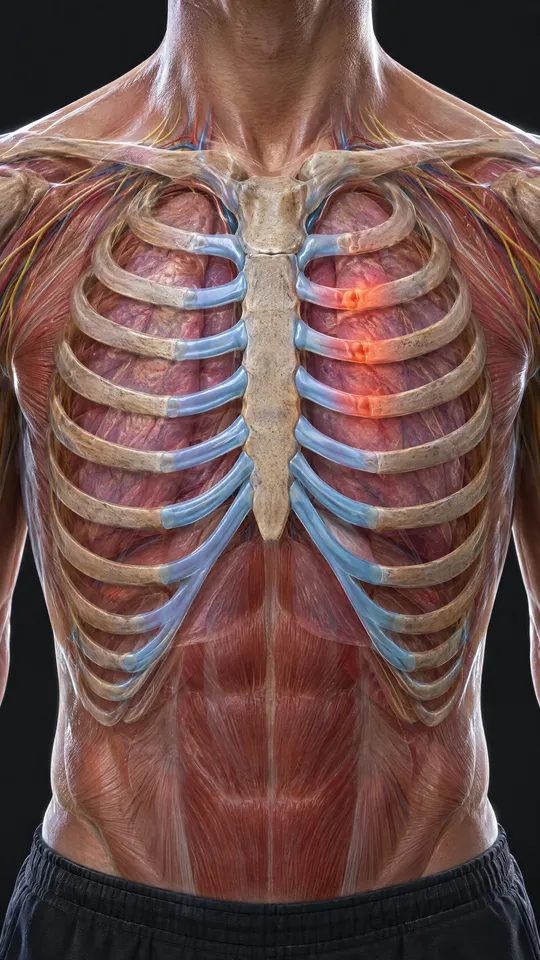
Your ribs don't attach straight onto your breastbone. The last stretch of each rib is cartilage, a firm, slightly flexible tissue that lets your ribcage move as you breathe. In costochondritis, the cartilage where those ribs meet the breastbone becomes inflamed. You may see it called costosternal syndrome or anterior chest wall syndrome 1.
The pain is usually sharp, at the front or side of the chest 2, and often sits on one side of the breastbone 1. It tends to get worse when you move your upper body, lie down, breathe deeply, cough or sneeze, or press on the breastbone or ribs 1,2. Visible swelling isn't part of the usual picture 1.
Why it happens is often unclear 1. Where a trigger can be identified, the usual ones are heavy coughing, a chest injury, physical strain from exercise or heavy lifting, repetitive upper-body movements, or an infection 1,2. It's most common between the ages of 40 and 50 1,3.
It's also common. In one emergency department study, 30% of chest-pain patients turned out to have costochondritis 3.
You can't reliably tell on your own, and a physiotherapist shouldn't be the first to try.
Doctors treat costochondritis as a diagnosis of exclusion. It's what remains once the serious causes of chest pain have been ruled out: a heart attack, a blood clot in the lung (pulmonary embolism), a tear in the body's main artery (aortic dissection), pneumonia, and a collapsed lung (pneumothorax) 3.
Your GP will examine you and may order an ECG (a heart tracing), a chest X-ray or blood tests to rule those out 1. An ECG and chest X-ray should be considered for any adult with chest pain. In costochondritis, both come back normal 3. Your pulse and blood pressure should be normal too. A fast heart rate or low blood pressure points towards something else 3.
One common belief needs correcting. Pain you can reproduce by pressing on your chest does not rule out your heart. Heart-related chest pain can occasionally be reproduced by pressure too 3. That's why tenderness helps a doctor build the picture but can't settle the question for you.
Once the serious causes are off the table, other chest-wall problems can still look similar. A pulled chest muscle and an intercostal strain each have their own page. Working out which one you have is part of a proper assessment.
No scan shows costochondritis. Once the serious causes have been dealt with, the diagnosis comes from your story and a hands-on examination, and more imaging isn't recommended just to confirm it 3.
Your doctor will ask what brings the pain on and what makes it worse. Then they'll press gently on the joints where your ribs meet the breastbone to see whether that reproduces it, and check whether movement does too 1. Often the sore spot is where one or two ribs join the breastbone 3. They'll look at the skin and the joints around the breastbone as well. Warmth, redness, swelling or a rash don't belong to costochondritis and point to something else 3.
We see people once a doctor has ruled out the serious causes, usually because the pain is lingering longer than expected, keeps coming back, or is getting in the way of work, sleep or training.
Here's what the evidence does and doesn't show. In that case series, eight people who'd had costochondritis for an average of 6.3 months had about five sessions. Their pain and function improved, and all eight returned to their usual activities 4. But there was no comparison group, so natural recovery can't be ruled out. The authors say physiotherapy "may facilitate" recovery 4, and we'd put it the same way: a reasonable option for costochondritis treatment when pain persists, not a guaranteed fix.
A heat pack over the area, plus topical pain-relief gels, are standard self-care 1,3.
Paracetamol and anti-inflammatory painkillers are the usual medical treatment 1,2,3. That's a conversation for your GP or pharmacist, because physiotherapists don't prescribe or administer medication.
A doctor may offer a steroid or local anaesthetic injection when pain is severe and won't settle 1,2. There isn't yet enough evidence to show that steroid injections work for costochondritis 3. They're given by a doctor, not by us.
It hasn't been rigorously tested for costochondritis 3, so there's no evidence we can point you to.
If it isn't improving, your GP may refer you to a rheumatologist, a doctor who specialises in joint and inflammatory conditions 1,3.
To help prevent it, keep good posture, avoid heavy lifting and repetitive movements that strain the chest, do gentle low-impact exercise, and manage stress 1.
Once a doctor has ruled out the serious causes of chest pain 3, costochondritis that lingers follows The Well Motion Recovery Path™. You move up a phase when your chest tolerates more, not when a date arrives.
How long it usually takes. Over 90% of people improve within three to four weeks 3, and some cases last several months 2. For pain that persists, no study gives a reliable timeframe for physiotherapy. The only evidence is one small case series with no comparison group 4, so we will not put a number on it.
Costochondritis rarely comes back 1, and no trial has tested how to prevent it. So this list works from its recognised triggers:
The triple zero signs at the top of this page always come first. Beyond those, see your doctor promptly if:
The reassuring part is that costochondritis is harmless and gets better with time 3. Once the serious causes are ruled out, you're dealing with an irritated joint, not a damaged heart.
We start by listening: how it began, what makes it worse, and what it's stopping you from doing. Then we examine the area, explain what we find in plain English, and agree a plan with you. Your first visit is 40 minutes at Engadine and 30 minutes at our other clinics.
We see patients at Engadine, Mount Annan, Narellan and Appin, and at home through our mobile physiotherapy service. If you have private health cover, here's how health fund rebates work for physiotherapy.
Usually a sharp pain at the front or side of the chest, often on one side of the breastbone 1,2. It's worse with deep breaths, coughing, moving your upper body, lying down, or pressing on the ribs 1,2. It can feel like heart pain 1, so get it checked rather than assume.
Most people need only heat, pain relief and a break from aggravating activities 1,3. Stretching and gentle exercise are recommended 1. For pain that persists, physiotherapy may help, though the evidence is limited 3,4. A doctor may consider injections for severe, lasting pain 2.
Often nothing obvious 1. Recognised triggers include heavy coughing, a chest injury, strain from exercise or heavy lifting, repetitive upper-body movements, and infection 1,2.
There isn't one proven best exercise. Stretching and gentle, low-impact exercise are recommended 1. The research on specific programs is small: one stretching study and one eight-person case series 3,4. The right starting point depends on what aggravates your pain, so it should be worked out for you.
Over 90% of people improve within three to four weeks 3. Some cases take several months 2.
Avoid heavy lifting and the repetitive or strenuous movements that set your pain off 1. Don't try to rule out your heart by pressing on your chest, because heart pain can sometimes be reproduced that way too 3. And don't dismiss new or worsening chest pain, breathlessness or dizziness as "just the costochondritis" 3.
A pulled chest muscle: a sudden catch or tearing feeling at the front of your chest or near the armpit, usually mid-press, mid-throw or mid-lift.
Read moreA cracked rib after a direct knock, a fall or a long run of hard coughing, with pain that bites when you breathe in or laugh.
Read more
How would you like to reach us?
Message us on WhatsAppFor bookings and enquiries. Please don't send medical details. Call (02) 8111 5633Request a call-back
Request sent
Thank you. We'll call you back on the number you gave us.
This is a preview, so nothing was actually sent.