Heat.
A heat pack or hot shower, alongside keeping the neck moving as much as pain allows, is standard advice from both Australian government sources for an acute neck 1,2. It helps. It just isn't the whole treatment.
It usually starts as a tight, one-sided ache between your shoulder blade and the base of your skull. You roll the shoulder, turn your head until something clicks, and it eases for ten minutes. Then a long day at a laptop, or a long day on site with your arms overhead, and by evening it's the only thing you can think about. Some weeks it's gone. Then it's back, same spot, same reason.
Neck pain like this is very common (around 203 million people worldwide were living with it in 2020 9), and it's rarely mysterious. The explanation is usually mechanical, and ordinary.
Your neck is seven vertebrae stacked on top of each other. At every level there are two small facet joints at the back and a disc at the front, held and moved by layers of muscle running up from your shoulders and upper back 1.
That design is built for movement and copes poorly with being held still. Shoulders slouched and chin poking forward (hours at a computer, or long stretches looking down at a phone) can strain the neck over time 1. Other everyday causes are just as ordinary: the wrong pillow, a sprain or strain, long desk sessions without breaks, age-related change in the neck joints (cervical spondylosis), and stress or anxiety, which raises muscle tension 3.
We'll be straighter here than most pages on this topic: "your posture caused this" is a bigger claim than the evidence supports. A review pooling 15 studies did find adults with neck pain sit with their head further forward, but the effect was small enough that the result nearly included no difference at all, and in adolescents there was no association 6. A later study found no usable link between head position and pain or disability; what differed was how the neck moved, with less range and slower turning 7.
That's the more useful target. It's measurable, it changes with treatment, and it doesn't ask you to hold a perfect sitting position all day. Rates of neck pain have also barely shifted since 1990: the rising case count tracks population growth and ageing, not screens 9.
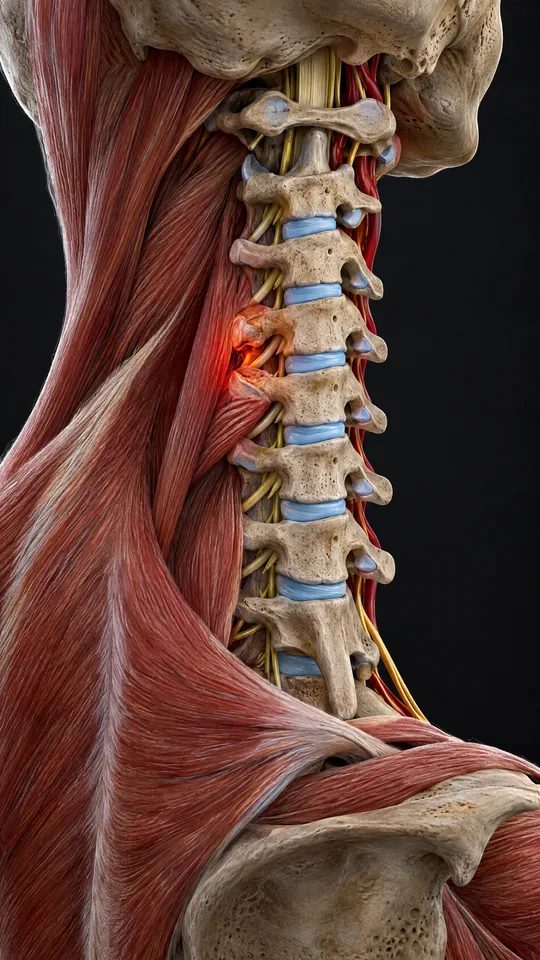
These three account for most of what we see, and they're managed differently.
Wry neck (torticollis). The neck muscles spasm, one side becomes painful, and you can't straighten your head 2. It happens at any age but is most common in teenagers and young adults, usually after something small: sleeping awkwardly, a sudden flick of the head, carrying an unbalanced load like a suitcase, or a viral infection 1,2. Treated early it responds well, often within days 1, and usually clears within about 7 to 10 days 2. Rarely (particularly over 40, and very rarely in infants) it has an underlying medical cause, not a mechanical one 1. Torticollis in a baby is a different problem again, covered in Torticollis in Babies.
A simple muscle strain. Pain and stiffness stay in the neck and shoulder. It's sore to move but it does move, it eases with heat and gentle activity, and nothing is happening in your arm.
A pinched nerve (radicular pain). The giveaway isn't the neck, it's the arm. Pins and needles, numbness, or an arm that feels cold points away from a simple strain 4, and weakness or numbness in an arm or leg needs prompt assessment, not a wait-and-see week 3.
Neck pain that started in a car accident is a different pathway again: see Whiplash.
Most neck pain is diagnosed without a scan 3. A doctor asks about your symptoms and your pain, then examines you 3. Blood tests, an X-ray, or a CT or MRI scan are for tracking down a specific cause when one is suspected 3.
The arm is what changes things. Shooting pains down your arm, or numbness or a loss of power in your arm or hand, are a reason to see your doctor, because you may need further investigations such as medical imaging 1.
The first appointment is about working out which of those you have. Clinical practice guidelines sort neck pain into four categories: mobility deficits, movement coordination impairments (where whiplash sits), headaches, and radiating pain 10. And the category changes the plan. So we test how your neck moves, not just where it's sore.
From there:
On what physiotherapy can offer: treatment may help you recover more quickly and may give short-term relief 3, and the Better Health Channel (approved in consultation with the Australian Physiotherapy Association) says neck pain can generally be successfully treated by physiotherapists 1. We'd rather quote both than promise more than either says.
A heat pack or hot shower, alongside keeping the neck moving as much as pain allows, is standard advice from both Australian government sources for an acute neck 1,2. It helps. It just isn't the whole treatment.
Most clinic pages lead with this. We won't, because the evidence doesn't support it as the centrepiece. A 2024 Cochrane review of 33 trials and nearly 2,000 people found the contribution of massage remains uncertain, and that for subacute and chronic neck pain it may make little or no difference to pain, disability or quality of life compared with placebo 8. Higher doses (eight or more sessions over four weeks) did better in subgroup analysis 8. So we may use it to get you comfortable enough to move, not to build a recovery around.
We won't send you for a scan by default: imaging isn't needed for most people with neck pain 3. And we won't put you in a collar: neck supports, braces and collars aren't considered useful 3, and the NHS is blunt about why: it's better to keep your neck moving 4.
We plan neck pain treatment along The Well Motion Recovery Path™. What moves you up a phase is what your neck can do, not how many days have passed.
How long it usually takes. A wry neck usually settles within about 7 to 10 days 2. Most other neck pain improves within a few weeks 3,4. It often comes back, though: a review of general population studies found between half and three quarters of people with neck pain reported it again 1 to 5 years later 14.
Prevention has been tested for neck pain, and moving comes out ahead of furniture:
Most neck pain settles. Some of it shouldn't be managed at home, and it's worth knowing the difference before you're in the middle of it.
Call triple zero (000) and ask for an ambulance if neck pain comes with chest pain, shortness of breath or sweating 3. For sudden severe neck pain, or neck pain after an accident, call us: we assess it the same day and tell you plainly if it needs a hospital.
Seek urgent care for neck pain with a fever, sweats or chills; changes to vision or hearing; light-headedness or loss of balance; confusion; or bowel or bladder problems 3. With a wry neck, trouble breathing or swallowing, drooling or a severe sore throat also mean urgent assessment 2.
Call us the same day for pins and needles, numbness or weakness in an arm or leg.
Book an assessment if a wry neck hasn't improved after 7 to 10 days 2; if general neck pain isn't settling after a few weeks, is getting worse, or is affecting daily life 3,4; or if you've noticed pins and needles or a cold arm at any point 4.
None of that is a reason to panic. It's a reason to get looked at properly instead of working around it for another six months.
We start by listening: how it began, what makes it worse, and what it's stopping you from doing. Then we examine the area, explain what we find in plain English, and agree a plan with you. Your first visit is 40 minutes at Engadine and 30 minutes at our other clinics.
We see patients at Engadine, Mount Annan, Narellan and Appin, and at home through our mobile physiotherapy service. If you have private health cover, here's how health fund rebates work for physiotherapy.
For most mechanical neck pain, yes, with honest expectations. Australia's public health service is measured: physiotherapy may help you recover more quickly and may give short-term relief 3. The Better Health Channel, written in consultation with the Australian Physiotherapy Association, goes further, saying neck pain can generally be treated successfully by physiotherapists 1. The practical value is usually in the assessment: knowing which pattern you have, and whether your arm symptoms matter, changes what you should be doing.
Guidelines classify it into four categories 10: neck pain with mobility deficits (stiffness and restricted movement); with movement coordination impairments, including whiplash-associated disorders; with headaches, where the neck generates head pain (cervicogenic headache); and with radiating pain, where a nerve root is involved and symptoms travel into the arm. Each is managed differently, which is why the classification matters more than the label.
A wry neck usually resolves within about 7 to 10 days 2, often within days if treated early 1. More general neck pain typically settles over a few weeks 3,4. Past those windows with nothing shifting is the point to get it assessed, not wait longer.
Keep the neck moving as much as pain allows, use a small heat pack or hot shower, stay active, keep warm, and avoid the positions that aggravate it 1,2. Over-the-counter pain relief can help you move more comfortably 2. In clinic, heat plus passive joint mobilisation loosens the joints and reduces the spasm 1. The one thing not to do is immobilise it: collars aren't recommended, and keeping it moving is better 3,4.
No source we'd trust endorses a rolled towel specifically, so we won't pretend otherwise. What is supported: pillow choice is very individual and no single pillow suits everyone; measuring the distance between the side of your neck and your shoulder gives a rough guide to the height you need, and avoid sleeping on your stomach 1. A small pillow keeping your head and neck in line with your body is the general advice 2,4.
Neck pain, stiffness or headache that started after a car accident, often a day or two later.
Read moreYou've woken with your head stuck tilted to one side, and a spasm that won't let you straighten it. Infants too.
Read morePain, numbness, tingling or weakness travelling from your neck down into your shoulder, arm or hand.
Read moreArm symptoms coming from compression in the narrow space between your neck and shoulder, often worse overhead.
Read moreA headache that starts in the neck joints and muscles rather than in your head.
Read moreAching at the base of your neck and between your shoulder blades after hours looking down at a screen.
Read more
How would you like to reach us?
Message us on WhatsAppFor bookings and enquiries. Please don't send medical details. Call (02) 8111 5633Request a call-back
Request sent
Thank you. We'll call you back on the number you gave us.
This is a preview, so nothing was actually sent.