Scapular control and movement retraining.
A Dutch guideline says training to stabilise the shoulder blade should be part of the exercise programme 5, so retraining it is a reasonable option within a broader programme.
It shows up in a small, specific set of movements. Reaching the top shelf. Getting a shirt over your head. Putting a bag in the overhead locker. The shoulder is fine at rest, then there's a catch of pain in the arc as the arm goes up. And lately it's been waking you when you roll onto that side at night.
Up to two in three people will experience shoulder pain at some point in their lifetime 2, which doesn't make yours less annoying, but does mean this is well-trodden ground.
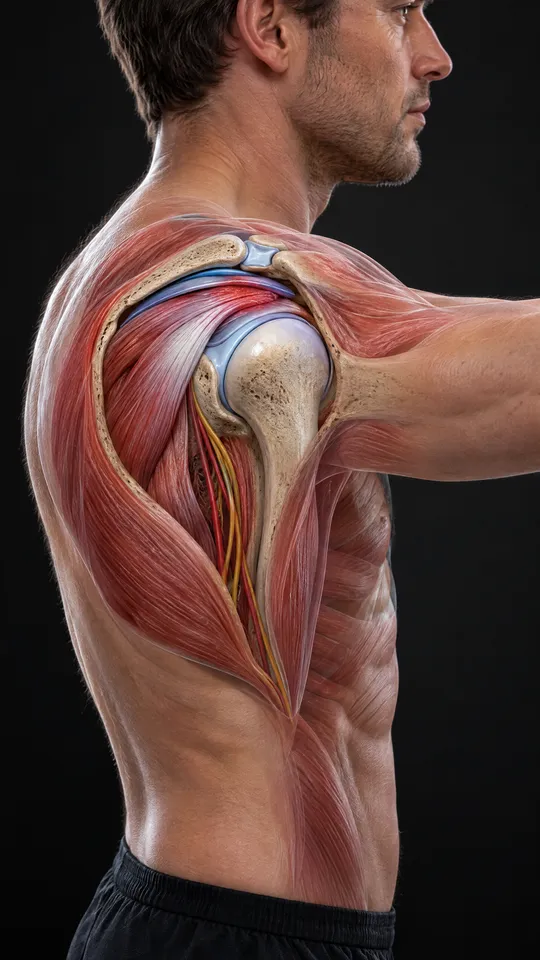
There's a gap at the top of your shoulder called the subacromial space: between the acromion (the bony roof on top of your shoulder blade) and the top of the upper arm bone, with the rotator cuff tendons running through it. Lift your arm and that gap narrows 8.
The plain-English version: a tendon inside your shoulder swells and rubs against tissue or bone, causing pain as you lift your arm. It can come from irritation, injury or plain wear and tear 1.
But that mechanism isn't settled. Clinicians increasingly use subacromial pain syndrome instead, because the impingement label doesn't fully explain what's going on 5. It's an umbrella term for several overlapping things that can hurt in that same space: bursitis, calcific tendonitis, rotator cuff tendinopathy, partial rotator cuff tears, biceps tendinitis 5. The original idea, that the acromion pinches the tendon as the arm lifts, hasn't held up with better imaging, and structure, load and pain don't always line up 5.
In many cases of shoulder pain it isn't possible to find the exact cause, and it's still possible to treat it even when the cause is unknown 2.
What can be worked on is a shorter list. Some factors linked to how it goes aren't modifiable, like age and the shape of your acromion. Others are: how well the rotator cuff and the muscles that steady your shoulder blade work, your posture, and the loads and positions you repeat at work or in sport 5. That modifiable list is what an assessment looks for.
They're not cleanly separable. Subacromial pain syndrome, the more accurate label for what's usually called impingement, already includes rotator cuff tendinopathy and partial rotator cuff tears within it 5. A swollen, irritated tendon and a partially torn one can produce a very similar arc of pain overhead.
Where they tend to diverge is weakness. Pain that stops you lifting is different from an arm that genuinely won't hold a weight. And pain that started at a clear moment (a fall, a heavy lift, a sudden wrench) points somewhere different from pain that crept in over months of overhead work; the Rotator Cuff Tear page covers that side of it. If your main problem is stiffness rather than pain (the shoulder won't go where you send it, particularly turning outwards), Frozen Shoulder is a different picture again. Our rotator cuff exercises guide shows a safe progression.
This is the case for an assessment rather than a label: imaging is only helpful in certain situations, and shoulder problems are often diagnosed on examination alone 2. What you get from it is a clearer picture of which movements and loads to change, which is more use than a better name.
A physio or GP can usually work this out without a scan 1 2. After asking about your symptoms, we press around the shoulder to find tender spots, ask you to move your arm in several directions and test your arm strength 8. If pain stops you lifting the arm yourself, we may gently move it for you to judge how stiff the shoulder is 8. We may also check your neck, in case a pinched nerve there is behind the pain 8.
An X-ray is usually normal with this kind of shoulder pain 8. An MRI or ultrasound gives a better view of the tendons and the tissue around them, and can show inflammation or a tear 8.
The evidence points away from rushing into a procedure and towards a structured, individualised plan. In practice:
A Dutch guideline says training to stabilise the shoulder blade should be part of the exercise programme 5, so retraining it is a reasonable option within a broader programme.
Injection is listed as something some people may be offered if rest and exercise haven't helped on their own 1. Worth knowing first: no subacromial injection approach has been shown superior to another, and the evidence remains unclear 7. Injections are given by a GP, sports physician or specialist: outside physiotherapy scope, so not something we do.
Surgery is listed as an option some people may be offered when rest and exercise haven't helped 1, but the strongest evidence doesn't support rushing to it. In a randomised trial of 210 people including a placebo surgery group, arthroscopic subacromial decompression gave no benefit over placebo surgery, or over exercise therapy, at five years 3. A Cochrane review of rotator cuff repair landed similarly: at 12 months, surgery probably provides little or no pain improvement compared with non-operative care 4, though those participants mostly had small degenerative tears, so it may not apply to traumatic tears, large tears or younger people 4. "No clinically meaningful advantage" isn't "surgery is useless"; it means the case for trying rehab properly first is strong. That decision sits with you and a surgeon, not with us.
An impinged shoulder is treated along The Well Motion Recovery Path™. What moves you up a phase is what the arm can do overhead, not how many weeks have passed.
How long it usually takes. Shoulder impingement usually gets better in a few weeks or months 1. That range comes from patient guidance, not from a study that tracked recovery, and the research behind this page gives nothing more precise. If an injection or surgery is being considered, the doctor providing it sets that part of the timeline.
Shoulder injury prevention has been trialled in sport, and the work risks have been measured. Neither body of research looked at impingement alone:
Get it assessed rather than continuing to manage it yourself if:
Seek immediate medical attention if after an injury the joint looks deformed, you can't use the shoulder at all, the pain is intense, or it swells suddenly 2. Separately: shoulder pain with trouble breathing and chest tightness is a medical emergency: call 000 2.
Most shoulder impingement is none of that, and it usually gets better in a few weeks or months 1. Getting it looked at early mostly saves you months of guessing which movements to avoid.
We start by listening: how it began, what makes it worse, and what it's stopping you from doing. Then we examine the area, explain what we find in plain English, and agree a plan with you. Your first visit is 40 minutes at Engadine and 30 minutes at our other clinics.
We see patients at Engadine, Mount Annan, Narellan and Appin, and at home through our mobile physiotherapy service. If you have private health cover, here's how health fund rebates work for physiotherapy.
Often it settles on its own, usually in a few weeks or months 1. The catch is that both common instincts are wrong: pushing through repeated overhead lifting keeps irritating it, and resting completely can stop it getting better 1. Pain that isn't going away, or is worse at rest, should prompt action 2.
A few weeks or months 1. We won't give you a more precise number, because the sources behind this page don't. And anyone quoting an exact timeframe for your shoulder is guessing. What matters more is whether it's trending the right way.
Most of the time it does resolve 1, but "cure" is the wrong shape of word. No procedure reliably outperforms structured exercise 3. Getting better means changing what's loading the shoulder and rebuilding its capacity, not having something fixed.
Ice is the better-supported first step: up to 20 minutes, two or three times a day 1. Heat isn't mentioned in the impingement guidance we're citing at all. Australian guidance for shoulder pain more broadly allows a hot pack later, after the first few days following an injury, to relax the muscles 2. Treat heat as comfort, not as a treatment for the impingement itself.
There isn't a quick fix. What the evidence supports is unglamorous: change the loads irritating it, keep the shoulder moving, start prescribed exercises early, and use ice for symptom control 1. The fast options people hope for (an injection, a procedure) don't have the evidence to justify going there first 3,7.
Weakness or pain lifting the arm out to the side, reaching behind you, or sleeping on that shoulder. Often after a fall, or after years of overhead work.
Read moreStiffness in every direction, including when someone else moves the arm for you. Comes on gradually and moves through stages.
Read moreSLAP stands for Superior Labrum, Anterior to Posterior. The labrum is the rim of cartilage that deepens your shoulder socket. The long head of the biceps tendon attaches to it at the top, and that's where these tears happen
Read moreA rupture at the shoulder usually follows tendon wear that's been building for a while. Uncommonly, a severely worn tendon gives way altogether
Read moreBiceps tendinopathy is thickening and irritation of the biceps tendon at the front of the shoulder. It often starts without any known injury.
Read moreA dislocated shoulder is the ball at the top of your upper arm bone coming out of its shallow socket. Most often it comes out the front.
Read moreYour AC joint is where the far end of your collarbone meets the top of your shoulder blade. A sprain means the ligaments holding that joint together have been stretched or torn.
Read moreSubacromial bursitis is inflammation of a small, fluid-filled cushioning sac (a bursa) under the bony point at the top of your shoulder
Read more
How would you like to reach us?
Message us on WhatsAppFor bookings and enquiries. Please don't send medical details. Call (02) 8111 5633Request a call-back
Request sent
Thank you. We'll call you back on the number you gave us.
This is a preview, so nothing was actually sent.