Need urgent care? 24/7 Mobile & After-Hours Emergency Physiotherapy Call (02) 8111 5633 For life-threatening emergencies, always call 000
Hamstring

Hamstring Strain

5.0 average rating on Google
Registered NDIS Provider
SIRA Registered Provider

You were most of the way through a sprint (chasing a ball, forty metres into a rep) when something at the back of your thigh pulled up sharp and you had to stop. Maybe you walked off it and by evening it felt almost fine.

That last part is the one worth watching. A strain that feels manageable within a week is exactly the one people rush back from, and rushing back is the biggest reason this injury returns worse than it started.

What's actually causing it

Your hamstrings cross two joints, the hip and the knee. At full sprint stride your hip flexes forward while your knee straightens, so the muscle is lengthened and asked to contract hard at the same moment. Muscles spanning two joints (hamstrings, quadriceps, calf) are injured at much higher rates than muscles spanning one 2.

So the sports that produce it are predictable: sprinting, kicking and high-speed skilled movement, or positions taking the hip into flexion with the knee extended 4: football codes and athletics.

How bad it is comes down to how much has torn. Australian guidance uses an expanded classification from grade 0 to grade 4 2:

GradeWhat it looks like
0–1Focal or small tears, minimal loss of power or function
2Moderate localised tears. Immediate pain, moderate power loss and moderate functional limitation, but no loss of range of motion
3Extensive tears. Significant power loss and functional limitation, and some range can be lost
4Complete tear. Can come with visible deformity in the muscle

One thing to know early: imaging identifies a strain and separates it from tendinopathy, but scans have not been shown to correlate with return to play 11. A scan grades your tissue; it doesn't set your timeline.

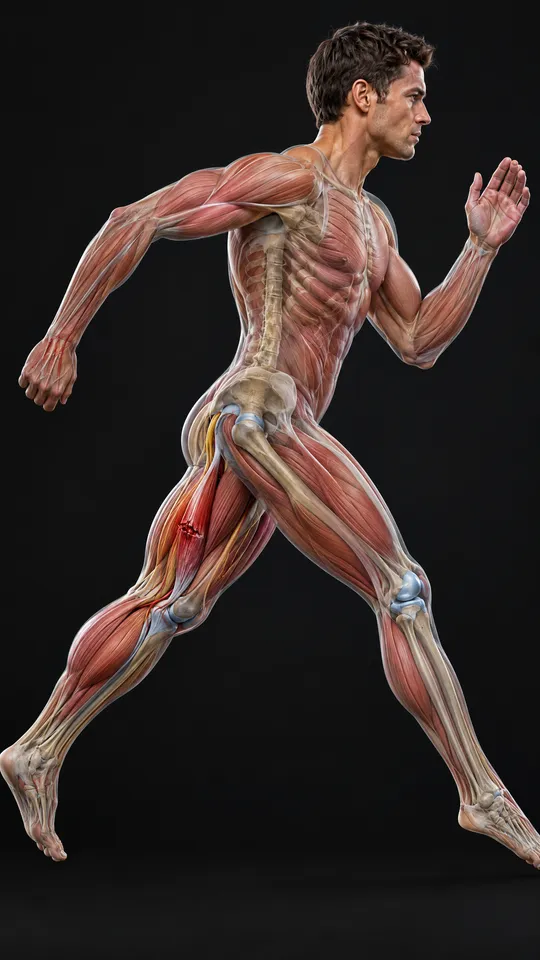
Sprinter with the hamstring muscles shown at the back of the thigh and a small tear in one of them

Hamstring strain or proximal hamstring tendinopathy? How to tell the difference

These two get confused constantly, and they're managed differently.

A strain has a moment. You can name the sprint, the kick, the stride where it happened, and the pain arrived immediately.

Proximal hamstring tendinopathy has no inciting event. It builds from chronic overuse, sits high where the hamstring attaches under the buttock, and bites when you sit, drive or load the leg in deep hip flexion rather than at top speed. It's managed with eccentric strengthening over a longer horizon, not an acute-injury plan 11. If that sounds more like yours, start with proximal hamstring tendinopathy instead.

Posterior thigh pain has other causes, which is why a thorough history and examination matters 11.

How it's diagnosed

When there was a clear moment and sudden pain at the back of the thigh, the examination is less about whether you've strained it and more about where and how badly 3. A clinician tests your hamstring strength against resistance (pain counts as much as weakness), compares how far each leg lifts, and presses along the muscle to find the sorest spot 3. The closer that spot is to your sit bone, the longer recovery tends to take 3.

No clear moment? Then they look for other sources, such as pain referred from the lower back or the sciatic nerve 3. Plain X-rays are of little use unless a piece of bone may have pulled away, and MRI is often kept for severe injuries where a rupture is suspected 3.

How we treat it

The first 48 to 72 hours.

Protection, relative rest, ice, compression and elevation; ice for up to 20 minutes every two to three waking hours 1,2. Then there's the avoid-list: no heat (hot baths, heat packs), no alcohol, no running and no direct firm massage for the first 72 hours, because each can increase swelling 1,2. Pain-relieving medication is a decision for your GP or pharmacist, not us, though it can sometimes disrupt soft-tissue healing 2.

Relative rest, not shutdown.

Avoid what significantly increases your pain, but otherwise stay gently active 2, and keep the leg moving once pain allows so the hamstring doesn't stiffen 1.

Then the part that changes the outcome: progressive loading.

The evidence supports rehabilitation built on neuromuscular control work plus eccentric strength training, alongside objective measures of readiness 3, loading the injury site progressively rather than resting then testing it 12. In elite sprinters and jumpers, a program emphasising lengthening exercises returned athletes in a mean of 49 days against 86 for conventional exercises 5, which is what our exercise prescription and conditioning work is built around.

A return decided by criteria, not a date.

Across nine studies of more than 600 acute hamstring injuries, progression was guided by the athlete's own perception of pain and clearance leaned on subjective assessment; the review concluded the field needs more objective criteria 6. Studies using a standardised active-lengthening test had the lowest reinjury rates, 1.3 to 3.6% 6. Our sports physiotherapy return-to-sport testing runs on that principle: you go back when you pass, not when the three weeks are up.

Other treatments we may use

Manual therapy: timing, not a yes or no.

Direct firm massage is off the table for the first 72 hours because it can increase swelling 1,2. Beyond that, mobilisation and massage are a recognised part of treatment 2. We use manual therapy to help you tolerate loading sooner, never as a substitute for it.

Working into some pain.

Does rehab have to stay strictly pain-free? A randomised trial put it to the test: working up to a pain threshold did not get athletes back faster (median 15 days versus 17, not significant), but it did produce around 15% greater knee-flexor strength at clearance and better fascicle length at two months 8. Reinjuries were identical in both groups, and the trial wasn't powered to detect a difference. So it buys tissue quality, not speed: a conversation, not a rule.

Nordic hamstring exercise, for preventing the next one.

The most-recommended hamstring exercise on the internet, and the evidence is genuinely split. One trial in nearly 600 amateur footballers found significantly fewer injuries in the group doing it, but no difference in how severe they were, at a 91% compliance rate far above real-world 9. A second, in high-school footballers, found the opposite: no reduction in injury rate, but a dramatic cut in time lost 10. Both are real findings. Worth doing, but the benefit is inconsistent across populations, not a guarantee against hamstring injuries.

Injections.

Physiotherapists don't prescribe, administer or arrange injections, so this is just what the research reports: corticosteroid and platelet-rich plasma injection studies have shown mixed results 11.

Your recovery path: Reset, Rebuild, Return

A hamstring strain is treated along The Well Motion Recovery Path™. Each phase ends when the leg passes a test, not when it feels fine.

  • Reset: the first few days. Relative rest, ice, compression and elevation 1,2, then gentle movement as soon as pain allows 1. Expect it to feel better before it is ready for speed. We move you on once you can walk at your normal pace without the pain building.
  • Rebuild: the longest phase. Progressive loading through exercise prescription and conditioning: eccentric strength and neuromuscular control work 3, lengthening exercises 5, then agility and trunk stability drills 13, with manual therapy alongside. We move you on when the leg handles strength work and steady running without pain.
  • Return: sprinting and full training for sport, or the bending and lifting your work asks of you. We test strength, tolerance to lengthening and running load first 3,6. You leave with a prevention program built around the Nordic exercise 13.

How long it usually takes. In one randomised trial, the median time to clearance was 15 to 17 days 8. In another, elite sprinters and jumpers on a lengthening program averaged 49 days, and proximal free tendon tears took significantly longer 5. A complete tear may need surgical repair, with recovery running several months 1. These are single trials in athletes, so yours may differ.

Reducing the risk of it happening again

Hamstring strains are one of the few muscle injuries where prevention has been properly tested:

  • Keep the Nordic in your week. The physiotherapy guideline for hamstring strain gives it the top grade of recommendation, as one part of a programme with a warm-up, strengthening and sprint work 13. One review pooled 15 studies and 8,459 athletes and found that programmes including it roughly halved hamstring injuries 14. A later re-analysis kept only the six trials that randomly assigned players to the exercise, and found the result too uncertain to call 16. A 2026 review of football trials reached the same view 17. So the reviews disagree, and so do the single trials covered above 9 10.
  • Add agility and trunk work to your rehab. The same guideline recommends progressive agility and trunk stability exercises, on top of the stretching and strengthening, to lower the reinjury rate 13.
  • Know your odds. A review of 78 studies found that any previous hamstring strain raised the risk 2.7 times, and a recent one 4.8 times 15. Older age counts too 15. You can't change either. They're the reason not to rush the return.
  • Don't train or play tired. You're more likely to be injured when your muscles are tired 1. After a lay-off, build your fitness back step by step 1.

When to get it checked properly

Most hamstring strains settle with sensible early management and a properly progressed loading program. Get it assessed rather than pushing on alone if:

  • It hurts to walk or stand on the leg, or pain and swelling are getting worse rather than better 1
  • There was a distinct snap or pop, or rapid swelling and bruising came on 1
  • You still can't get the leg moving after the first few days without pain stopping you 1
  • The pain sits very high up, near where the hamstring attaches: proximal free tendon injuries take significantly longer regardless of rehab program 5
  • You're being cleared to return purely because a certain number of weeks has passed

If you felt a snap or pop, or you can't walk on the leg, and it's after hours, a weekend or a public holiday, our after-hours emergency physiotherapy can come to you. Call (02) 8111 5633.

Mild strains often settle within days. More severe ones take weeks to months and usually need a physiotherapist; a complete tear may need surgical repair with recovery running several months 1. Knowing which you're in is worth one appointment.

Your first appointment

We start by listening: how it began, what makes it worse, and what it's stopping you from doing. Then we examine the area, explain what we find in plain English, and agree a plan with you. Your first visit is 40 minutes at Engadine and 30 minutes at our other clinics.

We see patients at Engadine, Mount Annan, Narellan and Appin, and at home through our mobile physiotherapy service. If you have private health cover, here's how health fund rebates work for physiotherapy.

FAQs

How long does a pulled hamstring take to heal up?

Anyone giving you a single number is guessing. Australian guidance puts the average return to play at around three weeks, while noting some studies cite over 100 days 2. In elite sprinters and jumpers, one trial recorded means of 49 days for a lengthening-based program against 86 for a conventional one, with ranges of 18 to 107 and 26 to 140 days 5. Proximal free tendon tears took far longer in both 5.

How to tell if grade 2 or 3 hamstring tear?

Grade 2 is moderate localised tears: immediate pain, moderate power loss, moderate functional limitation, but no loss of range of motion. Grade 3 is extensive tears, with significant power loss, significant functional limitation, and some range can be lost 2. A snap or pop with rapid swelling points to the severe end 1. It's graded by examination, not self-assessment or a scan alone 11.

Can you walk with a grade 2 hamstring tear?

Usually yes, but limited: grade 2 involves moderate power loss and functional limitation without losing range of motion 2. Don't read that as reassurance: walking doesn't make it minor, and if it hurts to stand or walk on the leg, that's a reason to get urgent advice 1.

What should you not do with a pulled hamstring?

For the first 72 hours, avoid heat (hot baths, heat packs), alcohol, running and direct firm massage; each can increase swelling 1,2. After that, the big one: don't return to sprinting because a date has arrived. One review argues the muscle still shows immature scar tissue at the average current return point, that 25% of reinjuries happen in the first week back and at the exact same spot, and that four weeks should be the minimum after a grade 1 or 2 strain 7. That's a position extrapolated from healing-biology studies rather than a guideline (its own authors call the evidence scarce), but it fits the one-in-three reinjury rate seen in the first year 3,4.

Should I stretch or rest a pulled hamstring?

Neither extreme. Relative rest is the middle ground (avoid what significantly increases your pain, otherwise stay gently active 2), and keep the leg moving once pain allows, so it doesn't stiffen 1. Aggressive early stretching isn't the goal; progressive loaded lengthening later in rehab is 5.

Should I rub out a pulled hamstring?

Not in the first few days: direct firm massage is on the avoid-list for the first 72 hours because it can increase swelling 1,2. After that it changes: mobilisation and massage are a legitimate part of treatment 2. A timing distinction, not a blanket no.

More Hamstring conditions

If you've strained a hamstring and the plan you've been given is "rest it for three weeks and see how it feels", that's worth a second opinion: a date is not a criterion, and the reinjury numbers are what they are.

Book an assessment with the Well Motion team at Engadine, Mount Annan, Narellan or Appin, or head back to the Hamstring section of our Injury Finder if you're not yet sure which part of the back of your leg is actually the problem.

Book an Assessment
Ahmed Elsayed, Principal Physiotherapist
Reviewed by Ahmed Elsayed Principal Physiotherapist at Well Motion

References

  1. Hamstring injury. NHS. Page last reviewed 28 July 2025. https://www.nhs.uk/conditions/hamstring-injury/
  2. Sprains and strains. Better Health Channel, Victorian Department of Health: approved with the Australian Physiotherapy Association. Reviewed 02-10-2023. https://www.betterhealth.vic.gov.au/health/conditionsandtreatments/sprains-and-strains
  3. Heiderscheit BC, Sherry MA, Silder A, Chumanov ES, Thelen DG. Hamstring strain injuries: recommendations for diagnosis, rehabilitation, and injury prevention. Journal of Orthopaedic & Sports Physical Therapy, 2010;40(2):67-81. Retrieved from PubMed. https://doi.org/10.2519/jospt.2010.3047
  4. Erickson LN, Sherry MA. Rehabilitation and return to sport after hamstring strain injury. Journal of Sport and Health Science, 2017;6(3):262-270. Retrieved from PubMed. https://doi.org/10.1016/j.jshs.2017.04.001
  5. Askling CM, Tengvar M, Tarassova O, Thorstensson A. Acute hamstring injuries in Swedish elite sprinters and jumpers: a prospective randomised controlled clinical trial comparing two rehabilitation protocols. British Journal of Sports Medicine, 2014;48(7):532-9. Retrieved from PubMed. https://doi.org/10.1136/bjsports-2013-093214
  6. Hickey JT, Timmins RG, Maniar N, Williams MD, Opar DA. Criteria for progressing rehabilitation and determining return-to-play clearance following hamstring strain injury: a systematic review. Sports Medicine, 2017;47(7):1375-1387. Retrieved from PubMed. https://doi.org/10.1007/s40279-016-0667-x
  7. Pieters D, Wezenbeek E, Schuermans J, Witvrouw E. Return to play after a hamstring strain injury: it is time to consider natural healing. Sports Medicine, 2021;51(10):2067-2077. Retrieved from PubMed. https://doi.org/10.1007/s40279-021-01494-x
  8. Hickey JT, Timmins RG, Maniar N, et al. Pain-free versus pain-threshold rehabilitation following acute hamstring strain injury: a randomized controlled trial. Journal of Orthopaedic & Sports Physical Therapy, 2020;50(2):91-103. Retrieved from PubMed. https://doi.org/10.2519/jospt.2020.8895
  9. van der Horst N, Smits DW, Petersen J, Goedhart EA, Backx FJG. The preventive effect of the Nordic hamstring exercise on hamstring injuries in amateur soccer players: a randomized controlled trial. American Journal of Sports Medicine, 2015;43(6):1316-23. Retrieved from PubMed. https://doi.org/10.1177/0363546515574057
  10. Hasebe Y, Akasaka K, Otsudo T, Tachibana Y, Hall T, Yamamoto M. Effects of Nordic hamstring exercise on hamstring injuries in high school soccer players: a randomized controlled trial. International Journal of Sports Medicine, 2020;41(3):154-160. Retrieved from PubMed. https://doi.org/10.1055/a-1034-7854
  11. Chu SK, Rho ME. Hamstring injuries in the athlete: diagnosis, treatment, and return to play. Current Sports Medicine Reports, 2016;15(3):184-90. Retrieved from PubMed. https://doi.org/10.1249/JSR.0000000000000264
  12. Hickey JT, Opar DA, Weiss LJ, Heiderscheit BC. Hamstring strain injury rehabilitation. Journal of Athletic Training, 2022;57(2):125-135. Retrieved from PubMed. https://doi.org/10.4085/1062-6050-0707.20
  13. Martin RL, Cibulka MT, Bolgla LA, et al. Hamstring Strain Injury in Athletes. Journal of Orthopaedic & Sports Physical Therapy Clinical Practice Guideline, 2022;52(3):CPG1-CPG44. PMID 35164536. https://www.jospt.org/doi/10.2519/jospt.2022.0301
  14. van Dyk N, Behan FP, Whiteley R. Including the Nordic hamstring exercise in injury prevention programmes halves the rate of hamstring injuries: a systematic review and meta-analysis of 8459 athletes. British Journal of Sports Medicine, 2019;53(21):1362-1370. PMID 30808663. https://pubmed.ncbi.nlm.nih.gov/30808663/
  15. Green B, Bourne MN, van Dyk N, Pizzari T. Recalibrating the risk of hamstring strain injury (HSI): a 2020 systematic review and meta-analysis of risk factors for index and recurrent hamstring strain injury in sport. British Journal of Sports Medicine, 2020;54(18):1081-1088. PMID 32299793. https://pubmed.ncbi.nlm.nih.gov/32299793/
  16. Impellizzeri FM, McCall A, van Smeden M. Why methods matter in a meta-analysis: a reappraisal showed inconclusive injury preventive effect of Nordic hamstring exercise. Journal of Clinical Epidemiology, 2021;140:111-124. PMID 34520846. https://doi.org/10.1016/j.jclinepi.2021.09.007
  17. Hong B, Hong X, Lin H, Yang Z, Feng J. Comparative effectiveness of exercise interventions for hamstring injury prevention in football players: a systematic review and network meta-analysis. Sports Medicine - Open, 2026;12(1). PMID 42742879. https://doi.org/10.1186/s40798-026-01087-w