Knee
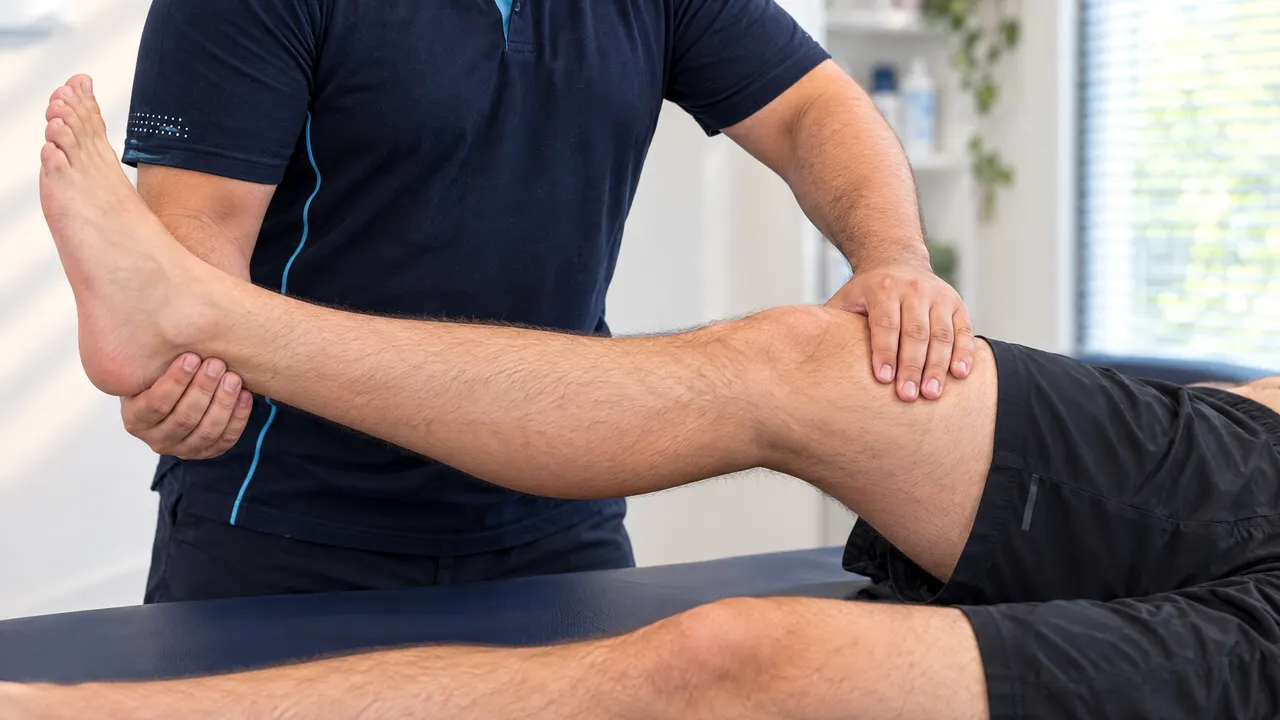
ACL injuries, meniscus tears, ITB syndrome in runners and cyclists, and Osgood-Schlatter disease in growing teenagers
You rolled an ankle at training back in March, sat out six weeks, and it felt fine by the time you were back on the field. Then it went again in the first month of the new season. The rest let the pain settle; it just never dealt with the reason it happened in the first place.
That's the gap this service exists to close. We work out what caused the injury, then build your way back around your sport, your position and the training load you're returning to, not a generic timeline pulled off the internet. If you play, train or compete in southern or south-west Sydney, sports physiotherapy with us starts at whichever of our four clinics is closest to where you train.
The first session is mostly questions and assessment, not treatment. We want to know what you play, what position, how many sessions a week, what the injury felt like when it happened, and what you were doing in the weeks before it, because a hamstring that goes in round three after a light pre-season is a different problem to one that goes in round eighteen.
Then we assess. That means looking at how the injured area moves and loads, but also at what's happening above and below it. A knee that keeps flaring up under load is often a hip and ankle story as much as a knee one.
You leave with a clear explanation of what we found, what we think caused it, a realistic sense of how long it's likely to take, and what has to happen before you're back playing.
Most of the frustrating sports injuries we see aren't mysteries. They're the predictable result of a load the tissue wasn't ready for, a movement pattern that puts stress somewhere it shouldn't go, or a previous injury that was rested rather than rehabilitated.
Your program is built to change that, and it progresses on what you can do rather than how many weeks have passed. Early on that might be settling pain and keeping you moving. Later it's loading the injured tissue deliberately and progressively, then rebuilding the specific qualities your sport demands: sprinting, changing direction, jumping and landing, kicking, contact. We call those three stages The Well Motion Recovery Path™: Reset, Rebuild, Return.
This isn't just a preference for being thorough. In a two-year study following people back into pivoting sport after knee reconstruction, those who passed a set of strength and hopping targets before returning had a reinjury rate of 5.6%, compared with 38.2% among those who returned without meeting them 1. Same surgery, same sports: the difference was whether the decision to return was made on measurable criteria or on something less specific.
The last stage is the one most commonly skipped: doing those things at full intensity, under fatigue, before you're cleared. Returning to play when you feel fine at 70% is how re-injury happens.
Knee, hamstring, calf and groin problems make up a large share of what walks through the door from field and court sport:
ACL injuries, meniscus tears, ITB syndrome in runners and cyclists, and Osgood-Schlatter disease in growing teenagers
hamstring strains and calf strains, the two most likely injuries to recur if the return was rushed
Achilles tendinopathy, which responds to loading rather than rest
osteitis pubis, common in footballers and anyone with a heavy kicking or change-of-direction load
including a corked thigh, which is more straightforward to manage well early than to unpick weeks later
If you need short-term support to get through a game or a training block while the underlying work continues, sports taping is a tool we use inside a plan, not instead of one. Our guide to sports taping explains where it helps. Some athletes also use dynamic cupping therapy alongside their exercise plan.
Returning to sport after a reconstruction is its own process, measured in months rather than weeks, and it has stages that can't be compressed. After an ACL reconstruction in particular, the gap between "the knee feels good" and "the knee is ready for competitive change of direction" is wide, and closing it is most of the work.
Time matters here too, alongside the criteria. In the same two-year cohort, the reinjury rate fell by roughly half for every additional month that return to sport was delayed, up to about nine months after surgery 1. That's a hard thing to hear at month five when the knee feels good, which is why we're specific about the targets you need to hit before each progression and don't leave it to how you feel on the day.
We run that alongside your surgeon's protocol, not in competition with it. Our post-surgical rehabilitation page covers the broader recovery process after an operation.
You don't have to be injured to come in. A movement screen looks at how you squat, hinge, land, balance on one leg and control your trunk under load, and it's usually good at highlighting the obvious asymmetries and restrictions worth addressing before a season rather than during one.
It's particularly worth doing if you've had a significant injury before, or if you're ramping up running volume, where most problems come from the size and speed of the increase rather than the running itself.
Being pain-free and being ready to perform aren't the same standard. Once you're through rehabilitation, the same assessment and programming can keep going: building strength, power, speed and the capacity to handle your training week without breaking down.
For a lot of people, that's the part that finally stops the cycle of recurring niggles: it addresses the capacity gap underneath rather than the most recent flare-up.
Compression therapy (the inflatable boots or sleeves that squeeze the limb in a repeating cycle) has become a fixture in gyms and clubrooms. We use it, and we'll tell you plainly what the evidence supports.
A 2024 review pooling 17 studies found lower-limb intermittent pneumatic compression (IPC) had a trivial-to-small benefit for muscle function, a trivial-to-moderate effect on pain and soreness, and a highly variable effect on markers of muscle damage, concluding it mainly helps with how sore you feel, with most protocols running about 20 to 30 minutes 2. A 2025 review went further, finding moderate-certainty evidence that it did not reduce muscle soreness at 24 hours after exercise 3. So the evidence is mixed, and we'd rather tell you that than sell it harder than it deserves.
Which lands here: worth using, pleasant, and reasonable to include between heavy sessions or in a congested fixture period. Not a treatment for an injury, and not a substitute for the loading work that gets you back playing.
You can book at Engadine, Mount Annan, Narellan or Appin. We also see patients across the Sutherland Shire, where a lot of our sports work happens close to the clubs and ovals people train at.
The underlying training is the same. The difference is focus: sports physiotherapy is built around getting you back to a specific activity at a specific intensity, so the assessment looks at sporting demands and the endpoint is a set of return-to-play criteria rather than just being pain-free. Our general physiotherapy page covers the broader scope.
Usually not by default. Medicare only contributes in specific circumstances that have to be arranged through your GP, and most sports injuries won't meet them. Private health insurance is the more common route. Our physiotherapy page explains how the Medicare side works in full.
It depends on the clinic and on what your appointment involves, and an initial assessment is usually priced differently to a follow-up. Ask us when you book. We'd rather tell you upfront than have you guessing.
Not by the date. You should be able to do the specific things your sport demands (sprint, cut, land, kick, take contact) at full intensity and while fatigued, with strength on the injured side close to the other side. Those targets aren't arbitrary: people who meet them before returning are reinjured far less often than people who don't 1. If the boxes aren't ticked, "it feels fine" isn't enough information to go on.
They mostly help with how sore you feel, and the effect is modest: one review found a small benefit for perceived soreness 2, another found no reduction in soreness at 24 hours 3. That can still be worth having when you've got another game in four days, but it's not the same as healing faster, and it won't do anything about the cause of an injury.
How would you like to reach us?
Message us on WhatsAppFor bookings and enquiries. Please don't send medical details. Call (02) 8111 5633Request a call-back
Request sent
Thank you. We'll call you back on the number you gave us.
This is a preview, so nothing was actually sent.