Plantar Fasciitis
Sharp heel pain that's at its worst on your first few steps out of bed, settles once you get moving, then comes back after sitting or a long day on your feet.
Read moreYour child's been complaining their heel hurts after footy training, or you've noticed them limping or walking on their toes after sport, and it's happening often enough that you're wondering if it's something more than growing pains. If your child is somewhere between about 8 and 14, there's a good chance you're dealing with Sever's disease, and the reassuring news first: it's extremely common, it's not actually a disease in the serious sense of the word, and it resolves completely once your child finishes growing.
During a growth spurt, a child's bones can lengthen faster than the muscles and tendons attached to them can keep up. That tightens the calf muscles and Achilles tendon, which increases the pull on the growth plate at the back of the heel bone every time your child runs or jumps. Enough repetition of that pulling force, and the growth plate becomes irritated. That's the heel pain you're seeing.
It's genuinely one of the most common causes of heel pain in active children, particularly those playing running- and jumping-heavy sports like football, basketball or ballet. Risk factors include a sudden jump in activity level, tight calf muscles, flat feet or high arches, and worn-out or poorly cushioned shoes1. It's worth knowing this sits right at the intersection of two areas we work in: genuinely a paediatric presentation since it only happens in growing bones, but also very much a sports physiotherapy one given how closely it's tied to your child's training load and sport.
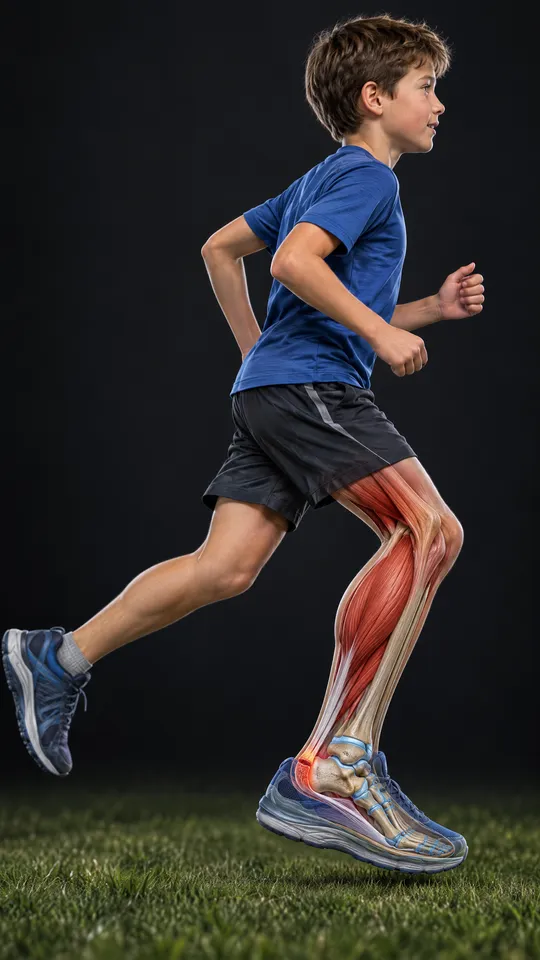
The reassuring part: this usually doesn't need an X-ray. The classic test is simple: gently squeezing the back of the heel from both sides reproduces the pain, along with discomfort when your child stands up on their toes. Imaging is really only needed if the presentation doesn't fit the usual pattern, or there's been an actual injury behind the pain rather than gradual onset1.
Being upfront with you: the research quality behind some of the common treatments for Sever's disease is genuinely mixed, and we'd rather tell you honestly what's better and less supported than present everything as equally proven.
Worth knowing honestly: the researchers behind that same review noted the evidence overall is still limited, and called for larger, better-quality studies2, which is exactly why an actual assessment matters more than a generic one-size-fits-all approach off a website.
A few practical things genuinely help while your child's heel settles down:
Sever's disease itself isn't dangerous, and it isn't something to panic about. But get your child properly assessed rather than assuming it's "just growing pains" if:
None of those necessarily mean something serious; they just mean it's worth ruling out something else before assuming it's Sever's disease.
We start by listening: how it began, what makes it worse, and what it's stopping you from doing. Then we examine the area, explain what we find in plain English, and agree a plan with you. Your first visit is 40 minutes at Engadine and 30 minutes at our other clinics.
We see patients at Engadine, Mount Annan, Narellan and Appin, and at home through our mobile physiotherapy service. If you have private health cover, here's how health fund rebates work for physiotherapy.
Most children recover fully within 2 to 3 years as the growth plate matures and fuses, and importantly, it doesn't cause any long-term problems once it resolves. That timeline can feel long if your child's mid-season right now, which is exactly why managing load properly in the meantime matters, rather than just waiting it out.
Often yes, in a modified way: complete withdrawal from sport usually isn't necessary unless symptoms are severe. The aim is finding the level of activity your child's heel can currently tolerate, then adjusting as things settle, rather than an all-or-nothing choice between full training and none at all.
Usually not. Sever's disease is typically diagnosed with a simple physical examination. Imaging is generally only used if something about the presentation doesn't fit the usual picture.
Sharp heel pain that's at its worst on your first few steps out of bed, settles once you get moving, then comes back after sitting or a long day on your feet.
Read morePain, swelling or bruising across the middle of your foot after a fall, an awkward landing or a twist, and a midfoot that still doesn't want to take your weight.
Read moreIt's a thickening of the tissue around one of the nerves between your toes, after that nerve has been irritated or damaged.
Read moreTurf toe is the sporting name for a sprain of the big toe joint: the structures underneath get overstretched or torn when the toe is forced upwards.
Read moreMetatarsalgia is a general term for pain around the joints at the base of your toes, a group of conditions rather than a single one. Which one you have changes what helps.
Read moreA stress fracture is a fine crack in a bone from repeated loading without enough recovery between efforts, not a one-off injury. In the foot and lower leg it's the most common form of hairline fracture, usually from jogging or running.
Read moreCuboid syndrome is pain on the outer midfoot, thought to come from a subtle disruption of the joint between the cuboid (a small bone on the outside of your foot) and your heel bone. The exact mechanism hasn't been worked out.
Read moreTarsal tunnel syndrome is compression of the tibial nerve as it runs behind your inner ankle, under a band of tissue called the flexor retinaculum.
Read moreA heel spur (calcaneal spur) is a small outgrowth of bone on the heel bone. It can form on the underside or at the back.
Read moreA bunion (hallux valgus) is a bony lump at the big toe joint that forms when the big toe leans towards the other toes. Around 23% of adults have one.
Read more
How would you like to reach us?
Message us on WhatsAppFor bookings and enquiries. Please don't send medical details. Call (02) 8111 5633Request a call-back
Request sent
Thank you. We'll call you back on the number you gave us.
This is a preview, so nothing was actually sent.