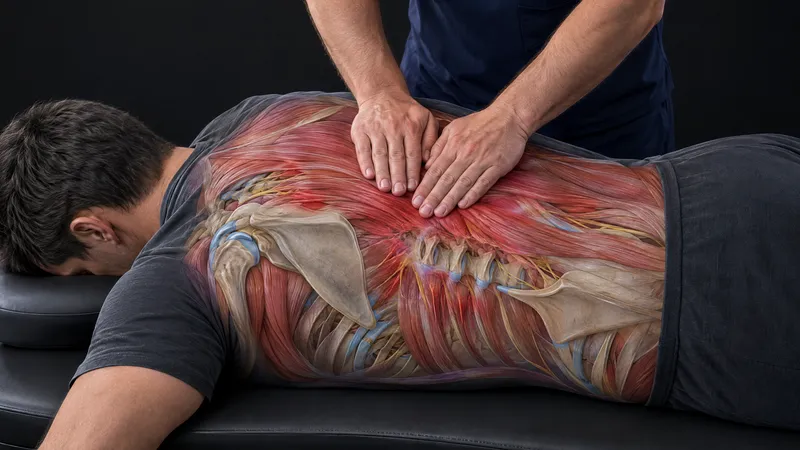
The three kinds of hands-on work
"Manual therapy" is an umbrella term, not a single technique. Underneath it sit three broad families 1.
Joint mobilisation. Your physio moves a stiff joint passively, within its normal range of movement 1. The force is slow and controlled, the size of the movement varies, and there's no thrust 4. It's controlled and repeated, not sudden, and it's the one most people have had without knowing it had a name.
Manipulation. A small, quick thrust that takes a joint slightly beyond its passive range: the "high-velocity, low amplitude" end of the same spectrum 4. Some people hear a pop. It's easy to read that as something going back into place, but "putting it back in place" is the part of the traditional story the evidence has moved away from, as we'll get to below 1. Spinal manipulation is delivered by several kinds of clinician 3, and physiotherapists are among them 5.
Soft-tissue work. Hands-on pressure that strokes, kneads or presses muscle and the soft tissue around it 1, usually where an area has tightened or started guarding around an injury. healthdirect lists massage, joint manipulation and stretching side by side as things a physiotherapist may do in an appointment 5. That's a useful reminder that these are techniques within a profession, not competing professions.
What ties all three together is that they're passive. The formal description in the research literature is "a passive, skilled movement applied by clinicians" intended to change some part of your pain experience 2. Passive here means you're not producing the movement, which matters more than it sounds, and we'll come back to it.
Manual therapy vs massage: what's different
There's real overlap, and anyone who tells you the two have nothing in common is overstating it. Soft-tissue work looks and feels a lot like massage, and healthdirect lists massage as one of the things a physiotherapist might do 5.
Two things separate them in practice.
The first is assessment. Manual therapy is described in the research as a process grounded in clinical reasoning 2. The hands-on part follows a working diagnosis: what's stiff, what's guarding, where in the range it hurts, and what that pattern suggests. The technique is chosen for that finding, and changed when the finding changes.
The second is what's included. Joint mobilisation and manipulation are techniques applied to a joint rather than to muscle, and they sit inside manual therapy alongside soft-tissue work 1. Remedial massage therapists do skilled soft-tissue work; the joint techniques are the part of manual therapy that goes beyond soft tissue.
Neither of those makes one better than the other. They're not competing for the same job. But if what's limiting you is a joint that won't move through its range, soft-tissue work alone isn't aimed at that problem.
Why it probably doesn't work the way you think
This is where the usual explanation falls down.
The traditional explanation was mechanical: a joint had moved out of position and was put back, an adhesion was broken up, "normal" movement was restored. It's intuitive, and it's still the story you'll hear most often.
The evidence has moved away from it. One published research model is direct: hands-on treatment does move tissue for a moment, but no lasting change in position has been shown. Instead, the mechanical force "initiates a cascade of neurophysiological responses" in the nervous system, and those are what produce the result 1. Expectation and other psychological factors may play a part too 1.
In plain English: the change you feel after hands-on treatment is likely to be less about the structure being physically rearranged, and more about what the input does to your nervous system: how sensitive the area is, how much your muscles are guarding, how threatening the movement feels once you've experienced it not hurting.
And nobody is pretending this is finished. The research describes biomechanical, neurophysiological, psychological and non-specific factors all acting together, and states that there's "a crucial need to advance our understanding of the underlying mechanisms" behind why manual therapy works when it works 2.
That's not a reason to be cynical about it. It's a reason to be suspicious of any explanation that comes with total confidence.
Does manual therapy actually work?
Yes, modestly, for some problems, and mostly in the short term. Here are the numbers, because they matter more than the adjective.
For recent low back pain, a 2017 review pooled 15 randomised trials covering 1,711 people and found moderate-quality evidence that spinal manipulation improved pain over the first six weeks, by a pooled average of about 10 points on a 100-millimetre scale (95% CI −15.6 to −4.3). Twelve trials covering 1,381 people gave moderate-quality evidence of improved function. The authors' own word for the effect was "modest," and they stated that "heterogeneity in study results was large" 3, meaning the trials disagreed with each other a lot, so the average hides a wide spread.
For long-standing low back pain, a 2018 review pooled nine trials covering 1,176 people and found moderate-quality evidence that manipulation and mobilisation reduced both pain and disability compared with other active treatments. One detail matters here: when mobilisation was looked at on its own, it significantly reduced pain but did not significantly reduce disability 4. Feeling better and functioning better aren't the same outcome, and they don't always move together.
Two limits on all of that. Both reviews are about the low back: that's where the strongest evidence sits, and we're not going to stretch those numbers to cover necks, headaches or jaws. And trials comparing these techniques against a sham or against no treatment at all were too few and too varied to pool 4, which is a real gap, not a technicality.
On combining treatments, the evidence is cautious, not conclusive. The 2018 authors concluded that multimodal programs (hands-on work combined with other treatment) "may be a promising option" 4. The 2017 review, on the other hand, couldn't explain its spread of results by whether manipulation was given alone or as part of a package 3. "May be promising" is the fair summary.
Hands-on work plus exercise: why the combination matters
Go back to that word passive. Manual therapy is something done to you 2, which is what makes it useful early (you can't mobilise your own stiff joint, or talk a guarding muscle out of guarding) and why we don't treat it as the whole plan.
The way we think about it at Well Motion is that hands-on work opens a window. It brings the pain down and gives you range you couldn't produce on your own. What decides whether the change holds is what you do inside that window: the loading and movement work that teaches the area to tolerate what it couldn't tolerate before. That's what exercise prescription is for. It's a clinical judgement about what each part does, backed by a research "may" 4 rather than a settled verdict.
Other hands-on techniques sit alongside manual therapy; they don't replace it. Dry needling, for instance, targets one specific tight point in a muscle (a narrower job than mobilising a joint through its range), so the two often get used in the same session on different parts of the same problem.
If you want the specifics of how we decide whether to use hands-on work on a given day, and what a session looks like, that's on our manual therapy page.
What it feels like, and how you'll feel afterwards
During the session you'll usually feel pressure, stretch, or a firm sustained hold. Some of it is comfortable. Some of it is the kind of discomfort that eases while it's happening. There's no need to grit your teeth through it. Say so when something hurts. A good physio will adjust or stop.
Afterwards, some soreness is common and normal. In large case series, minor effects (increased pain, muscle stiffness, headache) were reported 50% to 67% of the time, and the researchers describe them as transient 3. That's a majority, not a rare side effect, and we'd rather you knew that going in than wondered whether something had gone wrong.
The reassuring half of that same review: across every randomised trial included, no serious adverse event was reported 3. The 2018 review reached the same conclusion, describing both manipulation and mobilisation as appearing safe 4.
None of that replaces being assessed first. Hands-on work isn't appropriate for everyone or for every stage of an injury, which is why it should follow an assessment rather than start one.
When hands-on treatment isn't the answer
There are situations where more hands-on work is the wrong response, and they're worth recognising in yourself.
When nothing has changed. If several sessions of hands-on treatment haven't shifted your pain or your range, repeating it isn't a plan. That result is information: it usually means the thing limiting you isn't stiffness or tissue guarding at all.
When the problem is strength or load tolerance. Hands-on work doesn't build capacity. If your knee gives way on stairs or your shoulder fails at a certain weight, no amount of mobilising changes that, and the active part of the plan needs to be doing the heavy lifting.
When relief keeps expiring. Needing the same treatment every week to stay functional is a sign the underlying capacity problem hasn't been addressed. That's the point where the active side of the plan needs to take over.
When you haven't been assessed. Booking a technique rather than an assessment means somebody has decided what's wrong with you before looking, and manual therapy is meant to rest on clinical reasoning about your particular problem 2.
Talk to someone about your specific problem
General information only goes so far. If something has been stiff or sore for longer than it should have been, the useful next step isn't picking a technique, it's getting the area assessed, so the right one gets chosen, and so you find out early if hands-on work isn't the answer at all.
Book an appointment at Engadine, Mount Annan, Narellan or Appin, or call (02) 8111 5633, and we'll work out together what's actually limiting you.
Engadine
996 Old Princes Hwy, Engadine NSW 2233
Mount Annan
Shop 11/13 Main St, Mount Annan NSW 2567
Narellan
22 Sharman Cl, Harrington Park NSW 2567
Appin
49 Appin Rd, Appin NSW 2560
FAQs
Is manual therapy the same as physiotherapy?
No, it's one part of it. In Australia, physiotherapists must be registered with the Physiotherapy Board of Australia, and must be qualified, insured and undertaking continuing professional education 5. Hands-on techniques like massage, joint manipulation and stretching sit in that same toolkit alongside exercise prescription 5. So "manual therapy" describes a group of techniques used within physiotherapy, not a separate profession you'd see instead of a physio. You may see "manual therapist" used as a job title overseas; here, the person doing it is your physiotherapist.
Is manual therapy the same as chiropractic?
They're different professions with different training that share some techniques. Spinal manipulation in particular is delivered by more than one kind of clinician, and in the 2017 review of recent low back pain, the spread of results wasn't explained by which type of clinician performed it 3. The difference is less about the individual technique than about the wider approach around it: what gets assessed, what else is in the plan, and what the treatment is building toward. A physiotherapist's toolkit covers hands-on treatment, stretching and exercise prescription 5.
Can a physiotherapist realign your spine?
Not in the way the phrase suggests, and that's not false modesty. The idea that a vertebra slips out of position and gets pushed back is the mechanical model the evidence has largely moved away from; the leading research model now points to nervous-system responses and psychological factors instead 1. What a physiotherapist can do is restore movement at a joint that isn't moving well, reduce the pain and guarding around it, and help you keep that range. That's a real change. It just isn't realignment.
What are the potential downsides of manual therapy?
The common one is feeling sore afterwards, and "common" is the right word. Minor, transient effects such as increased pain, muscle stiffness or headache were reported 50% to 67% of the time in large case series 3. Serious harm is a different matter: no serious adverse event was reported in any of the randomised trials included in that review 3, and the 2018 review of longer-standing back pain concluded that manipulation and mobilisation both appear safe 4. The other real downside is opportunity cost: if hands-on work is the whole plan, you can spend months feeling temporarily better without building the capacity that would keep you that way.