Mobile & In-Home Physiotherapy
Three days after a knee replacement, the front steps are the whole day's project. A parent who stopped driving two years ago isn't going to make a 9am in Engadine. A flare-up that makes sitting in a car for forty minutes worse than the appointment is good: that's a real reason to skip care, and plenty of people do.
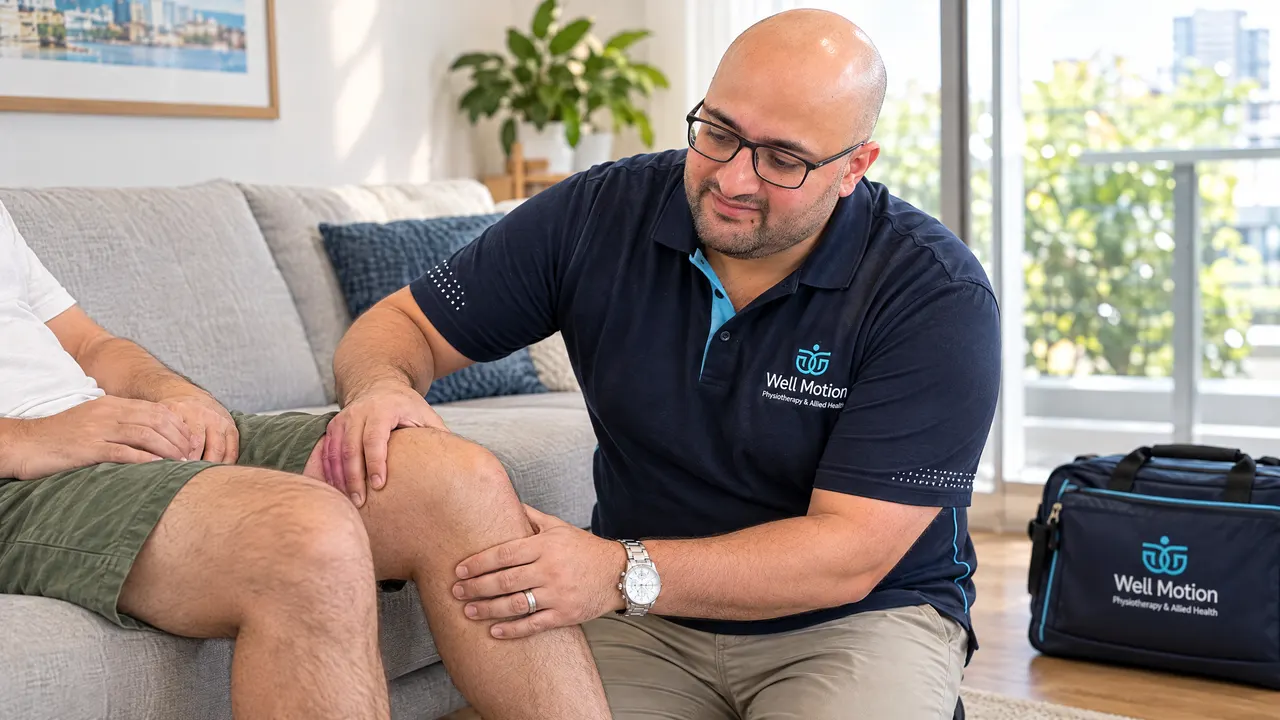
Mobile and in-home physiotherapy is a full physiotherapy appointment, delivered where you already are. Your lounge room, your bedroom, your own hallway. Same physiotherapist, same assessment-first structure, same plan you'd get in a treatment room. We just bring it to you. We visit homes in four parts of Sydney: the Sutherland Shire, Macarthur and Camden, South-West Sydney and Western Sydney.
Distance shouldn't decide whether you get proper care.
What a home visit looks like
Every Well Motion appointment follows the same seven-step structure, whether you're on a treatment table at Mount Annan or sitting on the edge of your own bed. Coming to you changes the setting, not the standard.
We listen first. Your symptoms, your health history, what you've already tried, what your days demand, and what you want to get back to. If a family member or carer is involved in your recovery, they're welcome to be part of that conversation: often they've noticed things worth hearing.
We assess you where you live. This is where a home visit earns its place. In a clinic we ask you to describe the step you're struggling with; at home we watch you do it. The real stairs, the real chair height, the real distance from the bed to the bathroom at 2am. We'll take you through the movements and tasks that matter to your problem, in the environment you have to manage.
We explain what we've found. In plain English: what's likely driving your symptoms, what's contributing to it, and why it hasn't settled. You can ask questions the whole way through, and we'd rather you did.
We treat. Depending on what the assessment shows, that can include hands-on treatment, movement retraining, exercise therapy, and practical changes to how you're getting through your day. This is the part telehealth can't do: if your plan needs someone's hands on you, a home visit is how that happens without the drive.
You get a personalised plan. Treatment priorities, what to expect at each stage, and what we'll reassess. Your plan goes to your phone and inbox, and your exercises are set up online with clear instructions, same as every other Well Motion patient. If anything's unclear afterwards, message us and we'll walk you through it.
We reassess. Next visit we check what's changed. If you're not improving the way we expected, we review the plan and talk about what's next.
Built around the space you have to recover in
The point isn't convenience. It's that for a lot of people, home is where the problem lives, so it's the most useful place to assess and treat it.
After surgery. The weeks straight after an operation are when consistent rehab matters most and travel is hardest. A home visit means post-surgical rehabilitation starts on schedule rather than whenever someone's free to drive you, and it means we can set up your environment properly: how you're getting in and out of bed, how you're managing the steps, what to move out of the way before it trips you.
Being cared for at home, or in aged care. For older adults, the gap between what you can do in a clinic gym and what you can do in your own kitchen is the whole problem. Assessing balance, transfers and falls risk in the room where a fall would happen gives us something a clinic assessment can't.
Simply at home. Not every reason has to be medical. A carer role you can't step away from, a condition that makes the trip cost more than it's worth, shift work, no car, or a suburb that's a long way from anywhere. Those are all sound reasons, and none of them should end with you managing an injury on your own.
Whatever brings us out, the standard doesn't move. Same clinician, same whole-person approach, same honest explanation of what we find, and the same willingness to tell you when something needs a different kind of attention.
Claiming and funding
If you're claiming through private health, we bring HICAPS with us: your rebate is processed on the spot at the end of the appointment, exactly as it would be at reception. You pay the gap, not the full amount up front.
If you're an NDIS participant, home and community visits are part of what NDIS physiotherapy with us looks like, and that page covers how funding and plan management work.
Mobile, telehealth or in-clinic
Three ways to be seen, and they're different tools, not tiers.
A home visit is for when you need someone physically there: hands-on treatment, a proper in-person examination, or an assessment of the environment itself.
Telehealth is a video consultation. No travel for anyone, which makes it well suited to progress reviews, exercise technique questions and flare-up problem-solving, but there's no hands-on treatment in it.
In-clinic at Engadine, Mount Annan, Narellan or Appin gives us the full setup: equipment, space, and everything in one room.
Plenty of people use more than one. A home visit while you're least mobile, a telehealth review a fortnight later, then into the clinic once the drive stops being the problem. That's a normal shape for a plan.
To be clear, mobile visits are booked appointments, scheduled in advance. Our 24/7 emergency mobile service is a separate thing entirely: that's for an acute problem after hours that can't wait until morning.
Where we travel
Mobile and in-home physiotherapy extends well past the four clinics, across four regions:
- Sutherland Shire
- Macarthur & Camden: Camden, Campbelltown, Gregory Hills, Harrington Park, Oran Park and surrounding suburbs
- South-West Sydney: Liverpool, Casula, Austral, Moorebank, Prestons, Edmondson Park and surrounding suburbs
- Western Sydney: Fairfield, Cumberland, Parramatta and Blacktown
Check the full list of suburbs we cover to find yours.
Conditions we treat
FAQs
Do you come to my home for physiotherapy?
Yes, that's what mobile and in-home physiotherapy is. We travel to you and run a full appointment in your own space, whether that's your home after surgery, where you're being cared for, or simply where it's easiest for you to be seen.
Which suburbs do you cover for mobile physiotherapy?
Mobile visits reach across four regions: Sutherland Shire, Macarthur and Camden, South-West Sydney and Western Sydney. The service areas page has the full suburb list, which is the quickest way to check whether yours is on it.
Can I claim a mobile physiotherapy visit through my health fund?
If you have private health cover with physiotherapy included, yes: we carry HICAPS, so your claim is processed at the end of the appointment and you only pay the gap. NDIS funding is covered on the NDIS physiotherapy page.
What's the difference between mobile physiotherapy and your 24/7 emergency service?
Timing and urgency. A mobile appointment is planned: you book it, we come to you during normal appointment hours, and it's for ongoing or scheduled care. The 24/7 emergency service is for something acute that's happened after hours and can't reasonably wait. If you're not sure which you need, book the mobile appointment and say what's going on.