A properly fitted brace.
Recommended in the first six weeks alongside load modification and stretching 2: a load-sharing device, not a painkiller.
It usually starts with something small. Lifting a full kettle. Turning a doorhandle. A sharp catch on the outside of your elbow that wasn't there last month, with no single moment you can point to.
You probably don't play tennis either. Most people who get it don't. It turns up in tradespeople, office workers, gardeners and new parents, anyone whose hands have been working harder than usual.
The muscles that lift your wrist and straighten your fingers start above your elbow and funnel into one shared tendon, attaching to the outside of your upper arm bone. Every time you grip, type or carry a shopping bag, that attachment takes load. Tennis elbow (clinically, lateral epicondylitis) is what happens when it's asked to do that too often 1. The triggers are ordinary: tennis and rowing, but also screwdrivers and hammers, typing, painting and plumbing 1.
This is what changes the treatment. In most people with elbow tendinopathy, the tendons are not inflamed or swollen 2. True inflammation (tendinitis) starts suddenly; tendinopathy builds over much longer 2. What's happening instead is microtearing leading to scarring: an overuse problem, not an inflammatory one 5. That's why "take an anti-inflammatory and rest it" so often runs out of road.
It's common (roughly 2 in 100 people aged 30 to 65 1) and more likely if you smoke or do two or more hours of repetitive movement a day 6.
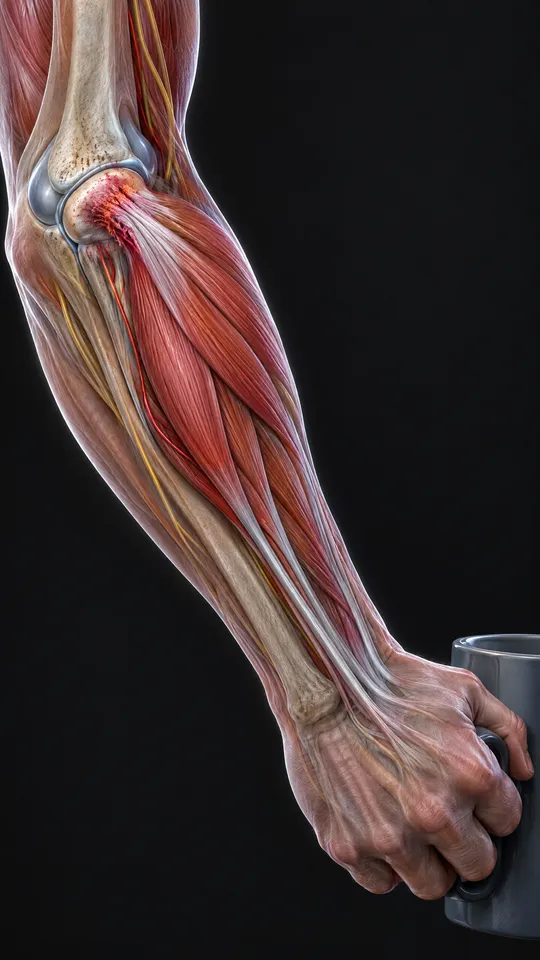
Same problem, opposite sides of the same joint. The quickest way to tell them apart is where it hurts. Tennis elbow is the tendon on the outside, the muscles that pull your wrist backwards 2. It bites when you grip, lift with your palm down, or turn a doorhandle.
Golfer's elbow is the tendon on the inside instead 2, same mechanism and timeline, different muscle group, so different exercises. You can have both at once, and plenty of people do.
Tennis elbow is diagnosed from your story and an examination. No scan to start with. Your doctor will ask about your symptoms, examine your arm and may measure your grip strength 1. A physio can do a thorough examination too, and use it to build a rehab program around you 2.
Scans come later, if at all. An X-ray, an ultrasound or sometimes an MRI may be needed 1, and NSW Health guidance is specific about the timing: your doctor may consider further investigation if the pain hasn't gone after six weeks of treatment 2.
The first job is confirming it's the tendon and working out which movements are feeding it. Australian guidance splits the plan into the first six weeks and everything after 2.
First six weeks: settle the load, don't stop moving. Avoid what provokes pain: if you feel pain, you're probably irritating the tendon, and that risks ongoing problems 2. But that's relative rest, not a sling: stay active and don't immobilise the limb 6. Gentle daily stretching within pain-free limits starts here 2: arm straight out, fingers pointing down, other hand pressing the back of that hand. Hold 30 seconds, repeat three times, once a day 1,2.
Then load it, with actual numbers. Once the wrist moves with little or no pain, strengthening starts 2. The resisted wrist extensor exercise is the backbone: forearm supported, moving the wrist into extension against a band or small weight, on this progression 6:
The exercise shouldn't provoke pain beyond about 2 out of 10, and if moving the wrist hurts you start with a static (isometric) hold instead 2,6. The first six to eight weeks are worth supervising 6.
Hands-on work, alongside the exercise. The Australian program combines exercise with specific elbow glide techniques, graded at the highest level of evidence 6. That's the role Manual Therapy plays. It doesn't replace loading the tendon. It makes the loading more tolerable.
What physiotherapy realistically adds. Professional-body guidance says a program involving exercise beats wait-and-see, short and long term 6. A large Australian trial was more qualified: at four weeks, physiotherapy patients were far more likely to be recovered or much improved (39% vs 10%), but by one year the groups had converged (91% vs 88%) 3. It speeds the early phase and avoids the injection's recurrence penalty. It isn't the difference between recovering and not.
Recommended in the first six weeks alongside load modification and stretching 2: a load-sharing device, not a painkiller.
None of the six sources behind this page evaluates dry needling for tennis elbow, so we won't claim an evidence base we haven't checked. It may form part of a program for the forearm muscles feeding the tendon, but the loading program above is what the evidence supports.
Most muscles from shoulder to fingers are weak in long-standing cases, so that work is recommended too 6.
A systematic review found home eccentric and concentric strengthening lead to similar outcomes, and that adding either to home stretching provided no additional benefit 4. Home wrist extensor strengthening does beat wait-and-see for short-term pain, and supervised exercise may beat home exercise, with the reviewers' own hedge, "minimally" 4. Whether stretching or strengthening is more effective remains unknown 4.
Rebuilding the tendon without changing the load that irritated it is how people end up back here. Take breaks during repetitive work, use gloves or two hands with tools, keep your elbows slightly bent when you lift, and avoid lifting palm-down, the loaded position for this tendon 1,2,6.
A corticosteroid injection is a real option in the literature, administered by doctors, not physiotherapists. Australian guidance says it improves pain initially but won't prevent the problem returning and may even do harm 2. The trial above is blunter: at one year, injection patients did worse than those given a placebo (83% vs 96% recovered or much improved), with recurrence of 54% vs 12% 3. Surgery is rarely needed, and carries a risk of reduced grip strength 1.
Tennis elbow treatment runs along The Well Motion Recovery Path™. You step up a phase when your arm handles the work of the one before, whatever the calendar says.
How long it usually takes. Australian guidance puts recovery at six to twelve months 1,6. In one Australian trial, 88 to 96% of people had recovered or much improved at one year 3. None of these sources gives a separate timeframe for getting back to sport or heavy work, so we judge that on what your arm can do.
Relapse is the one part of this that has been trialled. The rest follows the known risk factors:
Book an assessment with us promptly if any of these turn up 1:
See a doctor promptly if fingers or the arm turn blue or white, or there is redness and heat or fever-like symptoms 1.
Those point to something other than a straightforward tendon problem.
Otherwise the clearest trigger is time: if your pain hasn't improved after six to twelve weeks, see a physiotherapist rather than keep waiting 1,6. Past six weeks, a doctor may also consider imaging such as an X-ray or ultrasound 2. Tennis elbow is one of the more reassuring conditions we see: it does settle, and what stands between most people and a good outcome is doing the right amount at the right time.
We start by listening: how it began, what makes it worse, and what it's stopping you from doing. Then we examine the area, explain what we find in plain English, and agree a plan with you. Your first visit is 40 minutes at Engadine and 30 minutes at our other clinics.
We see patients at Engadine, Mount Annan, Narellan and Appin, and at home through our mobile physiotherapy service. If you have private health cover, here's how health fund rebates work for physiotherapy.
There isn't a fast one. Australian guidance puts recovery at six to twelve months 1. The fastest realistic path is the staged plan: settle the provoking load, then progress to isometric and strengthening work 2,6. Physiotherapy's advantage shows there, far better recovery at four weeks than no treatment 3. The genuinely fast option, an injection, leaves you worse at a year 3.
Usually yes, but slowly: six to twelve months 1,2. In a trial setting, 88 to 96% had recovered or much improved by one year 3. What you do in the first six weeks changes how fast you get there.
No single exercise is proven best, and we're not going to invent a hero one. A systematic review found eccentric and concentric home strengthening produce similar outcomes, that adding strengthening to home stretching gave no additional benefit, and that stretching versus strengthening remains an open question 4. What's concrete is the wrist extensor stretch and the resisted wrist extensor exercise, run through a proper progression 1,2,6.
Under load, slightly bent: both government sources give that advice for lifting and exercising 1,2. The prescribed stretch is the exception, done with the arm straight out. Neither makes a recommendation for resting position, so we won't invent one. The rule isn't a fixed angle: it's avoiding what provokes pain, particularly lifting palm-down 6.
Hands-on treatment has a real place, as part of a program rather than a standalone fix. The Australian professional-body program combines exercise with elbow manipulation, graded at the highest evidence level 6; that's what Manual Therapy is for here. What we can't tell you is that rubbing the sore spot helps on its own: none of these sources evaluates massage, pressure points or massage guns.
Australian guidance names ice packs, not heat 1, and the staged plan lists rest, pain relief, stretching and bracing without mentioning heat 2. So heat isn't part of the evidence-backed plan. That's an absence of recommendation, not a warning that it's harmful. That fits the problem: a degenerative change, with inflammation probably absent in longer-standing cases 5.
The same pattern of overuse, on the inside of the elbow instead. Common in golfers, and just as common in tradies and anyone who grips hard all day.
Read moreTingling or numbness running into your ring and little finger, from the "funny bone" nerve being compressed as it passes the elbow. You may have heard it called cubital tunnel syndrome instead.
Read moreCubital tunnel syndrome is compression of the ulnar nerve at the inside of your elbow. It's the second most common nerve compression in the arm, after carpal tunnel syndrome
Read more
How would you like to reach us?
Message us on WhatsAppFor bookings and enquiries. Please don't send medical details. Call (02) 8111 5633Request a call-back
Request sent
Thank you. We'll call you back on the number you gave us.
This is a preview, so nothing was actually sent.