Need urgent care? 24/7 Mobile & After-Hours Emergency Physiotherapy Call (02) 8111 5633 For life-threatening emergencies, always call 000
Knee

ITB Syndrome / Runner's Knee

5.0 average rating on Google
Registered NDIS Provider
SIRA Registered Provider

You're twenty minutes into a run, about the same point you were last week, and a sharp pain switches on at the outside of your knee. Walking eases it. Downhills and stairs make it worse. The next day the knee feels fine, until you run again, and the pain turns up a little earlier.

That's iliotibial band syndrome (ITB syndrome). It's one of the most common overuse injuries in runners, and one of the most misexplained: the tight-band-rubbing-over-bone story doesn't match the anatomy.

What's actually causing it

The iliotibial band is a long sheet of connective tissue running down the outside of your thigh, from hip to just below the knee. The usual story is that it slides across a bony bump at the end of the thigh bone and the friction inflames a small sac called a bursa. The anatomy doesn't support that.

Examined in cadavers and on MRI, the band is anchored to the thigh bone by fibrous strands: it can't roll across that bony point at all, and the sense of movement is an illusion created by tension shifting between its front and back fibres as the knee bends 1. No bursa was found in any cadaver, or in the healthy volunteers scanned 1.

Underneath the band sits a mass of fatty tissue with a rich blood and nerve supply: a fat pad whose nerve endings include ones that register pressure 1. In two runners with acute symptoms, the MRI changes appeared in that fat, not the band 1. So the mechanism is compression, not friction: the band presses onto that fat pad as your knee bends and straightens, and the pressure is the pain 1,2.

It's an overuse injury 3. The most common findings in the history are a sudden increase in training volume, hill running (especially downhill) and running on banked surfaces 2. Fatigue compounds it: 20 to 30 minutes of running fatigues the hip muscles enough to allow up to 5° more inward thigh movement 2, which is much of why the pain arrives at the same point in a run.

On hip weakness: the honest version. Hip control is where the treatment evidence points, but the causal story is murkier than most clinic pages admit. The literature is contradictory or inconclusive on whether weak hips actually cause ITB syndrome: one well-known study found significant hip abduction weakness in affected runners; another paper, titled "Hip abductor weakness is not the cause for iliotibial band syndrome", found none 6. What holds up is movement, not strength: runners who later developed it ran with larger hip adduction angles 6. Being female may also be a predisposing factor 6.
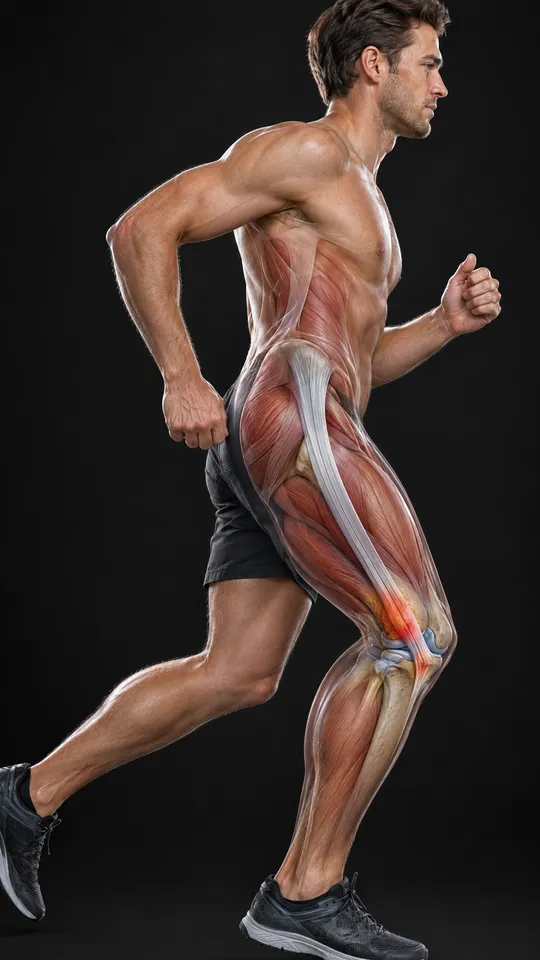

Runner with the iliotibial band shown down the outer thigh and an irritated area where it crosses the outer knee

ITB syndrome or patellofemoral pain? How to tell the difference

"Runner's knee" gets used loosely, and more often than not for a different condition. The quickest sorting question is where the pain sits.

ITB syndrome: pain on the outside of the knee, a sharp focal spot you can point to, over the bony point at the end of the thigh bone and tender to press there 2. It builds during a run and is worse on downhills and stairs.

Patellofemoral pain syndrome: pain at the front, around or behind the kneecap, typically aggravated by squatting, stairs, and sitting for long periods with the knee bent.

Patellofemoral pain is the condition most often mistaken for ITB syndrome, but not the only one. Also worth ruling out: a lateral collateral ligament sprain, osteoarthritis of the outer compartment, and lateral meniscal problems 2. All produce pain on the outside of the knee, and all need different management.

How it's diagnosed

ITB syndrome is diagnosed from a detailed history and a basic physical examination, plus a look at how you move 2. The history covers how much you've been running, what you've already tried and how the pain behaves. The classic check is the Noble test. With your knee bent to about 30 degrees, the clinician presses on the bony point on the outside of your knee. If that brings on your usual pain, the test is positive 2.

The rest is about your hips and your running. Expect strength tests for the muscles that move your hip outwards and rotate it, then single-leg stands, small squats and step-downs. Sometimes there's a treadmill run until you tire, to see when the pain switches on and whether your thigh drifts inwards as you land 2.

How we treat it

Conservative treatment built around hip strengthening exercises is effective for reducing pain and improving function in runners with ITB syndrome 3. The sequence we'd work through with you:

1
A calming period first. The load has to come off the irritated tissue before strengthening means much: reduced running volume, modified activity, cross-training to keep your fitness while the knee settles 2. Active neuromuscular work begins once pain is down around 3 out of 10 2.
2
Hip and neuromuscular control work. Building the strength, endurance and control of the hip abductors and external rotators (the muscles that stop your thigh dropping inwards when you land) is the treatment with the best support behind it 2. It's individualised and progressive, and it's the core of what we'd build with you through exercise prescription and conditioning.
3
Gait retraining, where it's warranted. Hip and knee co-ordination and running style appear to be key factors in treating ITB syndrome 4, so we look at how you run, including whether there's a visible gap between your knees as you land 2. Paired with hip strengthening, this is where the fastest improvements are reported: around 4 to 6 weeks, holding at long-term follow-up 3.
4
Working out what changed. Training errors turn up in the history of most confirmed ITB injuries 2: a jump in weekly distance, a new hill route, a change of surface. Our sports physiotherapy page covers return to running more broadly.

Strengthening your hips doesn't automatically change how you run: one hip abductor program had no significant effect on running mechanics 6. That's why we do both.

Other treatments we may use

Shockwave therapy.

One trial found shockwave plus hip abductor strengthening produced better results within four weeks than ultrasound with the same strengthening and stretching over six 3. That's a single comparison inside a review that calls its own evidence base limited. An option worth discussing, not a proven shortcut. See shockwave therapy.

Stretching the ITB.

The most common self-treatment here, and the evidence is against it. Stretching techniques aren't recommended for reducing pain or improving function 2, and the reason is structural: the band can't be stretched to any appreciable degree even when it feels tight, because the force required is well outside what any manual technique can produce 2.

Deep friction massage.

Also not recommended for pain or function 2, which follows from the mechanism. If the problem is compression of a sensitive fat pad, pressing harder into it isn't an obvious fix.

Injections and anti-inflammatory medication.

Corticosteroid injections are graded as not recommended for pain or function here, and have been described as ineffective and without scientific foundation for this condition 2. Physiotherapists don't prescribe or administer either. That's a GP conversation.

So how strong is any of this?

Stronger on the mechanism than the treatment. The recommendation for hip-focused work and those against stretching, injection and friction massage all rest on inconsistent or limited-quality evidence 2, and the most recent systematic review draws on 13 studies and 201 runners (six of them single case reports) and says plainly that the variation between them hinders firm conclusions 3. We'd rather say that than hand you a menu of treatments as though they were settled.

Your recovery path: Reset, Rebuild, Return

ITB syndrome is a load problem, so The Well Motion Recovery Path™ is built around load. You move up a phase when the knee tolerates more running, not when a week count is up.

  • Reset: the calming period. Less running, modified activity and cross-training to hold your fitness 2. Expect the knee to feel fine at rest well before it is ready to run. We move you on once pain has dropped to the low level that marks the start of active work 2.
  • Rebuild: graded hip abductor strengthening, usually run over 4 to 8 weeks 3. Gait retraining joins it where your running style calls for it, and shockwave is an option we may discuss 3. We move you on when single-leg tasks and short test runs stay comfortable.
  • Return: back to your usual running, with hills and downhills added last because they are common findings in people who get this 2. We test runs that go past the point where the pain used to switch on. You leave with a hip program and a plan for building distance.

How long it usually takes. Pain and function improved over 2 to 8 weeks of conservative treatment 3. Being back running takes longer: in the same review, only 44% of runners had returned to their sport after 6 to 8 weeks 3. Those figures come from 13 small studies, six of them single case reports 3, so treat them as a guide.

Reducing your risk of it coming back

Preventing ITB syndrome hasn't been properly tested: the main review says better long-term studies are still needed 2. What is known is what tends to come before it:

  • Build distance slowly. A sudden jump in training volume is one of the most common findings in runners with ITB syndrome 2. In a year-long study of 874 new runners, those who raised their weekly distance by more than 30% over a fortnight picked up more distance-related injuries, ITB syndrome among them, than those who stayed under 10%. The gap fell just short of statistical significance 7.
  • Count hills and cambered roads as extra load. Hill running, especially downhill, and banked surfaces are the other common findings 2. Bring in new surfaces gradually 5.
  • Plan easy days. A rest day between runs, or a lighter week, gives your body time to adapt 5.
  • Keep the hip work going. In the one study that followed runners before they were injured, women who went on to develop ITB syndrome ran with the thigh angled further inwards 8. Hip strength and control work is the best-supported treatment 2.

When to get it checked properly

Most ITB syndrome responds well to load management and a structured program. Get it assessed properly, rather than managing it alone, if:

  • The pain is arriving earlier in each run, or persisting into walking and stairs
  • Your knee locks, catches, gives way or swells; none of that fits ITB syndrome
  • The pain is diffuse rather than a focal spot you can put a fingertip on
  • You've genuinely reduced your running load for a few weeks and nothing has changed

For scale: about one in three recreational runners will have a running-related injury at some stage, and roughly three in four of those happen in the lower leg, the knee among the most common sites 5. None of that means something is seriously wrong with your knee. This is a treatable overuse problem, and an accurate diagnosis early is what shortens it.

Your first appointment

We start by listening: how it began, what makes it worse, and what it's stopping you from doing. Then we examine the area, explain what we find in plain English, and agree a plan with you. Your first visit is 40 minutes at Engadine and 30 minutes at our other clinics.

We see patients at Engadine, Mount Annan, Narellan and Appin, and at home through our mobile physiotherapy service. If you have private health cover, here's how health fund rebates work for physiotherapy.

FAQs

Can iliotibial band syndrome be cured?

Most people get better. Conservative treatment has produced pain reductions of 27% to 100% and functional improvements of 10% to 57% 3, and hip-focused programs have returned athletes to their pre-injury running volume 2. We'd stop short of "cured", though: that evidence comes from 201 runners across 13 mostly small studies 3, and it returns if the training load doesn't change.

How long does ITBS take to heal?

Improvements occurred over 2 to 8 weeks of conservative treatment 3. With gait retraining plus hip abductor strengthening they came within 4 to 6 weeks, and persisted at long-term follow-up 3. Sequencing matters too: a calming period first, with active neuromuscular training starting once pain is down around 3 out of 10 2.

Is walking bad for IT band syndrome?

Usually not, though this is clinical reasoning, not something the research addresses directly. The compression peaks around the knee angles you move through while running, so level walking is generally tolerated where downhills and stairs aren't. What the evidence supports early on is reducing and modifying load rather than stopping altogether 2.

How do you confirm IT band syndrome?

Clinically, not with a scan: focal pain on the outside of the knee reproduced at a predictable point in a run, tender over the bony point on the outside of the knee 2, a history that usually includes a training change 2, and the conditions above ruled out. The Ober test is traditionally used for ITB tightness, though the same review undercuts it: the band can't meaningfully be lengthened anyway 2.

More Knee conditions

Knee

Meniscus Tear

Catching, locking or swelling after a twist, sometimes with a knee that won't fully straighten.

Read more
Knee

MCL Injury

The MCL runs down the inside of your knee. Most injuries happen when something hits the outside of the knee and forces it inwards; it's the ligament most commonly injured in knee trauma.

Read more
Knee

Prepatellar Bursitis

A bursa is a small fluid-filled sac that cushions bone from the soft tissue around it. The prepatellar bursa sits at the front of your knee, over the kneecap. When it's irritated it swells, and a tender, warm swelling right over the bursa is the classic sign.

Read more
Knee

Patellar Dislocation

A patellar dislocation is the kneecap being forced out of its groove at the end of the thigh bone. It almost always goes outwards, towards the outside of the knee.

Read more
Knee

Baker's Cyst

A Baker's cyst is a build-up of fluid behind the knee, usually excess fluid from the knee joint itself.

Read more

If the outside of your knee switches on at the same point in every run, the useful question isn't how to stretch the band; it's what changed in your training, and how your hip is controlling your leg when you land.

Book an assessment with the Well Motion team, or head back to the Knee section of our Injury Finder if you're not yet sure which part of the knee is actually the problem.

Book an Assessment
Ahmed Elsayed, Principal Physiotherapist
Reviewed by Ahmed Elsayed Principal Physiotherapist at Well Motion

References

  1. Fairclough J, Hayashi K, Toumi H, et al. The functional anatomy of the iliotibial band during flexion and extension of the knee: implications for understanding iliotibial band syndrome. Journal of Anatomy, 2006;208(3):309-316. https://pmc.ncbi.nlm.nih.gov/articles/PMC2100245/
  2. Geisler PR. Current clinical concepts: synthesizing the available evidence for improved clinical outcomes in iliotibial band impingement syndrome. Journal of Athletic Training, 2021;56(8):805-815. PMID 34375405. https://pmc.ncbi.nlm.nih.gov/articles/PMC8359713/
  3. Sanchez-Alvarado A, Bokil C, Cassel M, Engel T. Effects of conservative treatment strategies for iliotibial band syndrome on pain and function in runners: a systematic review. Frontiers in Sports and Active Living, 2024;6:1386456. PMID 39247485. https://pmc.ncbi.nlm.nih.gov/articles/PMC11377285/
  4. van der Worp MP, van der Horst N, de Wijer A, Backx FJG, Nijhuis-van der Sanden MWG. Iliotibial band syndrome in runners: a systematic review. Sports Medicine, 2012;42(11):969-992. PMID 22994651, abstract via PubMed. https://doi.org/10.2165/11635400-000000000-00000
  5. Running and jogging: preventing injury. Better Health Channel, Victorian Department of Health, with Sports Medicine Australia. https://www.betterhealth.vic.gov.au/health/healthyliving/running-and-jogging-preventing-injury
  6. Hadeed A, Tapscott DC, et al. A literature review and clinical commentary on the development of iliotibial band syndrome in runners. https://pmc.ncbi.nlm.nih.gov/articles/PMC7296998/
  7. Nielsen RO, Parner ET, Nohr EA, Sorensen H, Lind M, Rasmussen S. Excessive progression in weekly running distance and risk of running-related injuries: an association which varies according to type of injury. Journal of Orthopaedic & Sports Physical Therapy, 2014;44(10):739-747. PMID 25155475. https://doi.org/10.2519/jospt.2014.5164
  8. Aderem J, Louw QA. Biomechanical risk factors associated with iliotibial band syndrome in runners: a systematic review. BMC Musculoskeletal Disorders, 2015;16:356. PMID 26573859. https://doi.org/10.1186/s12891-015-0808-7