Early self-care.
In the first few days: rest the knee, ice wrapped in a towel for up to 20 minutes every two to three hours, a bandage or support (off for sleep), and keep the leg raised 7.
You turned awkwardly getting up off the floor, or twisted on the court, and something in the knee caught. The swelling came up over the next day or two, and deep bending has felt wrong since. Or there was no single moment at all: the knee has grumbled for months, and a scan has come back saying "meniscal tear".
Either way you've probably been handed two options with little explanation: surgery, or "try physio first". Here's what sits behind that choice, including the parts of the evidence that don't flatter either option.
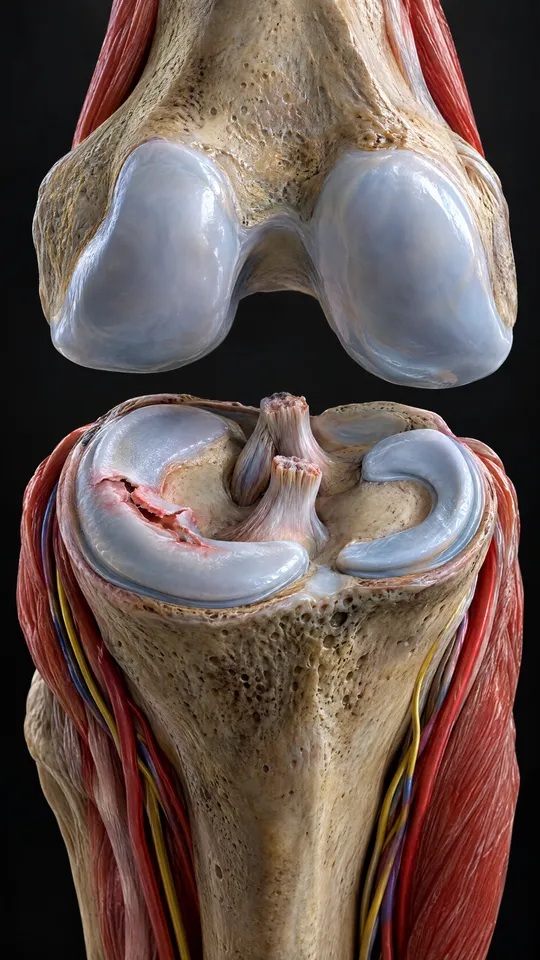
Your knee has two menisci: C-shaped wedges of cartilage between the thigh bone and the shin bone that spread load and keep the joint stable. They take the strain when the knee bends and rotates under your weight.
Tears come in two forms, and that difference explains most of the confusion. A traumatic tear happens to a particular knee at a particular moment, usually with a twist. A degenerative tear is a change in the tissue itself. It comes on without an injury, is age-related, builds gradually, sits most often on the inner side of the knee, and often keeps company with knee osteoarthritis. Many never cause symptoms 5.
Whether a tear can heal comes down to blood supply. The outer third is richly supplied, so a tear there may heal on its own or be repaired. The inner two-thirds has no significant blood supply, so a tear there can't 9. That single fact drives most of what follows: why some tears are worth repairing surgically, why others aren't, and why "just get it fixed" isn't a plan.
Often, they aren't alternatives. Degenerative tears commonly accompany knee osteoarthritis 5; the 879 people in the largest recent trial on this page had knee pain, osteoarthritis and a degenerative tear together 3. A scan finding also isn't automatically your diagnosis: plenty of degenerative tears sit quietly in knees that feel fine 5. The useful question is what's driving your symptoms, not which label fits.
Where to start instead: pain at the front of the knee, around the kneecap rather than along the joint line, points to Patellofemoral Pain Syndrome. A knee that gave way with a pop and swelled within hours points to ACL Injury & Rehabilitation. The two often travel together. And a tear alongside established arthritis usually makes Knee Osteoarthritis the bigger part of the picture.
A meniscus tear can be diagnosed clinically, from your story and a hands-on examination 10. The clinician presses along the joint line, where the meniscus sits, to see if it's tender. They may also do the McMurray test: bending your knee, then straightening and rotating it, to see if that brings on pain, a click or a clunk 9. Neither test is perfect. Joint line tenderness is about 83% sensitive and 83% specific, and the McMurray test about 61% and 84% 10, so they're read alongside your history.
An X-ray won't show a meniscus tear. It may still be ordered to look for other causes of knee pain, such as osteoarthritis. For a tear caused by an injury, MRI is the preferred scan 9.
Operation or not, the work has the same shape: settle an irritable knee, rebuild the strength that protects it, then load it progressively until it holds up.
One honest caveat about supervised sessions. In a 2025 trial of 879 people with knee pain, osteoarthritis and a degenerative meniscal tear, adding supervised physiotherapy to a home-exercise program was no better for pain at three months than the home program alone: 2.5 points on a 100-point scale, an interval crossing zero 3. We'd rather you knew that. It's an argument against selling you a long block of appointments, not against the exercise: the program does the work. Supervision earns its place by getting that program right, progressing it, and picking up the knees that need a different plan.
In the first few days: rest the knee, ice wrapped in a towel for up to 20 minutes every two to three hours, a bandage or support (off for sleep), and keep the leg raised 7.
Listed among the treatment options for knee pain generally 8, but none of the research behind this page tests a brace for a meniscal tear, so you won't get a product recommendation from us.
Anti-inflammatory medication and corticosteroid injections are real options in the literature, but they're prescribed and administered by your GP or specialist, not a physiotherapist. Platelet-rich plasma (PRP) deserves a plainer answer: results have been inconsistent on MRI, and a 2024 review of six studies found the clinical benefit in degenerative tears unclear 12.
Not a first-line treatment for a degenerative tear, and reserved for true mechanical locking or a three-to-six-month conservative trial that hasn't worked 5. An acute traumatic tear is a different case. Where a tear is repairable, repair beats removal: repairs in the outer zone have healed in 87 to 91% of cases, against 59 to 79% in the middle zone 6. Preserving tissue matters because long-term results, osteoarthritis included, are worse after part of the meniscus is removed 6.
You'll hear that meniscal surgery causes arthritis. The ten-year follow-up doesn't support it: osteoarthritis appeared on X-ray in 23% of the surgery group and 20% of the exercise group, and both improved 4. The case for exercise first isn't that surgery wrecks knees; it's that for degenerative tears it doesn't do better 2,4.
With or without an operation, a torn meniscus is worked through The Well Motion Recovery Path™. The knee earns each step by what it can do, inside your surgeon's protocol after an operation.
How long it usually takes. Without surgery, allow three to six months of rehabilitation 1,5. A trim often takes 4 to 12 weeks. A repair takes at least 4 months, or 6 to 9 for complex tears 14. The surgical figures are expert consensus on low-grade evidence.
An international consensus panel concluded that meniscus injuries can be prevented, through knee injury reduction programs and by avoiding certain activities 1:
Most meniscal tears need none of that. Degenerative tears are common, many cause no symptoms 5, and the agreed starting point is loading and strengthening, not an operating theatre 1.
We start by listening: how it began, what makes it worse, and what it's stopping you from doing. Then we examine the area, explain what we find in plain English, and agree a plan with you. Your first visit is 40 minutes at Engadine and 30 minutes at our other clinics.
We see patients at Engadine, Mount Annan, Narellan and Appin, and at home through our mobile physiotherapy service. If you have private health cover, here's how health fund rebates work for physiotherapy.
Often not. Degenerative tears build gradually and many never cause symptoms at all 5. Symptoms flare on load and twisting rather than sitting at a constant level. Constant severe pain, a knee you can't weight-bear on, or a hot, red, swollen knee with a fever is a different situation; get that seen 8.
It depends entirely on where it is: a tear in the outer third, which has a rich blood supply, may heal, and one in the inner two-thirds, which has very little, can't 9. That isn't the same as the knee not getting better: physiotherapy is first line for degenerative tears 1, and at five years it matched surgery for knee function 2.
Locking or clicking, the knee giving way, and difficulty straightening the leg, all listed among knee-pain symptoms by Australia's government health service 8, usually with pain on twisting and some swelling. None are proof on their own; plenty of knees do all three for other reasons.
Less dramatic than most people fear: at ten years, arthritis appeared on X-ray in 20% of exercise-treated knees and 23% of operated ones 4. But "untreated" and "unmanaged" differ. Knee problems left alone can cause ongoing pain and joint damage, and after a knee injury you're more likely to injure it again 8.
None of the research behind this page gives a timeline by grade, and we won't invent one; "grade" describes how a tear looks on MRI, not how bad it is clinically. What is documented: three to six months of conservative treatment before surgery is considered 5, 12-week programs 4 and 16-session courses 2 in the trials, and return to sport judged on criteria as well as time 1.
A twist or sudden change of direction, often with a pop at the time, and a knee that hasn't felt trustworthy since.
Read morePain on the outside of the knee that builds through a run, settles with rest, then comes straight back on the next one.
Read moreAn ache at the front, around or behind the kneecap. Worse on stairs, on hills, and after long sitting.
Read moreA tender, bony lump just below the kneecap in a growing, sporty teenager.
Read moreMorning stiffness and an ache after activity, building over years rather than days.
Read moreThe MCL runs down the inside of your knee. Most injuries happen when something hits the outside of the knee and forces it inwards; it's the ligament most commonly injured in knee trauma.
Read moreA bursa is a small fluid-filled sac that cushions bone from the soft tissue around it. The prepatellar bursa sits at the front of your knee, over the kneecap. When it's irritated it swells, and a tender, warm swelling right over the bursa is the classic sign.
Read moreA patellar dislocation is the kneecap being forced out of its groove at the end of the thigh bone. It almost always goes outwards, towards the outside of the knee.
Read morePatellar tendinopathy, often called jumper's knee or patellar tendonitis, is pain in the tendon just below your kneecap that builds when the tendon is overloaded.
Read moreA Baker's cyst is a build-up of fluid behind the knee, usually excess fluid from the knee joint itself.
Read more
How would you like to reach us?
Message us on WhatsAppFor bookings and enquiries. Please don't send medical details. Call (02) 8111 5633Request a call-back
Request sent
Thank you. We'll call you back on the number you gave us.
This is a preview, so nothing was actually sent.