Rotator Cuff Tear
Weakness or pain lifting the arm out to the side, reaching behind you, or sleeping on that shoulder. Often after a fall, or after years of overhead work.
Read moreA few throws into a session, or a flat return in from the boundary, and the top of the shoulder catches. It's deeper than a muscle strain, there's often a click or pop with it, and the arm has quietly stopped throwing the way it used to.
Or it happened in one moment: a fall onto an outstretched hand, a shoulder that came out, a heavy object caught badly. Either way, someone has now said "SLAP tear", often straight after a scan, and it isn't obvious what that means or what happens next.
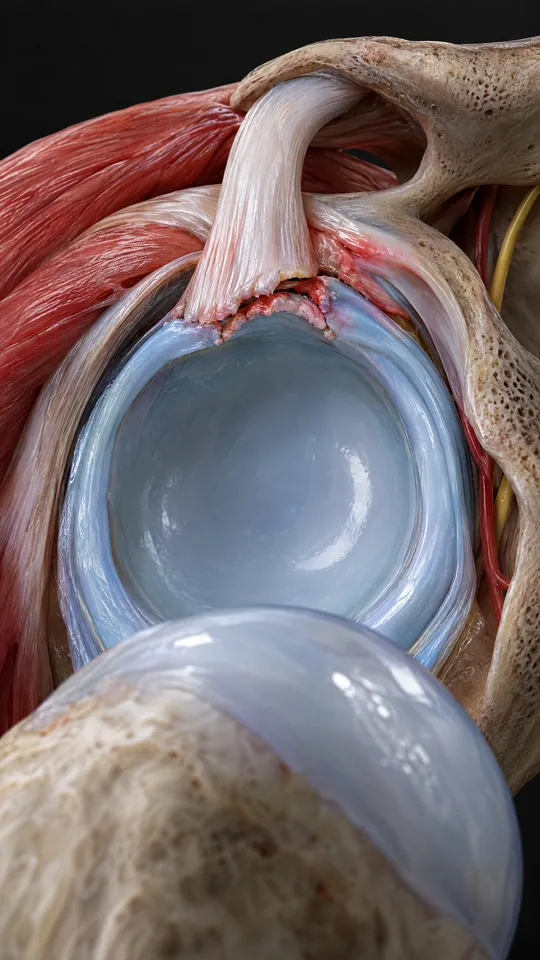
Your shoulder socket is shallow, which is part of what lets the arm move so freely. A thick rim of cartilage called the labrum surrounds and deepens it. The long head of your biceps tendon anchors into that rim at the top of the joint 3. A SLAP lesion is a tear in exactly that area 1.
It happens in two broad ways.
In one go. A common way is a fall onto an outstretched arm, with the shoulder out to the side 1. A dislocation, a car accident, catching a heavy object or a forceful pull on the arm can do it too 3.
Over time. Repetitive overhead sport or work, throwing and weightlifting all feature 3, and cricket is the obvious Australian example 2. When you cock your arm back to throw, the ball of the joint slides backwards and the biceps pulls on the back-top corner of the labrum. The research calls this a peel-back mechanism 1. Throwers sometimes call the result "dead arm": the throw is still there, but the speed isn't 6.
Age is a separate story. On scans of shoulders with no labral problem, the groove under the top of the labrum deepens with age, most clearly after 40 10. Change here over 35 to 40 is regarded as normal ageing rather than injury 3. If that's you, the tear on the report may be describing your shoulder, not explaining your pain.
Tears are graded I to IV. Type I is fraying with the biceps still attached. Type II is the labrum and biceps pulling away from the rim. Type III is a bucket-handle tear with the biceps intact, and Type IV extends into the biceps tendon itself 1. SLAP lesions also usually occur with other shoulder problems and rarely on their own 1. That's what the next section covers.
People often ask which one is worse. Often it isn't one or the other.
SLAP lesions are hard to diagnose because they look very similar to shoulder instability and rotator cuff problems 4,9. Over 40, wear-related SLAP tears become more common, and rotator cuff trouble is a common source of pain at that age too 1. How serious yours is depends on the type of tear, what else is injured and what you need the shoulder to do.
No single test settles it either. An MR arthrogram (an MRI with contrast injected into the joint) is the usual scan. It's reported to pick up 82 to 100% of tears, but normal variations in the labrum can be mistaken for one 9. Ultrasound can give clues, but a diagnosis can't be made on ultrasound alone 2. On examination, clinicians combine several tests. One positive out of three catches about 75% of real tears, but you need all three positive before the result is about 90% specific, meaning few false alarms 11. That's a real limitation, and it's why a scan report alone shouldn't set your treatment plan.
Diagnosis starts with your story and a hands-on examination. We'll ask when the pain began, whether there was a specific injury, and which movements at work or in sport set it off 6. Then we check the shoulder's range of motion, strength and stability, and place your arm in different positions to see if that brings on your symptoms. We may examine your neck too, in case the pain is coming from a pinched nerve 6.
What we find decides whether you need imaging 6. An X-ray won't show the labrum, but it can rule out arthritis or a fracture 6. Relying on MRI alone over-diagnoses labral problems, so the examination carries the most weight in working out what's actually causing the pain 4.
For the vast majority of SLAP injuries, the first treatment isn't surgery 1,3:
Be sceptical of confident numbers here. Reported success for conservative care runs from 22% to 85% 9, an enormous range that largely reflects your goals and the level you're returning to 9. A club cricketer and an elite professional thrower are asking different questions.
Anti-inflammatory medication. It's commonly used in early care 1,6, and it can make the first weeks easier. Talk to your GP or pharmacist about it, because physiotherapists don't prescribe medication.
Cold packs. Also part of the documented early management, and useful for comfort 1. Nothing suggests they change the tear itself.
Surgery: described here, not recommended. Well Motion doesn't perform surgery or decide who needs it, but you deserve to know what's involved. A SLAP repair is done by keyhole (arthroscopic) surgery through two to four small incisions of 5 to 7mm. It reattaches the labrum to the socket to reduce symptoms and restore stability 3. Type II tears are reattached or treated with a biceps procedure, and Type III bucket-handle fragments are usually removed 1. Biceps tenodesis moves the biceps tendon's attachment point. It's increasingly used instead of repair, because SLAP repair has had high rates of revision and complications 5.
Read the surgical numbers carefully. Operative success is reported at 80 to 97%, but those studies varied widely and defined "successful" in different ways 9. For overhead athletes, getting back to their previous level ranges from 7 to 84% 9. After biceps tenodesis, 70% of overhead athletes returned to sport, and complication rates ran from 0% to 14% 5. Surgery is generally considered when non-operative treatment hasn't improved things 3. That decision belongs to you and an orthopaedic surgeon, after a proper trial of rehab.
Post-operative rehabilitation. If you've had surgery, this is where we have a real role. You wear a sling, including in bed, and shouldn't lie on the operated shoulder for the first six weeks 3. Functional movement usually returns by 8 to 10 weeks, and gains keep coming more slowly for up to a year. Most people return to sport and full activity by around six months 3.
Rehab for a SLAP tear follows The Well Motion Recovery Path™. You step up a phase on what the shoulder can do, not on a date.
How long it usually takes. In one cohort of 63 people with an isolated type II tear, 71.4% had done well without surgery at an average of 21 months 12. It had no comparison group. After a repair, functional movement usually returns by 8 to 10 weeks and most people are back to sport by around six months 3.
No trial has tested preventing SLAP tears on their own. What has been tested is preventing shoulder injuries in throwing athletes, and that's the closest guide:
Book an assessment rather than waiting it out if:
There's a reassuring side too. For most people, shoulder pain improves over time with appropriate conservative treatment 2, and age-related SLAP change often needs no treatment at all 3.
We start by listening: how it began, what makes it worse, and what it's stopping you from doing. Then we examine the area, explain what we find in plain English, and agree a plan with you. Your first visit is 40 minutes at Engadine and 30 minutes at our other clinics.
We see patients at Engadine, Mount Annan, Narellan and Appin, and at home through our mobile physiotherapy service. If you have private health cover, here's how health fund rebates work for physiotherapy.
Don't count on the cartilage knitting back onto the rim. Whether it settles is a different question. For the vast majority of SLAP injuries the first treatment isn't surgery, and tears that are part of ageing often need no treatment 3.
Typical signs are pain with overhead movement that comes and goes, clicking or popping, not being able to lie on that side, and reduced shoulder strength 3,9. Throwers may also get "dead arm" 6. But SLAP tears look a lot like instability and rotator cuff problems 4,9, and they appear on scans in people with no symptoms 4. It takes an examination to sort out.
Often, yes. For throwers, getting back to overhand throwing is more common without surgery than with it. Rehab targeting the posterior capsule and shoulder blade posture is reported as more successful than surgery for most throwers 4. Physiotherapy is also one of the first approaches for shoulder pain generally 2. It's a real first option, but it isn't a guarantee.
While it's irritable, ease off the things that provoke it: repetitive throwing, work above shoulder height, forceful pulls and heavy overhead lifting 1,3. For throwers, that means a proper break from throwing 1.
For recreational and club players, usually not. The uncertainty is at the top end. After biceps tenodesis, 69% of recreational, 80% of competitive and 60% of professional overhead athletes returned to sport, and elite throwers tended to have poorer outcomes 5. Nobody can give you a confident number here.
Weakness or pain lifting the arm out to the side, reaching behind you, or sleeping on that shoulder. Often after a fall, or after years of overhead work.
Read moreStiffness in every direction, including when someone else moves the arm for you. Comes on gradually and moves through stages.
Read moreA pinch or catch through one particular part of the range as the arm goes up, often easing once you're past it.
Read moreA rupture at the shoulder usually follows tendon wear that's been building for a while. Uncommonly, a severely worn tendon gives way altogether
Read moreBiceps tendinopathy is thickening and irritation of the biceps tendon at the front of the shoulder. It often starts without any known injury.
Read moreA dislocated shoulder is the ball at the top of your upper arm bone coming out of its shallow socket. Most often it comes out the front.
Read moreYour AC joint is where the far end of your collarbone meets the top of your shoulder blade. A sprain means the ligaments holding that joint together have been stretched or torn.
Read moreSubacromial bursitis is inflammation of a small, fluid-filled cushioning sac (a bursa) under the bony point at the top of your shoulder
Read more
How would you like to reach us?
Message us on WhatsAppFor bookings and enquiries. Please don't send medical details. Call (02) 8111 5633Request a call-back
Request sent
Thank you. We'll call you back on the number you gave us.
This is a preview, so nothing was actually sent.