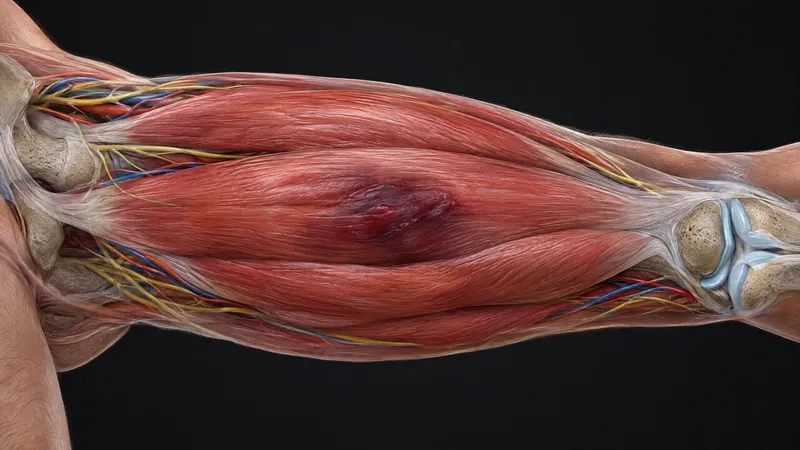
What a corked thigh is
The reason a corky hurts so much more than a bump on the arm comes down to what's directly behind the muscle. When something hard strikes the front of your thigh, the quadriceps gets compressed against the femur: the long, unyielding thigh bone underneath. The muscle has nowhere to go. The tissue ruptures deep inside, and bleeding and inflammation follow 1.
Muscle fibres tear at or immediately next to the point of impact, and the blood that escapes forms a haematoma, a collection of blood trapped inside the muscle 2. Plain English: pressure building inside a compartment that can't expand. That's the pain you're feeling, and it's why a corky often gets worse over the first several hours rather than better.
It's a contact-sport injury above all: most common in Australian football and rugby, and in cricket, hockey and lacrosse where a hard ball can strike the thigh at speed 1.
Cork or strain? They're not the same injury
Sort this out early, because the early management differs. A cork comes from an impact: something hit you. A quadriceps strain is torn muscle fibres from the muscle's own effort, usually sprinting, kicking or overstretching, with no contact involved.
If you can name the moment something hit you, it's a cork. If the pain arrived mid-sprint or mid-kick with nothing touching you, read our quad strain page instead; everything below is written for the contusion.
The first 24 hours: bend the knee, don't straighten it
This is the part most people get wrong, and it's the part that matters most.
The instinct with a sore leg is to stretch it out straight and keep it still. For a quadriceps contusion, the evidence points the other way. The one management difference between a contusion and a strain is that the injured leg should be placed in a position of knee flexion for the first 24 hours, to limit how much the haematoma can form: either a hinged brace set at 120°, or an elastic wrap holding the leg in that bent position, applied as soon as possible after the injury 2.
The logic is simple. Bending the knee puts the quadriceps on stretch and narrows the space available for blood to pool. Less room means a smaller haematoma, and less to reabsorb later.
The clearest demonstration comes from a study of 47 naval academy athletes whose contused leg was painlessly flexed to 120° within ten minutes of the injury and held there continuously for 24 hours, then progressed to pain-free stretching and isometric work. Average return to unrestricted athletic activity was 3.5 days 4.
Read that number carefully, because it isn't a promise. That study was a descriptive case series: no control group, no randomisation, a young and very fit cohort under constant supervision, and treatment beginning inside ten minutes. Almost nobody playing community sport on a Saturday can replicate any of that. Treat 3.5 days as the ceiling of what's theoretically possible under ideal conditions, not as your timeline.
What that research does tell you, and what a separate non-randomised comparison of protocols supports 3, is the direction: bent beats straight, and sooner beats later. The mechanism is well-reasoned and consistent across the sources. It just hasn't been tested in the kind of trial that would let anyone call it proven.
The first 72 hours: what else to do, and what not to
Alongside the flexion position, the standard acute soft-tissue approach applies. Australian first-aid guidance is to stop the activity, rest, apply an icepack for 20 minutes every two waking hours with wet towelling between the pack and your skin, bandage firmly from below the injury to above it, and keep the leg elevated above heart height 1,5. Rest here means relative rest: avoiding what clearly aggravates it while staying gently active 5.
Then the part people skip. For the first 72 hours: no heat, no alcohol, no running or activity, and no direct, firm massage of the area, all of which can increase swelling 1,5. Sports Medicine Australia frames this as applying to the acute phase; the Victorian government's guidance specifies 72 hours 1,5. We'd use the longer of the two. There's no advantage to being brave about it.
A note on ice, because it gets oversold. Cooling is thought to lower the temperature and blood flow inside the muscle, and it may help healing, but that specific claim has not been established in the scientific literature 2. What the same evidence does support is that cryotherapy reduces pain 2. So ice it for comfort and to limit early bleeding, not because it will make the muscle heal faster.
If you want something for the pain, talk to your doctor or pharmacist first; some pain-relieving medications can interfere with soft-tissue healing 5.
How bad is it? Grade it by your knee, not by the bruise
Severity is judged by how far you can actively bend the knee and how you're walking, usually assessed 12 to 24 hours after the injury 2,3:
| Grade | Active knee bend | How you're walking |
|---|---|---|
| Mild | More than 90° | Normal |
| Moderate | 45–90° | Limping |
| Severe | Less than 45° | Heavily limping |
So being able to walk normally is part of the assessment, not only a matter of convenience. A moderate or severe cork may need crutches for a few days if putting full weight through the leg is painful 1.
Notice what isn't on that list: bruising. Visible bruising may not appear for a full 24 hours after the injury 2, and with a deep contusion the blood stays trapped inside the muscle rather than tracking to the skin. A thigh with no visible bruise can be a worse injury than one that's gone spectacularly purple.
How long a corked thigh takes
The practical Australian guidance, graded by return to play: 2 to 3 weeks for a mild cork, a minimum of 4 to 6 weeks for a moderate one, and a minimum of 8 weeks for a severe one 1.
Those numbers sit at the longer end of what's been measured. A three-year study of 117 quadriceps contusions recorded average disability times of 13 days (mild), 19 days (moderate) and 21 days (severe) 3, noticeably shorter at the moderate and severe end. And the case series above found an average 3.5 days under an immediate-flexion protocol 4.
These aren't contradictory so much as different questions asked of different people. "Return to play" is a higher bar than "disability time", and a supervised academy athlete treated within minutes is not the same as a club player who iced it on Sunday night. So the answer is: somewhere in a wide range, and where you land depends heavily on what you did in the first few days.
Getting moving again
After the first 24 hours the brace or wrap comes off and gentle work begins: active, pain-free knee movement, stretching, and isometric quadriceps exercises (holding a contraction without moving the joint) 2. Strengthening generally starts somewhere between day 2 and day 7, depending on how severe the injury was 1.
The next gate is a specific one. The active, functional stage (the running and sport-specific work) starts once you have pain-free active knee flexion of at least 120° 2. That same 120° is part of the return-to-sport criteria too, alongside being pain-free and passing functional testing on the field 2. No established consensus guidelines exist for safe return to sport after a muscle injury 2, which is why this stage benefits from someone watching you move rather than a date on a calendar.
Our sports physiotherapy team works through that progression with you and builds the return-to-sport testing around your sport. Once you're past the 72-hour window and the leg is stiff rather than acutely swollen, hands-on manual therapy has a place too, but not before then.
One more thing for when you do go back: protective thigh padding is recommended on return to sport to reduce the chance of a repeat 2. Corks recur, and a previous quadriceps injury is itself a risk factor for a worse outcome next time 3.
Myositis ossificans: the complication worth avoiding
Sometimes, after a significant contusion, bone forms inside the injured muscle. It's called myositis ossificans, and it developed in 9% of cadets in that three-year study 3.
The risk factors identified in that same study are worth knowing, because several are within your control: knee motion of less than 120°, the injury happening during football, a previous quadriceps injury, an associated swollen knee, and (the one that matters most here) a delay in treatment of more than three days 3.
Bone formation usually stops after six to seven weeks. Reabsorption, in severe cases, can take up to 12 months, and there is no treatment that speeds it up 1. The only real lever is not getting there in the first place, which is why the first 72 hours carry so much weight.
Anti-inflammatory medication is sometimes used with the aim of preventing it, and after a severe contusion a doctor may consider a short course. Be clear on how strong that evidence is: it's inferred from studies of bone forming after hip replacement surgery, not demonstrated directly in contusions 2. Corticosteroids, by contrast, are discouraged; they've been associated with delayed healing and weaker healing tissue 2. Any medication decision belongs with your doctor or pharmacist; it sits outside what physiotherapists prescribe or administer.
When to get it looked at
Most corks settle with sensible early management. Get it assessed properly if:
- You can't put weight through the leg, or you're limping heavily 1,2.
- Your knee won't bend past about 45°, or swelling comes on rapidly 1,2.
- Symptoms get worse during the first 24 hours rather than settling 5.
- Pain and swelling haven't started to subside after a couple of days 5.
- Things were improving, then went backwards at the 2 to 3 week mark, with knee bend getting worse again and swelling persisting; that pattern is worth ruling out myositis ossificans 2.
Most people who come in with a corky are fine and back playing on a normal timeline. The reason to get it checked early isn't that it's usually serious; it's that the few corks that go badly are almost all ones where the first few days went wrong.
FAQs
How long do corked thighs last?
Roughly 2 to 3 weeks for a mild cork, a minimum of 4 to 6 weeks for a moderate one, and a minimum of 8 weeks for a severe one, judged by return to play 1. Measured disability times in one large study were shorter (13, 19 and 21 days 3), and a case series using an immediate-flexion protocol averaged 3.5 days 4. The range is that wide, and how fast treatment started explains much of it.
How to heal a corked thigh quickly?
"Quickly" really means "not making it slower". What clearly changes the timeline is the first 24 hours: knee held bent at around 120° rather than rested straight, plus ice and compression, then gentle pain-free movement from day two 2,4. And don't wait: a delay of more than three days before starting treatment is an independent risk factor for the complication that causes the longest layoffs 3.
Should you ice a corky?
Yes, for comfort and to limit early bleeding: 20 minutes every two waking hours, with wet towelling between the pack and your skin, never directly on it 1,5. But be clear about what it does: cryotherapy is supported for reducing pain, while the claim that it makes the muscle heal faster has not been established in the literature 2.
Can you massage a corky out?
No, not in the first 72 hours. Firm, direct massage of a fresh contusion can increase swelling 1,5, which is the opposite of what you want while there's still active bleeding inside the muscle. The No HARM protocol (no Heat, Alcohol, Running or Massage) applies to the acute phase, and Australian government guidance puts the window at 72 hours 1,5; we'd use the longer figure. After that, hands-on work has a role.
I have a corked thigh but no bruising. Is this normal?
Yes, and it doesn't mean the injury is minor. Visible bruising may not develop until 24 hours after the injury 2, and a deep contusion keeps the blood trapped inside the muscle rather than letting it track to the skin, so no bruise can point to the deeper kind. Judge it on your knee bend and how you're walking 2.
Can you walk with a thigh contusion?
Often yes, and how you're walking is part of how it gets graded. Normal gait with more than 90° of active knee bend suggests a mild cork; a limp with 45 to 90° suggests moderate; a heavy limp with less than 45° suggests severe 2. If full weight-bearing is painful, crutches for a few days are reasonable 1.