Need urgent care? 24/7 Mobile & After-Hours Emergency Physiotherapy Call (02) 8111 5633 For life-threatening emergencies, always call 000
Ankle

Achilles Tendinopathy

5.0 average rating on Google
Registered NDIS Provider
SIRA Registered Provider

The first few steps out of bed are the worst. The cord at the back of your heel feels stiff and sore, it eases off once you get moving, then it bites again that evening. You've cut back your running and you've been stretching your calves religiously for weeks. It hasn't made much difference.

That advice wasn't malicious, but it isn't what the clinical guideline for this condition recommends. Here's what the evidence says, including the parts that don't flatter any treatment, ours included.

What's actually causing it

Your Achilles is the thick cord joining your calf muscles to your heel bone, and every step and push-off runs through it. Tendinopathy is a painful overuse syndrome of that tendon 5: the load going through it has outpaced what it had adapted to carry.

That overload rarely arrives on its own. Things that make it more likely include an increase in training or activity, unsupportive footwear and high heels, flat or hyperpronated feet, carrying extra weight, inflammatory arthritis such as ankylosing spondylitis or psoriatic arthritis, and quinolone antibiotics 5.

How far it has progressed matters too: mild cases hurt during or shortly after one particular activity, moderate cases bring swelling and sometimes a hard nodule you can feel in the tendon, and in severe cases any weight-bearing activity hurts 5.

The other thing worth knowing is where your pain sits: insertional within the first 2 cm of the heel-bone attachment, midportion more than 2 cm above it 1. That isn't pedantry. Almost all the good treatment research was done on the midportion kind: in the largest comparative review, 86% of trials were midportion and no combined analysis could be run for the insertional variant at all 2. If your pain sits right down at the heel, the evidence behind any plan is thinner.
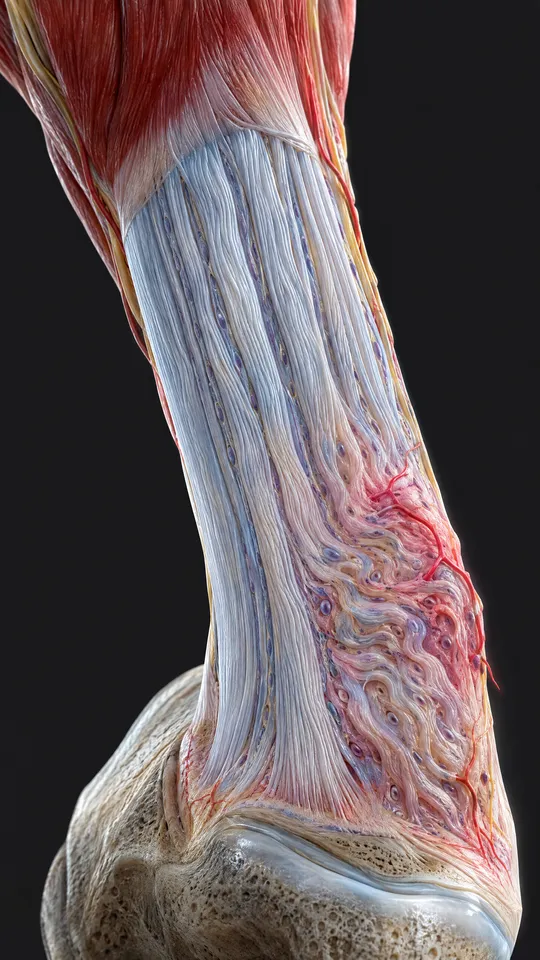
Close view of the Achilles tendon above the heel with an area of thickened, disorganised fibres

Achilles tendinopathy or a ruptured tendon? How to tell the difference

Tendinopathy builds gradually: weeks or months of stiffness and soreness that come and go with activity. A rupture doesn't. It's sudden, and it's described as feeling like a hard whack on the heel 5. It's also listed as an occasional progression of severe tendinopathy, which is one more reason not to push through pain that's getting worse 5. If that sounds like you, start with Achilles Tendon Rupture and get it assessed promptly.

Heel pain has more than one cause, and not all of them are the Achilles. If your pain sits underneath the heel, not behind it, our heel pain article covers the possibilities. Not sure? Start from the Ankle section of our Injury Finder.

How it's diagnosed

The reassuring part: you usually don't need a scan for this. The clinical guideline looks for four things. The symptoms sit in the tendon, it hurts when the tendon is loaded, it's sore when that spot is pressed, and the tendon is thickened there, although thickening can be missing early on. If all four fit, no imaging is needed 1.

A scan comes into it when the picture doesn't fit all four, when symptoms change in a way nobody expected, or when surgery is being considered. Ultrasound is the preferred one 1. Long-standing low back pain that began before age 45, or psoriasis, can prompt a referral to a rheumatologist, a specialist in joint and inflammatory conditions 1.

How we treat it

1
Assessment first. Where the pain sits (insertional or midportion, using the 2 cm mark 1), how far it has progressed 5, and what changed in your training, footwear or workload first.
2
Progressive calf strengthening, run for at least 12 weeks. The first-line treatment in the clinical guideline 1 and the core of what we do. It comes paired with the loading advice: temporarily stop what provokes the pain, then gradually increase the load again 1. Temporarily. Not indefinitely.
3
Sports physiotherapy to get you back to the thing you stopped doing. The return to running or sport is a graded increase, not a switch you flip once it stops hurting 1.
4
A program you'll actually finish, rather than the "correct" one. A trial of 58 people with chronic midportion tendinopathy compared heavy slow resistance training against eccentric training over 12 weeks. Both significantly improved pain and function, and both held at 52 weeks. Neither protocol beat the other. What differed was sticking with it: 92% of sessions completed in the heavy slow resistance group against 78% in the eccentric group 3. So we build the version you can fit into your week.

An honest caveat. The comparative evidence here is weaker than most physio websites imply. Across 29 trials, 76% were at high risk of bias, none at low risk, and the certainty of the evidence was rated very low to low, with no clinically relevant difference between different active treatments at three or twelve months 2. A 2023 review went further: passive treatments produced greater short-term pain reduction than eccentric loading, and its authors concluded no one treatment was superior to another 4. We start with loading because it's cheap, easy to prescribe and low-harm 2, not because it's proven to beat everything else. What is consistent is that doing something beats waiting 1,2.

Other treatments we may use

Shockwave therapy.

Worth discussing when tendon pain hasn't settled after a proper loading program. Since the comparative research found no clear winner among active treatments 2,4, we'd frame it as a reasonable option alongside loading, not an upgrade on it, and not the thing that finally works.

Anti-inflammatory medication and injections.

These come up, so here's where they stand. The clinical guideline advises caution with both 1, and corticosteroid injections aren't routinely recommended: the evidence on whether they work is inconsistent, and a steroid injection into the tendon may cause it to rupture 5. Either way, these are prescribed and administered by your GP or a specialist, never by a physiotherapist.

Surgery.

Reserved for after all other options have been tried without success 5. It isn't an early-stage decision, and it isn't one we make.

Your recovery path: Reset, Rebuild, Return

An Achilles tendon is treated by loading it, so The Well Motion Recovery Path™ has no rest phase here. You move up when the tendon copes with the work, not when a week number comes round.

  • Reset: the start. We assess where the pain sits and what changed in your training, then you step back for a while from whatever provokes it 1. Expect to keep walking. We move you on once everyday activity has stopped flaring the pain.
  • Rebuild: most of the work. Progressive calf strengthening 1, made heavier as the tendon allows, with shockwave therapy an option if loading alone has not settled it. Expect slow gains and some sore days. We move you on when the calf handles what your sport or work asks of it.
  • Return: running, sport or long days on your feet, brought back through sports physiotherapy as a graded increase in type, frequency and intensity 1. You leave with calf exercises to keep up after the symptoms have gone 1.

How long it usually takes. Months. The loading program runs for at least 12 weeks 1, and a full return to sport without symptoms usually takes at least a few months of active treatment 1. In one trial of 58 people, gains made by 12 weeks were still there at 52 weeks 3. Some people do not clear it completely: 23 to 37% still have symptoms up to ten years on 1.

Reducing your risk of it coming back

A past tendon problem in the leg is the best-supported risk factor for Achilles tendinopathy, so the guideline's advice on recurrence is worth following even though the research behind it is thin 1:

  • Give it months. A full, symptom-free return to sport usually takes at least a few months of active treatment. Going back within days is linked with a higher chance of it recurring 1.
  • Build up gradually. That applies after you've recovered and after any long spell off 1. It covers the type, frequency and intensity of training, not only how far you go 1.
  • Keep the calf work going. The guideline suggests carrying on with calf exercises after your symptoms have gone 1. Weaker calf muscles are one of the few risk factors a review of the research picked out, though the evidence for it is limited 6.
  • Winter training. Training in cold weather turned up as a risk factor in the same review 6, and the guideline recommends wearing enough warm clothing for winter sessions 1.

When to get it checked properly

  • Sudden, sharp pain at the back of the ankle, particularly if it felt like a hard whack on the heel 5. Get that assessed straight away.
  • Any weight-bearing activity causes pain. That's the severe end of the scale 5 and needs a proper look, not more self-management.
  • Swelling, or a hard nodule you can feel in the tendon 5.
  • Tendon pain that started after a course of quinolone antibiotics 5.
  • Symptoms that haven't shifted. This is the one people leave longest, and the guideline is direct about it: in chronic Achilles tendinopathy, expect little or no short-term improvement from waiting and seeing 1.

None of that means your Achilles is in trouble. Most people with this recover, and 85% of athletes get back to their sport 1, usually with a structured loading program, not anything more dramatic.

Your first appointment

We start by listening: how it began, what makes it worse, and what it's stopping you from doing. Then we examine the area, explain what we find in plain English, and agree a plan with you. Your first visit is 40 minutes at Engadine and 30 minutes at our other clinics.

We see patients at Engadine, Mount Annan, Narellan and Appin, and at home through our mobile physiotherapy service. If you have private health cover, here's how health fund rebates work for physiotherapy.

FAQs

How do you fix Achilles tendinopathy?

The guideline-recommended starting point is progressive calf muscle strengthening for at least 12 weeks, plus loading advice: temporarily stop what provokes the pain, then gradually increase activity again 1. Exercise is where clinicians are advised to start because it's easy to prescribe, low cost and low-harm 2, not because it's proven better than the alternatives. We'd avoid the word "fix". Most people improve a great deal; not everyone becomes symptom-free 1.

How long does it take for Achilles tendinopathy to heal?

Think in months, not weeks. Loading programs run for a minimum of 12 weeks 1, and in the trial comparing two of them, the improvements at 12 weeks were still holding at 52 weeks 3. The majority recover and 85% of athletes return to sport, but 23 to 37% still report symptoms as far out as ten years 1. Anyone quoting you a single number is guessing.

Can I still walk with Achilles tendonitis?

Usually, yes. The guideline advice is to temporarily stop the specific activities that provoke your pain, then gradually build load back up 1, not to stop moving. Waiting passively is what's specifically advised against, since active treatment beat it at three months 2. The exception is the severe end, where any weight-bearing activity causes pain 5. If that's you, get it assessed instead of pushing on.

Will tendinopathy ever go away?

For most people, largely yes. The majority of patients recover and 85% of athletes return to sport, while 23 to 37% still have symptoms at up to ten years despite treatment 1. That's not a reason to do nothing. It's a reason to start loading early instead of spending another year on rest and stretching.

What is the difference between Achilles tendonitis and tendinopathy?

Mostly it's a naming question. "Tendinopathy" is the term the clinical guideline and the trials behind this page use, and they classify it by where symptoms sit (insertional or midportion 1) rather than by what's happening inside the tissue. You'll see confident claims online about whether it's inflammation or degeneration; none of the sources behind this page settles that, so we won't tell you either way. The treatment approach is the same.

More Ankle conditions

Ankle

Ankle Sprain

You rolled or twisted it, usually landing or changing direction, and it swelled soon after. Includes high ankle (syndesmosis) sprains, where the pain sits higher up the leg.

Read more

If you've been stretching your Achilles for months and it's no better, book an appointment and we'll work out where exactly the pain sits, what your tendon can safely be loaded with right now, and what a genuine 12-week program looks like built around your week, not a generic sheet of exercises.

If you're not certain the Achilles is the problem, start from the Ankle section of our Injury Finder instead.

Book an Assessment
Ahmed Elsayed, Principal Physiotherapist
Reviewed by Ahmed Elsayed Principal Physiotherapist at Well Motion

References

  1. de Vos RJ, van der Vlist AC, Zwerver J, et al. Dutch multidisciplinary guideline on Achilles tendinopathy. British Journal of Sports Medicine, 2021;55(20):1125-1134. PMC8479731. https://pmc.ncbi.nlm.nih.gov/articles/PMC8479731/
  2. van der Vlist AC, Winters M, Weir A, et al. Which treatment is most effective for patients with Achilles tendinopathy? A living systematic review with network meta-analysis of 29 randomised controlled trials. British Journal of Sports Medicine, 2021;55(5):249-256. PMC7907558. https://pmc.ncbi.nlm.nih.gov/articles/PMC7907558/
  3. Beyer R, Kongsgaard M, Hougs Kjær B, et al. Heavy slow resistance versus eccentric training as treatment for Achilles tendinopathy: a randomized controlled trial. American Journal of Sports Medicine, 2015;43(7):1704-1711. PMID 26018970. https://doi.org/10.1177/0363546515584760
  4. Maetz R, Le Rest R, Coquart J, et al. Systematic review and meta-analyses of randomized controlled trials comparing exercise loading protocols with passive treatment modalities or other loading protocols for the management of midportion Achilles tendinopathy. Orthopaedic Journal of Sports Medicine, 2023;11(5). PMC10240875. https://pmc.ncbi.nlm.nih.gov/articles/PMC10240875/
  5. Achilles tendinopathy. Better Health Channel, Victorian Department of Health. Reviewed 10 July 2020. https://www.betterhealth.vic.gov.au/health/conditionsandtreatments/achilles-tendonitis
  6. van der Vlist AC, Breda SJ, Oei EHG, Verhaar JAN, de Vos RJ. Clinical risk factors for Achilles tendinopathy: a systematic review. British Journal of Sports Medicine, 2019;53(21):1352-1361. PMC6837257. https://pubmed.ncbi.nlm.nih.gov/30718234/