What's actually causing it
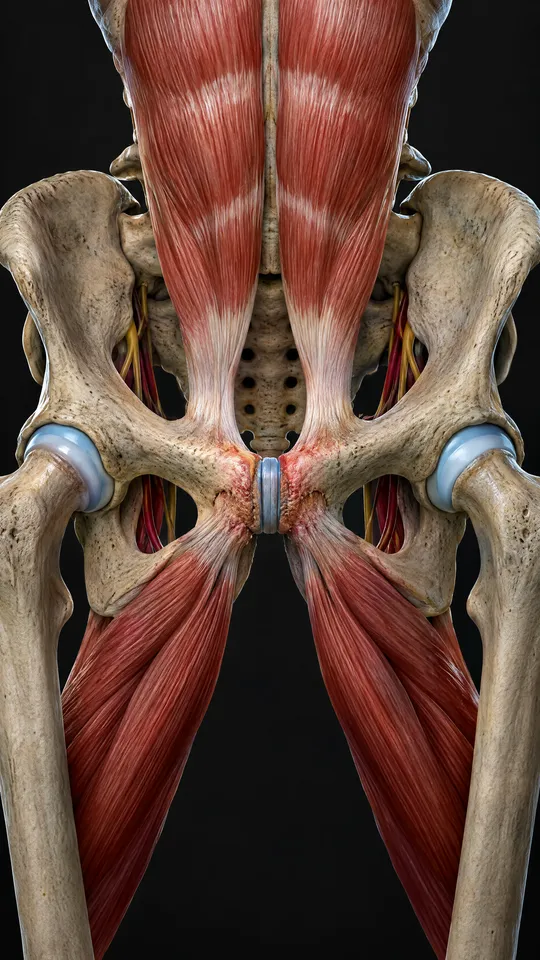
The pubic symphysis is the small joint at the front of your pelvis where the left and right halves meet. It's a busy piece of anatomy: your adductors (the inner thigh muscles) pull down and inwards on it from below, while your lower abdominals pull up from above. Kicking, sprinting and changing direction load both at once, in opposite directions, thousands of times across a season.
When that repeated load outpaces what the joint and the bone either side of it can adapt to, the area becomes irritated and painful. It's an overload problem, which is why it creeps up gradually rather than arriving in one bad moment. Reported rates in athletes sit between 0.5% and 8%, higher in distance runners and kicking sports, and in male soccer players it accounts for roughly 10 to 18% of injuries a year 1.
A note on what your physio will call it. In 2014, twenty-four groin pain experts from fourteen countries (including the Australian Institute of Sport, La Trobe and the University of Sydney) agreed on a shared way to classify groin pain in athletes. Under it, what you'd search as "osteitis pubis" is pubic-related groin pain, defined by local tenderness at the pubic symphysis and the bone next to it 2, and the older term is no longer recommended 4. The change is practical: the newer system points at which tissue is tender, and that's what changes the plan.