Plantar Fasciitis
Sharp heel pain that's at its worst on your first few steps out of bed, settles once you get moving, then comes back after sitting or a long day on your feet.
Read moreYou pushed off hard with the foot planted and the heel up, and the big toe bent back further than it should have, often with someone or something landing on the back of the foot at the same time. It may not have felt like much in the moment. The next morning the joint at the base of the big toe is swollen and tender, and push-off is the movement that hurts.
The big toe joint takes more load than most people expect. In normal walking, the ligament and capsule complex underneath it withstands 40% to 60% of your body weight. In athletic activity that rises to two or three times body weight, and with a running jump, as much as eight times 1.
Turf toe happens when that complex is forced past its limit. The classic mechanism is an axial load delivered to a foot fixed with the ankle pointed down and the great toe bent back 1. In plain terms, heel up, toe bent back, and a load driven through the back of the foot.
What gets injured is the plantar plate complex: a thick pad of ligament, the two small sesamoid bones under the joint, and the muscles and tendons that flex the toe. The plantar plate is the thickened capsule on the underside of the joint, and the complex is built to resist the big toe bending back 4. Overstretch or tear it and the joint loses the stability it relies on to push off.
Two other things contribute: lightweight, flexible shoes with little support, and firm or artificial playing surfaces 1. Be careful with the surface claim, though. A survey of 80 active NFL players found 45% had sustained a turf toe, 83% of those on artificial turf, but the same review reports a high-school study finding similar injury patterns on modern artificial turf and natural grass 1. It's a contributing factor, not the cause. The 2023 review names football, soccer, basketball, dancing and wrestling as the sports where it's most common 2.
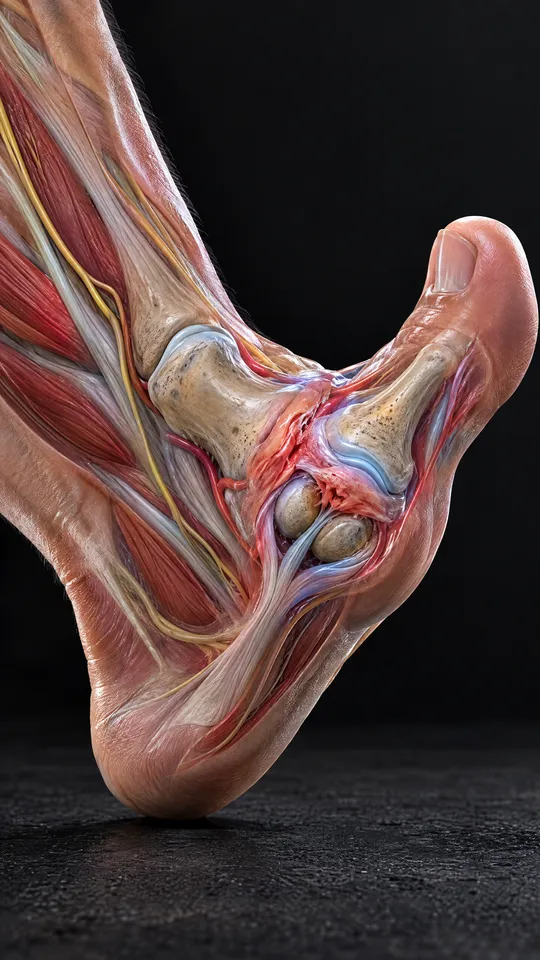
There's one mimic worth knowing about: a strain of the flexor hallucis brevis, the short muscle-tendon unit that flexes your big toe.
The distinguishing sign the research gives is where the tenderness sits. Pain proximal to the sesamoids (behind them, towards the middle of the foot) points towards a strain of that muscle-tendon unit. An unstable turf toe typically hurts distal to the sesamoids, out towards the toe 1.
It's a useful clue, but not something you can settle at home. It takes a hands-on examination, and sometimes imaging: an ultrasound, or an X-ray to rule out a fracture 3.
Turf toe can be a subtle injury, so a clear account of the moment it happened helps more than you'd expect 1 5. After that it's hands-on. We look for swelling, bruising and any change in how the toe sits, press around the joint, then move the toe in each direction to see whether the joint holds firm, often comparing it with your other foot 1 5. You'll also be asked to bend the toe down. If it's weaker than the other side, that can point to a tear underneath 1.
X-rays usually show normal bones. They're taken to catch a small chip of bone pulled away with the ligament, or sesamoid bones sitting out of position 1 5. An MRI is generally kept for a suspected grade 2 or 3 injury 1.
The shape of the plan is the same for everyone, but the timeline is set by the grade, not by the label.
On timelines the two major reviews disagree, and we'd rather show you that than pick one. Grade 1: return as tolerated 1, traditionally after 3 to 5 days 2. Grade 2: up to 2 weeks of lost play 1, or 2 to 4 weeks 2. Grade 3: 4 to 6 weeks or more 2, or 10 to 16 weeks depending on sport and position, and up to 6 months for symptoms to fully settle 1.
Footwear and in-shoe support. A stiff-soled shoe with a turf toe plate, or a custom orthotic with a Morton's extension, limits how far the toe can bend back 1. It's the most practical thing you can change about a return to sport.
Taping, but not yet. Taping the toe is not advised in the acute setting, because it may compromise circulation to the toe 1. Later on it's a different conversation: a grade 2 injury may need taping support on return to play 1. We'd rather tell you that than tape it on day two.
Things the evidence says to avoid. For a mild sprain: no heat on the area, no alcohol, and no massage, which can increase the swelling 3. Cortisone or anaesthetic injections are not advised for turf toe either 1. Not something physiotherapists give in any case, but it comes up.
Immobilisation or surgery, for the worst of them. A grade 3 injury may need long-term immobilisation in a boot or cast, or surgical reconstruction 1 (rare, at fewer than 2% of turf toe injuries 2).
The evidence is thinner than you'd hope. The research itself notes that only a few articles describe outcomes from managing these injuries 1.
Turf toe follows The Well Motion Recovery Path™, with the grade setting the pace. You move up when the toe passes each test, not on a date.
How long it usually takes. Grade 1: days 2. Grade 2: up to 2 weeks 1, or 2 to 4 weeks 2. Grade 3: 4 to 6 weeks or more 2, or 10 to 16 weeks, with up to 6 months for symptoms to settle 1. After surgery your surgeon sets the pace, and rehabilitation runs up to 20 weeks 2. The two reviews disagree, so treat these as guides.
Prevention hasn't been tested in a trial for turf toe, so these steps come from what's known to contribute to the injury:
Get it assessed rather than managing it alone if:
Getting it looked at early isn't about something dramatic happening now. Left unrecognised, this can become a persistent problem with ongoing pain, progressive deformity and eventual joint degeneration 4, and that's avoidable. If you're unsure, healthdirect runs a health advice line on 1800 022 222, around the clock 3.
We start by listening: how it began, what makes it worse, and what it's stopping you from doing. Then we examine the area, explain what we find in plain English, and agree a plan with you. Your first visit is 40 minutes at Engadine and 30 minutes at our other clinics.
We see patients at Engadine, Mount Annan, Narellan and Appin, and at home through our mobile physiotherapy service. If you have private health cover, here's how health fund rebates work for physiotherapy.
It depends on the grade. All grades start with rest, ice, compression and elevation 3. Grade 1 is symptomatic care with return as tolerated; grade 2 usually a walking boot and crutches if needed; grade 3 may need long-term immobilisation or surgical reconstruction 1. Fewer than 2% need surgery 2. Skip taping and injections early on 1.
By grade, and the two major reviews don't fully agree. Grade 1: as tolerated 1, traditionally 3 to 5 days 2. Grade 2: up to 2 weeks 1, or 2 to 4 weeks 2. Grade 3: 4 to 6 weeks or more 2, or 10 to 16 weeks depending on sport and position, and symptoms can take up to 6 months to settle completely 1.
Grade 1 is localised swelling with minimal bruising. Grade 2 adds moderate swelling and movement restricted by pain. Grade 3 shows significant swelling and bruising, weakness bending the toe down, and obvious instability of the joint 1.
If it goes unrecognised, it can lead to chronic problems including reduced push-off strength, persistent pain, progressive deformity and eventual joint degeneration 4. That's the case for getting it assessed early. Even with treatment, one five-year follow-up found 50% still had pain and stiffness at the joint, and a separate study measured a real loss of upward movement compared with uninjured toes 1.
Not until the joint can take it. For a grade 3 injury, the benchmark is 50° to 60° of painless passive upward movement before running or explosive activities are attempted 1. More generally, return happens once you have minimal to no pain with normal weight bearing 2.
Career-limiting for a minority, rarely career-ending, and we won't name an athlete we haven't verified. Among higher-grade injuries, treated both with and without surgery, about 70% are expected to maintain their previous level of performance 2, so roughly 30% don't. In one series of 19 high-level athletes with disabling turf toe, 9 needed operative repair and all but 2 returned to full athletic participation 1.
Sharp heel pain that's at its worst on your first few steps out of bed, settles once you get moving, then comes back after sitting or a long day on your feet.
Read morePain, swelling or bruising across the middle of your foot after a fall, an awkward landing or a twist, and a midfoot that still doesn't want to take your weight.
Read moreHeel pain in an active, growing child, usually somewhere between 8 and 14, turning up after footy or athletics training.
Read moreIt's a thickening of the tissue around one of the nerves between your toes, after that nerve has been irritated or damaged.
Read moreMetatarsalgia is a general term for pain around the joints at the base of your toes, a group of conditions rather than a single one. Which one you have changes what helps.
Read moreA stress fracture is a fine crack in a bone from repeated loading without enough recovery between efforts, not a one-off injury. In the foot and lower leg it's the most common form of hairline fracture, usually from jogging or running.
Read moreCuboid syndrome is pain on the outer midfoot, thought to come from a subtle disruption of the joint between the cuboid (a small bone on the outside of your foot) and your heel bone. The exact mechanism hasn't been worked out.
Read moreTarsal tunnel syndrome is compression of the tibial nerve as it runs behind your inner ankle, under a band of tissue called the flexor retinaculum.
Read moreA heel spur (calcaneal spur) is a small outgrowth of bone on the heel bone. It can form on the underside or at the back.
Read moreA bunion (hallux valgus) is a bony lump at the big toe joint that forms when the big toe leans towards the other toes. Around 23% of adults have one.
Read more
How would you like to reach us?
Message us on WhatsAppFor bookings and enquiries. Please don't send medical details. Call (02) 8111 5633Request a call-back
Request sent
Thank you. We'll call you back on the number you gave us.
This is a preview, so nothing was actually sent.