Need urgent care? 24/7 Mobile & After-Hours Emergency Physiotherapy Call (02) 8111 5633 For life-threatening emergencies, always call 000
Groin

Groin Strain

5.0 average rating on Google
Registered NDIS Provider
SIRA Registered Provider

You changed direction chasing a ball, or stretched for one, and something pulled high on the inside of your thigh. Sharp enough that you stopped. By the next morning it's sore to bring your legs together, sore getting out of the car, and you're quietly trying to work out whether this is a two-week problem or a two-month one.

Or nothing dramatic happened at all. The inner thigh has just been tightening up for weeks, worse after every game, and it hasn't come good on its own.

What's actually causing it

Your adductors are a group of muscles running from the pubic bone down the inside of your thigh. Their job is to pull your leg towards the midline and help control it when you're changing direction. A strain means the muscle-tendon unit has been loaded past what it could tolerate, and the adductor longus takes the hit far more often than the rest 1,4.

What it looks like clinically is specific: tenderness over the adductor tendon or where it attaches to the pubic bone, plus groin pain when you squeeze your legs together against resistance 1. In an acute strain the pain comes on suddenly, often badly enough to take you out of the game 11, and swelling and bruising can follow 9.

Grades describe how much damage is there. A "tear" isn't a different injury from a "strain"; it's the same injury further along the spectrum.

GradeWhat's happened 1Typical return to full team training 4
1: mildPain, with minimal loss of strength or movementAround 2 to 3 weeks
2: partial tearTissue damage that reduces strength, without complete loss of functionAround 2 to 3 weeks
3: complete tearComplete disruption of the muscle-tendon unit, with loss of muscle functionAround 11 weeks

Those figures come from male athletes following a supervised, criteria-based programme 4, so treat them as a guide, not a promise. Groin injuries are common in sport generally (in men's club football, groin injuries account for 4% to 19% of all injuries 8), and the single biggest risk factor for any soft-tissue injury is having had one before 3. A previous groin injury roughly doubles the risk of a new one 6.
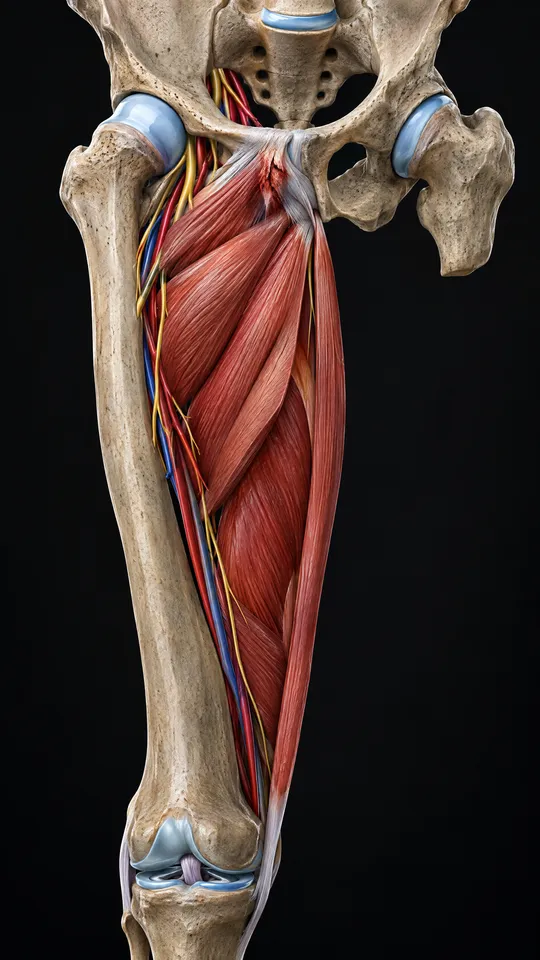

Pelvis and thigh bone showing the inner thigh muscles with a strain near the pubic bone

Groin strain, or something else? How to tell the difference

Groin pain is hard to label. More than 30 different diagnostic terms have been used for it 8, which is why an international group of clinicians agreed on a simpler system: sort groin pain by where it's coming from 8.

Where it's coming from 8What tends to point to it
Adductor-related (this page)Tenderness over the adductor tendon, pain on squeezing the legs together
Pubic-relatedPain centred on the pubic bone itself at the front of the pelvis
Iliopsoas- or hip-relatedDeeper pain, often with hip movement rather than adduction
Inguinal-relatedPain around the inguinal canal. A hernia can sit here
Other causesNerve irritation, pain referred from the lower back or pelvis, and non-musculoskeletal causes such as kidney stones or infection 8,2

Two of those overlap with conditions we cover separately. Persistent pain at the front of the pelvis, especially in footballers and runners, is worth reading about as osteitis pubis. Pelvic joint pain during pregnancy is a different thing again: see symphysis pubis dysfunction. If you already know the problem is specifically your inner-thigh muscles, our adductor strain page goes into that group in more detail.

Sorting this out is the first job of an assessment, and for most people it's done by examination rather than a scan 8.

How it's diagnosed

Most groin strains are diagnosed without a scan. The international consensus on groin pain in athletes built its whole system on a thorough history and a physical examination 8. For the adductors, two findings together make the diagnosis: tenderness when the muscles are pressed, and pain when you bring your leg inwards against resistance 8. Your clinician will also ask how it happened and check for swelling, bruising, movement and muscle strength 9.

Sometimes an ultrasound is used to see the damaged area more clearly, and an X-ray can rule out a fracture 9. In the athlete study behind the timeframes on this page, every injury was also graded on MRI 4. That was research, and it isn't what a usual assessment involves.

How we treat it

1
Working out which structure it actually is, first. A clinical diagnosis is usually sufficient, and imaging isn't routinely required 4,8. Our sports physiotherapy page explains how an appointment runs; you can see us at Engadine, Mount Annan, Narellan or Appin.
2
The first 48 to 72 hours: settle it down. The standard Australian first-aid advice for a strain is rest, ice for 20 minutes every two hours, compression and elevation, then referral for assessment, and no heat, alcohol, running or massage in that early window 3. Avoid the movements that provoke it, and ask your pharmacist or GP about pain relief if you need it 2.
3
Then start loading it, earlier than you'd think. Prolonged immobilisation isn't the goal: gentle, pain-limited isometric work starts early, before progressing into strength and endurance 1,11. That graded loading is what exercise prescription and conditioning is for.
4
Progress on what you can do, not on the date. Milestones like pain-free adduction against gravity and hip movement that matches the other side are used to decide when you move up a level 1, and returning to sport only after meeting a pain-free criterion was associated with far fewer reinjuries 4.
5
Then rebuild the way you actually move. Control work, running, and finally changing direction and kicking 4: the things that caused it in the first place.

Other treatments we may use

Hands-on treatment.

Massage sits on the "not yet" list in the first 48 to 72 hours under standard Australian first-aid advice 3. Past that window, manual therapy is a reasonable adjunct alongside active rehabilitation, helpful for comfort and movement, never the whole plan.

Ice and compression.

Useful for discomfort and swelling early on 2,3. Worth knowing that the "no heat, no massage" convention comes from a first-aid guideline last reviewed some years ago, and current practice leans more on getting sensible load back in than on prolonged rest.

Pain-relief medication.

A real option, and one to discuss with your pharmacist or GP 2; Well Motion physiotherapists don't prescribe medication.

Imaging.

Occasionally helpful when the diagnosis is unclear 1, but it isn't routine 8. One reason to be cautious: scan findings are common in athletes who have no symptoms at all 8, so a scan finding has to be read next to your history and examination, not instead of them.

Surgery.

Rarely part of the picture for an acute strain. One systematic review of long-standing groin pain in athletes found return to play was no different between surgery and rehabilitation for adductor-related pain, and the studies behind it were poor quality with a high risk of bias 12. Conservative care is first-line, and that's a conversation for a specialist, not a physiotherapist, in any case.

Strengthening to reduce the risk of it happening again: promising, not proven.

A single-exercise adductor strengthening programme, run three times a week preseason and weekly in season, cut the proportion of players reporting groin problems by 41% in a cluster-randomised trial 5. An earlier and larger trial of a six-exercise programme found a 31% reduction that didn't reach statistical significance 6. And a follow-up study of the successful programme found only 46% of players actually did it as prescribed 7. So: low-cost, worth doing, still not settled, and the weak link is whether you keep it up, not the exercise itself.

Your recovery path: Reset, Rebuild, Return

A groin strain is worked through on The Well Motion Recovery Path™. How the adductor copes with load decides when you step up a phase. The diary doesn't.

  • Reset: the first few days. Ice and compression for soreness and swelling 2,3, heat and massage held back for now 3, then gentle pain-limited isometric squeezes 1,11. Expect walking and getting out of the car to stay sore at first. We move you on once everyday movement stops provoking it.
  • Rebuild: once the sharpness has gone. Adductor strength and endurance work 1,11 through exercise prescription and conditioning, with manual therapy if it helps you move. Expect the groin to feel fine at rest well before it copes with a hard squeeze. We move you on when a resisted squeeze is pain free and the hip moves like the other side 1.
  • Return: back to sport, or whatever your week asks of the leg. Control work, running, then changing direction and kicking 4. You leave with an adductor strengthening exercise to keep up weekly in season, which has trial support but isn't settled 5,6.

How long it usually takes. For most people recovery is measured in weeks 2. In one cohort of male athletes on a supervised program, grade 1 to 2 strains were back in full team training at a median of 18 days and complete tears at 78 days 4. That is one study of athletes, so read it as a guide.

Reducing the risk of it happening again

The strengthening trials are covered above. Here's what else the research says about staying uninjured:

  • Pass the pain-free test before you go back. In the athlete study behind this page's timeframes, 8% reinjured within a year. Among those who'd reached the pain-free milestone it was 5%. Among those who hadn't, 21% 4.
  • Treat a past strain as a standing risk. A previous groin injury almost doubles the risk of another, and playing at a higher level almost triples it 6. That's the case for keeping your adductor exercise going once a week in season, as the trial teams did 5.
  • Keep your expectations realistic. Pooled across seven trials and 4,191 athletes, groin prevention programs cut injuries by 19%, which fell short of statistical significance 10. Worth doing, but no guarantee.
  • Build up gradually. Increase intensity in steps and leave recovery time between sessions 3. This last one is general sports injury advice and hasn't been trialled for groin strains.

When to get it checked properly

Some groin symptoms aren't a muscle problem at all. Call triple zero (000) or go to an emergency department if 2:

  • You have sudden severe pain and swelling in the scrotum: this can be a testicular torsion
  • You have a painful lump in the groin with nausea, vomiting, or signs of a bowel obstruction: this can be a strangulated hernia
  • Groin pain comes with a fever, or sudden sharp groin pain comes with blood in your urine

Book a proper assessment with us if:

  • You can't take weight through the leg
  • You're a few weeks in and not progressing
  • The same groin goes every season
  • The pain sits over the pubic bone at the front of your pelvis rather than in the inner thigh

Most groin strains are none of that. With sensible rehabilitation, recovery is usually measured in weeks 2, though a complete tear can take around three months, and sometimes much longer 4.

Your first appointment

We start by listening: how it began, what makes it worse, and what it's stopping you from doing. Then we examine the area, explain what we find in plain English, and agree a plan with you. Your first visit is 40 minutes at Engadine and 30 minutes at our other clinics.

We see patients at Engadine, Mount Annan, Narellan and Appin, and at home through our mobile physiotherapy service. If you have private health cover, here's how health fund rebates work for physiotherapy.

FAQs

How long does it take for a groin strain to heal?

In one study of athletes on a supervised, criteria-based programme, grade 1 to 2 injuries were clinically pain-free at a median of 13 days and back to full team training at 18 days; complete tears took a median of 55 days to become pain-free and 78 days to full team training 4. For most people, recovery is measured in weeks 2, and after a complete tear the range ran from five weeks to more than seven months 4. The date matters less than the milestones: returning only after reaching the pain-free criterion was linked to a reinjury rate of 5% rather than 21% 4.

How to tell the difference between a pulled groin and a torn groin?

They're the same injury at different severities. A grade 1 strain leaves your function and strength essentially intact; a grade 2 is a partial tear with obvious weakness; a grade 3 is a complete tear with full loss of function 1. The practical difference is time: grades 1 to 2 tend to run about two to three weeks to full training, a complete tear around 11 weeks 4. An examination usually settles which one it is, with a scan reserved for when the diagnosis is genuinely unclear 1.

Can you still walk with a torn groin?

Often, yes: a grade 1 strain doesn't take your strength away, and a grade 2 leaves you weaker rather than unable 1. Walking usually hurts on push-off, bringing your legs together, or changing direction. Being unable to take weight through the leg is different, and that one is worth getting looked at promptly.

What's the best exercise for a groin injury?

There isn't a single best one, and we'd be wary of any page that names one for an injury nobody has examined. The exercise with the strongest trial evidence behind it is a progressive adductor strengthening exercise, which cut reported groin problems by 41% in one cluster-randomised trial 5, though a larger earlier trial of a fuller programme didn't reach significance 6, and adherence is the real weak point 7. In rehabilitation, the sequence matters more than the exercise: pain-limited isometrics first, then strength and endurance, then control and running 1,4.

How to sleep with groin strain?

There's no good evidence on sleeping position for a groin strain; nothing we could find addresses it. What is supported is general comfort: avoid the positions and movements that provoke the pain, skip tight clothing, and use an ice pack for discomfort or swelling early on 2. Beyond that, whatever lets you sleep is fine.

More Groin conditions

Groin

Adductor Strain

A strain of the inner-thigh muscles, closely related to a groin strain but specific to the adductor group.

Read more

Whether yours arrived in a single moment or crept up across a season, the next step is the same: working out which structure is actually involved, and how much load it's ready for.

Book an appointment, or head back to the groin injury guide.

Book an Assessment
Ahmed Elsayed, Principal Physiotherapist
Reviewed by Ahmed Elsayed Principal Physiotherapist at Well Motion

References

  1. Tyler TF, Silvers HJ, Gerhardt MB, Nicholas SJ. Groin injuries in sports medicine. Sports Health, 2010;2(3):231-236. https://pmc.ncbi.nlm.nih.gov/articles/PMC3445110/
  2. Groin pain or swelling. healthdirect Australia (Australian Government-funded; page last reviewed April 2026). https://www.healthdirect.gov.au/groin-pain-or-swelling
  3. Sports injuries. Better Health Channel, Victorian Department of Health (last reviewed August 2015). https://www.betterhealth.vic.gov.au/health/healthyliving/sports-injuries
  4. Serner A, Weir A, Tol JL, et al. Return to sport after criteria-based rehabilitation of acute adductor injuries in male athletes: a prospective cohort study. Orthopaedic Journal of Sports Medicine, 2020;8(1). https://doi.org/10.1177/2325967119897247
  5. Harøy J, Clarsen B, Wiger EG, et al. The Adductor Strengthening Programme prevents groin problems among male football players: a cluster-randomised controlled trial. British Journal of Sports Medicine, 2019;53(3):150-157. https://doi.org/10.1136/bjsports-2017-098937
  6. Hölmich P, et al. (2010): cluster-randomised controlled trial of a six-exercise groin-injury prevention programme in 977 football players. PMID 19883386. https://doi.org/10.1111/j.1600-0838.2009.00998.x
  7. Harøy J, et al. (2019): implementation study of the Adductor Strengthening Programme, reporting player adherence. PMID 31050056. https://doi.org/10.1111/sms.13444
  8. Weir A, Brukner P, Delahunt E, et al. Doha agreement meeting on terminology and definitions in groin pain in athletes. British Journal of Sports Medicine, 2015;49(12):768-74. PMID 26031643. https://pmc.ncbi.nlm.nih.gov/articles/PMC4484366/
  9. Sprains and strains. healthdirect Australia (Australian Government funded). https://www.healthdirect.gov.au/sprains-and-strains
  10. Esteve E, Rathleff MS, Bagur-Calafat C, Urrútia G, Thorborg K. Prevention of groin injuries in sports: a systematic review with meta-analysis of randomised controlled trials. British Journal of Sports Medicine, 2015;49(12):785-91. PMID 25730819. https://doi.org/10.1136/bjsports-2014-094162
  11. McHugh MP, Nicholas SJ, Tyler TF. Adductor strains in athletes. International Journal of Sports Physical Therapy, 2023;18(2):288-292. PMID 37020448. https://pmc.ncbi.nlm.nih.gov/articles/PMC10069335/
  12. King E, Ward J, Small L, Falvey E, Franklyn-Miller A. Athletic groin pain: a systematic review and meta-analysis of surgical versus physical therapy rehabilitation outcomes. British Journal of Sports Medicine, 2015;49(22):1447-51. PMID 26130700. https://doi.org/10.1136/bjsports-2014-093715