Need urgent care? 24/7 Mobile & After-Hours Emergency Physiotherapy Call (02) 8111 5633 For life-threatening emergencies, always call 000
Shoulder

AC Joint Sprain

5.0 average rating on Google
Registered NDIS Provider
SIRA Registered Provider

You came off the bike, or went into a tackle, and landed right on the point of your shoulder. Now there's a sore spot on top of it. It's tender to press, it's sharp when you lift the arm, and there may be a small bump that wasn't there before. Someone may have called it an AC joint sprain, or a separated shoulder.

Those are two names for the same injury. For most people, it settles well with the right plan.

What's actually causing it

The acromioclavicular (AC) joint sits at the very top of your shoulder. It lies between the bony tip of the shoulder blade (the acromion) and the far end of the collarbone (the clavicle) 4. It's a small joint, and ligaments hold the collarbone firmly against the shoulder blade.

The most common way to injure it is a direct hit to the point of the shoulder with your arm by your side. Falling onto an outstretched arm can do it too 1. The force goes straight through the joint and stretches or tears those ligaments.

AC joint injuries make up roughly 9% of shoulder girdle injuries. In many contact sports, though, they account for 40 to 50% of shoulder injuries 1. Rugby, ice hockey, skiing and cycling all feature heavily 8. It's about five times more common in men than women, and most common in people in their 20s 1.

How bad is it? Clinicians grade these injuries into six types 2. At type I, the ligaments are sprained but still intact 1. Types I and II are the lower-energy injuries. With them there's usually no visible deformity, which is why the pain has to be pinned down by examination 1. The higher types are where an obvious step appears at the top of the shoulder.
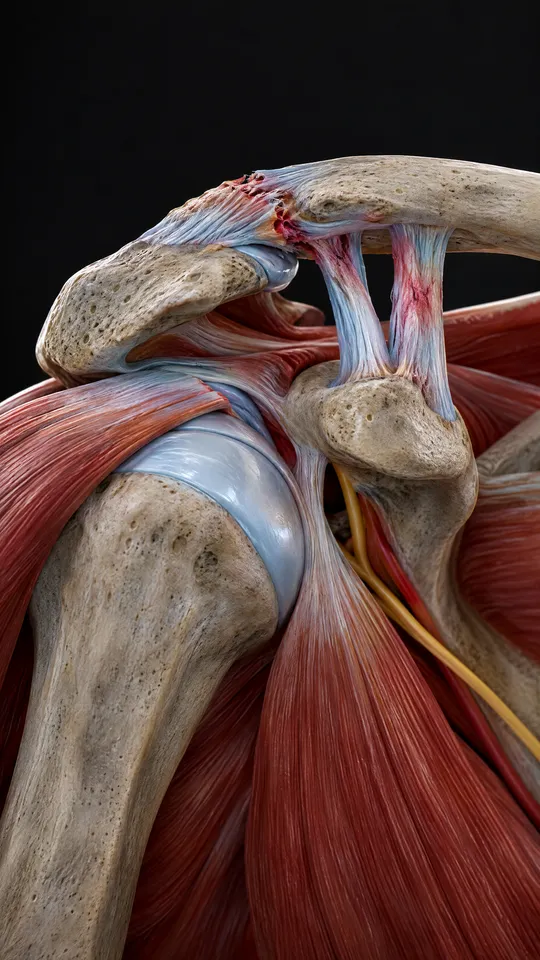

Top of the shoulder showing the small joint between the collarbone and the shoulder blade with stretched ligaments

Separated shoulder or dislocated shoulder? How to tell the difference

These two sound alike and get mixed up all the time. A separated shoulder is an AC joint injury. The problem is at the top of the shoulder, where the collarbone meets the shoulder blade 4, and the tenderness is on one spot directly over that joint 1.

A dislocated shoulder is a different injury in a different joint: the ball at the top of your upper arm bone coming out of its socket. If you're not sure which one you've done, get it assessed.

How it's diagnosed

An examination and a plain X-ray usually settle this. MRI isn't a routine test for it 1. You'll be examined sitting or standing, because the weight of your arm hanging makes any step at the joint easier to see 1. We also look for swelling and bruising over the end of the collarbone, see how far pain limits your shoulder movement, and check for other injuries from the same fall 1.

X-ray is the first choice for confirming and grading the injury 1, though a mild sprain can look normal on one 3. Holding a weight during the X-ray used to be common. It isn't routinely recommended now: it's uncomfortable and it doesn't change the treatment 1.

How we treat it

The first job is confirming it's the AC joint. Pressing directly on the joint is usually tender. Bringing your arm across your body tends to bring the pain on, which is called the cross-body adduction test 1,2. We may also use O'Brien's test or the Paxinos sign 2. If there's a visible deformity, or the injury looks higher-grade, an X-ray is how it gets properly graded 1.

For the common, lower-grade sprains:

1
A sling for a few days, not weeks. It gives the joint early comfort. Most people wean out of it within a few days 3.
2
Sports physiotherapy to rebuild the shoulder in stages. We start with pain-free movement and add load as the pain settles 3. Then we work towards the overhead and across-body positions your sport or job needs. The green light to go back is settled pain and normal movement, not a set date 3.
3
Manual therapy for the neck and upper-shoulder tightness that often comes with this injury. AC joint pain can spread into the neck and the front and side of the shoulder 2. We didn't find research showing that hands-on treatment speeds up ligament healing. Its job is keeping you moving comfortably while the joint settles.

Other treatments we may use

Surgery.

Higher-grade injuries (types IV to VI) are generally treated surgically 1. Type III is where it's debated. The current trend is towards non-surgical care, because results are similar either way 1. Surgery may still be chosen depending on what your work and sport demand of the shoulder 1, usually after a trial of non-surgical care 2. There's also no single gold-standard surgical technique 1. That decision belongs to an orthopaedic surgeon, and we'll help you go into it with a clear picture.

Ligament reconstruction later on.

Some people still have pain and a visible deformity months later, and for some of them ligament reconstruction may help 3.

Your recovery path: Reset, Rebuild, Return

An AC joint sprain is worked through in the three phases of The Well Motion Recovery Path™. You step up a phase on what the shoulder can do, whatever the date.

  • Reset: the first days after the fall. A sling for comfort 3, an X-ray if a bump or step needs grading 1, and manual therapy if your neck and upper shoulder have tightened up. Expect the top of the shoulder to stay tender to press after the arm feels easier. We move you on once you are out of the sling and moving within your pain-free range.
  • Rebuild: most of the work. Sports physiotherapy adds load as the pain settles 3. Expect reaching overhead and across your body to come good last. We move you on when the shoulder moves normally and loaded exercise no longer stirs the pain up.
  • Return: back to contact sport, the bike or manual work. We test the positions your sport or job asks for, at the load it asks for. You leave with a strength program, and knowing that a bump can stay even when the shoulder works well 3.

How long it usually takes. Lower-grade sprains typically settle in 4 to 6 weeks 3. Not everyone does: in one retrospective study quoted in a 2024 review, some people with type I and II injuries still had symptoms at 6 weeks 2. Types IV to VI are generally treated surgically 1, and then your surgeon sets the timeline.

Reducing the risk of it happening again

Nobody has run a trial on preventing AC joint injuries, so this is built on how they happen and what's been measured in the lab:

  • Contact is where it happens. In elite rugby union the AC joint was the most often injured part of the shoulder, and the main cause was a direct hit to the shoulder from another player or the ground 5. The researchers pointed to tackle skills and shoulder pads as the things to look at 5.
  • Shoulder pads. In one study, pads cut the peak force over the AC joint by about 40% in tackles 6. A lab test of four pads found they "bottom out" under heavier impacts, which is when you'd need them most 7. Neither study counted injuries.
  • The return. Movement in the pain-free range comes first, then loaded exercise as the pain settles. Sport or manual work waits until the pain has gone and the shoulder moves normally, which can take four to six weeks 3.

When to get it checked properly

Don't wait it out. Book an assessment if:

  • There's a visible bump or step at the top of your shoulder after the fall. It needs grading 1,3.
  • The pain isn't easing enough to come out of the sling after the first few days 3.
  • You're planning to go back to contact sport or heavy manual work. Your pain and movement should decide when, not the calendar 3.
  • Pain or function is still limited at three to six months. That warrants a review 3.

Most AC joint sprains are minor 1, and symptoms typically settle within four to six weeks 3.

Your first appointment

We start by listening: how it began, what makes it worse, and what it's stopping you from doing. Then we examine the area, explain what we find in plain English, and agree a plan with you. Your first visit is 40 minutes at Engadine and 30 minutes at our other clinics.

We see patients at Engadine, Mount Annan, Narellan and Appin, and at home through our mobile physiotherapy service. If you have private health cover, here's how health fund rebates work for physiotherapy.

FAQs

What does an AC joint sprain feel like?

You'll feel pain right on top of the shoulder, tenderness when you press one spot, and a sharper pain when you lift the arm 1. It can spread into the neck or the front and side of the shoulder 2. There may be swelling and sometimes a visible bump 3.

How long does it take for a sprained AC joint to heal?

Typically three to six weeks 4, and symptoms usually settle in four to six weeks 3. Soft-tissue injuries can linger for up to three months 4. Those timeframes are for the common, milder sprains. A higher-grade injury needs its own plan.

What happens if an AC joint injury is left untreated?

Most mild sprains settle. A bump that has formed is likely to stay 3. If pain or function is still limited at three to six months, get it reviewed, because some people go on to develop arthritis in the AC joint 3.

Is there a special test for AC joint sprain?

Yes. The cross-body adduction test is the main one: bringing your arm across your chest reproduces the pain 1,2. O'Brien's test and the Paxinos sign are also used 2, and an X-ray grades the injury 1.

What are the symptoms of a stage 1 AC joint sprain?

At type I the ligaments are sprained but intact, so there's usually no visible deformity 1. You'd expect tenderness over the joint and pain on movement, especially lifting the arm 1.

What aggravates AC joint pain?

Lifting the arm 1 and reaching across your body 1,2. Doing up a seatbelt, washing under the opposite arm and reaching overhead are the usual culprits.

More Shoulder conditions

Shoulder

Rotator Cuff Tear

Weakness or pain lifting the arm out to the side, reaching behind you, or sleeping on that shoulder. Often after a fall, or after years of overhead work.

Read more
Shoulder

Frozen Shoulder

Stiffness in every direction, including when someone else moves the arm for you. Comes on gradually and moves through stages.

Read more
Shoulder

SLAP Tear

SLAP stands for Superior Labrum, Anterior to Posterior. The labrum is the rim of cartilage that deepens your shoulder socket. The long head of the biceps tendon attaches to it at the top, and that's where these tears happen

Read more
Shoulder

Biceps Tendon Rupture

A rupture at the shoulder usually follows tendon wear that's been building for a while. Uncommonly, a severely worn tendon gives way altogether

Read more
Shoulder

Biceps Tendinopathy

Biceps tendinopathy is thickening and irritation of the biceps tendon at the front of the shoulder. It often starts without any known injury.

Read more
Shoulder

Shoulder Dislocation

A dislocated shoulder is the ball at the top of your upper arm bone coming out of its shallow socket. Most often it comes out the front.

Read more

If you've landed on your shoulder and there's a sore spot, or a new bump, on top of it, book an appointment at Engadine, Mount Annan, Narellan or Appin.

We'll work out the grade and what a realistic path back to your sport or your job looks like. Not sure it's the AC joint? Start from the Shoulder section of our Injury Finder instead.

Book an Assessment
Ahmed Elsayed, Principal Physiotherapist
Reviewed by Ahmed Elsayed Principal Physiotherapist at Well Motion

References

  1. Sirin E, Aydin N, Mert Topkar O. Acromioclavicular joint injuries: diagnosis, classification and ligamentoplasty procedures. EFORT Open Reviews, 2018;3:426-433. doi:10.1302/2058-5241.3.170027. https://pmc.ncbi.nlm.nih.gov/articles/PMC6129955/
  2. Lindborg CM, Smith RD, Reihl AM, Bacevich BM, Cote M, O'Donnell E, Mazzocca AD, Hutchinson I. Current Concepts in Management of Acromioclavicular Joint Injury. Journal of Clinical Medicine, 2024;13(5):1413. doi:10.3390/jcm13051413. https://pmc.ncbi.nlm.nih.gov/articles/PMC10931774/
  3. Acromioclavicular joint (ACJ) injury, patient information leaflet. Milton Keynes University Hospital NHS Foundation Trust. https://www.mkuh.nhs.uk/patient-information-leaflet/acromioclavicular-joint-acj-injury
  4. Acromioclavicular Joint Injury (self-management) leaflet. East Sussex Healthcare NHS Trust. https://www.esht.nhs.uk/leaflet/acromioclavicular-joint-injury-self-management/
  5. Usman J, McIntosh AS, Quarrie K, Targett S. Shoulder injuries in elite rugby union football matches: epidemiology and mechanisms. Journal of Science and Medicine in Sport, 2015;18(5):529-533. PMID 25156881. https://pubmed.ncbi.nlm.nih.gov/25156881/
  6. Pain MTG, Tsui F, Cove S. In vivo determination of the effect of shoulder pads on tackling forces in rugby. Journal of Sports Sciences, 2008;26(8):855-862. PMID 18569551. https://pubmed.ncbi.nlm.nih.gov/18569551/
  7. Harris DA, Spears IR. The effect of rugby shoulder padding on peak impact force attenuation. British Journal of Sports Medicine, 2010;44(3):200-203. PMID 20231600. https://pubmed.ncbi.nlm.nih.gov/20231600/
  8. Nordin JS, Olsson O, Lunsjö K. Acromioclavicular joint dislocations: incidence, injury profile, and patient characteristics from a prospective case series. JSES International, 2020;4(2):246-250. PMID 32490410. https://pmc.ncbi.nlm.nih.gov/articles/PMC7256880/