What's actually causing it
A hip can snap in three different ways 1.
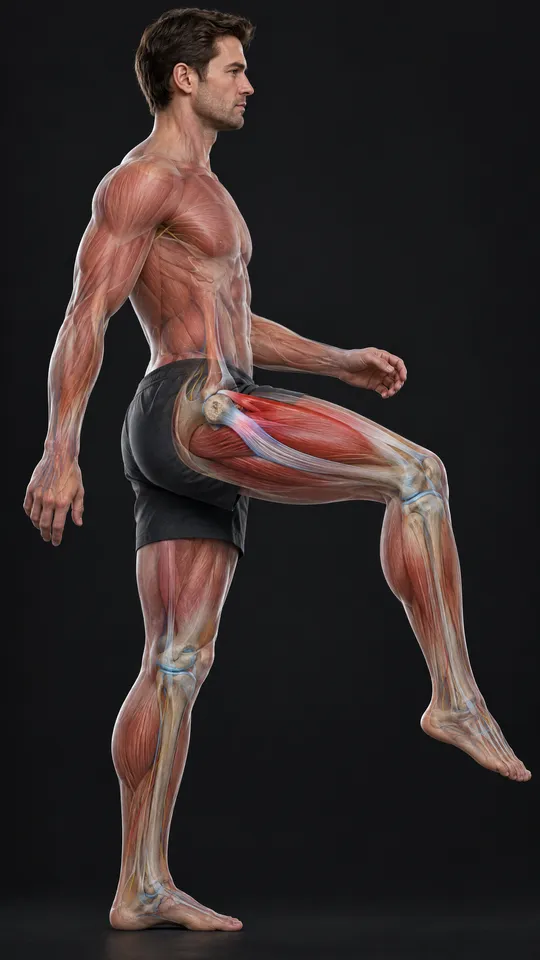
External snapping is the most common 1,6. The thick band down the outside of your thigh (the iliotibial band, or ITB), or the front edge of your buttock muscle, flicks over the bony point on the side of your hip (the greater trochanter) 1. You feel it on the outside of the hip 2.
Internal snapping happens at the front. The iliopsoas tendon, from your main deep hip flexor, catches on a ridge of the pelvis or on the ball of the hip joint 1. You feel it at the front of the hip or towards the groin 2.
Intra-articular snapping comes from inside the joint. The cause can be a tear in the labrum (the rim of cartilage around the socket), a loose fragment or a torn ligament 1. It often follows an injury and comes on quickly 3.
It's common with repeated hip bending and straightening 6, especially in dancers, who combine that with turning the leg out and lifting it sideways 5. Tightness is part of it 5, but so is control. A muscle can be short, or it can be switching on too hard at the wrong moment, which is common at the front of the hip 1. Weakness in gluteus medius, a stabilising muscle on the side of the hip, often goes with internal snapping. An imbalance between gluteus maximus and a smaller muscle, tensor fasciae latae, is a feature of external snapping 1. The internal type is reported more often in women than in men 4.