Need urgent care? 24/7 Mobile & After-Hours Emergency Physiotherapy Call (02) 8111 5633 For life-threatening emergencies, always call 000
Calf

Shin Splints

5.0 average rating on Google
Registered NDIS Provider
SIRA Registered Provider

You've upped your running mileage the last few weeks, and now there's a dull, aching pain along the inside of your shin that shows up every time you run. Sometimes it eases off once you're warmed up, sometimes it doesn't. If that sounds familiar, you're probably dealing with shin splints, and you're not alone: it's one of the most common overuse injuries in runners, and it's very treatable once you know what's actually going on.

What's actually causing it

Shin splints happen when the muscles and connective tissue along your shin bone (tibia) are loaded faster than they can adapt. Every step while running creates a small amount of stress on that bone and the tissue attached to it. A well-conditioned shin handles that easily, but ramp up your training too quickly and the tissue doesn't get the chance to catch up. The result is inflammation and tenderness along a stretch of the inner shin, typically the same spot every time you run.

It's genuinely common. Research into runners and military recruits, two groups that both ask a lot of their shins in a short space of time, consistently finds sudden increases in training load, flat or overpronating feet, and restricted ankle movement among the biggest risk factors1. Avoiding that kind of overstress in the first place is also the single biggest prevention factor recognised in the physiotherapy literature specifically2, which is exactly why load management, not just treatment after the fact, is the core of how we approach it.

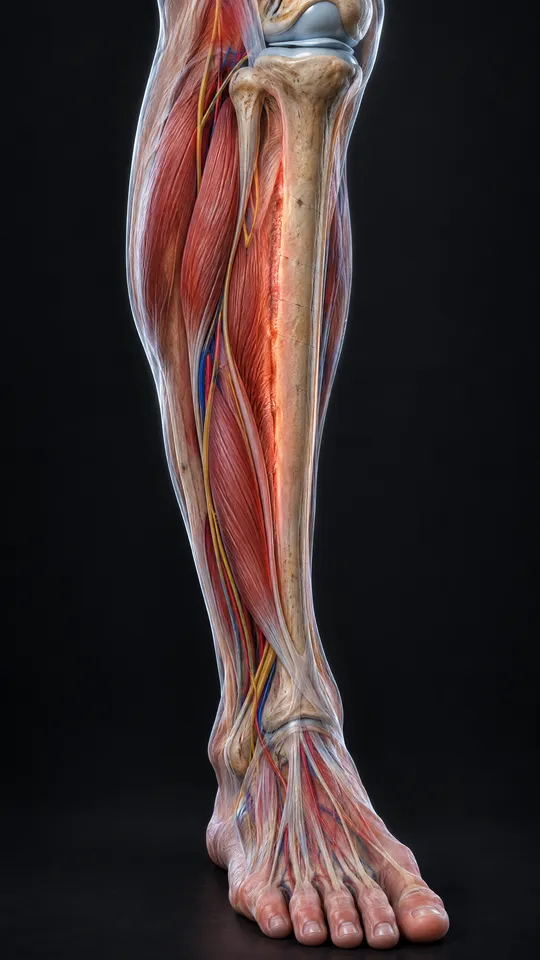
Lower leg showing an irritated strip along the inner edge of the shin bone

Shin splints or a stress fracture? How to tell the difference

This is the distinction that actually matters, because the two need different management.

Shin splints (MTSS): the pain is spread out (tender along more than about 5cm of the inner shin, not one exact spot) and it tends to ease once you've warmed up, then come back afterwards.

Stress fracture: the pain is much more localised (a specific point you could put a fingertip on) and it tends to get worse the longer you keep running on it, rather than easing with warm-up. It can also start hurting at rest, or at night.

Clinically, that spread-versus-pinpoint pattern is one of the main ways the two are told apart before any imaging is even needed1. If your pain fits the stress-fracture pattern, that's a genuine reason to get it properly assessed rather than pushing through: a stress fracture that keeps being loaded can get worse, not better.

How it's diagnosed

Shin splints can be diagnosed reliably from your history and an examination, so most people never need a scan1. Expect questions about recent changes to your training, your shoes, and where the pain sits and what kind of pain it is7. Then the clinician presses along the inner edge of your shin bone. Tenderness spread along more than 5cm of it, with no marked swelling, redness or weak pulse in the foot, supports the diagnosis1.

Scans are for when the picture is unclear or a stress fracture is a worry1. A plain X-ray looks normal in shin splints, and often in an early stress fracture too, so MRI is the preferred scan when one's needed1.

How we treat it

The first thing we do is work out where you actually sit on that spectrum, and how your training, footwear and running mechanics got you there, not just treat the sore spot in isolation.

From there, treatment usually involves:

1
Load management: not stopping running altogether for most people, but bringing your volume back to a level your shins can actually cope with, then rebuilding it gradually. A commonly used guide is increasing weekly running load by no more than about 10% at a time, which gives bone and soft tissue time to adapt rather than constantly playing catch-up.
2
Manual therapy to address tightness through the calf and surrounding muscles that can be loading the shin unevenly.
3
Targeted strengthening: particularly through the hip, calf and the muscles that control ankle movement, since weakness through this chain is a recognised contributor to how the shin gets loaded during running.
4
A look at footwear and running surfaces, since both genuinely change how much load reaches the shin with every step.

For cases that are slow to settle with the above, shockwave therapy is a real option worth discussing: it's specifically noted as a treatment approach for shin splints in the clinical literature, not just something we reach for generically1, and one military-population comparison found it outperformed several other adjunct treatments, including compression therapy and pneumatic leg braces, specifically for this condition.

Other treatments we may use

Dry needling.

A randomised controlled trial of 50 university-level athletes with MTSS found dry needling produced a significant drop in pain (from an average of 7 out of 10 down to 2 out of 10) over the short term, while a control group receiving standard care alone saw no improvement3. Worth noting: the same trial found dry needling didn't improve ankle range of motion specifically. It's a genuine pain-relief tool here, not a fix for every part of the picture on its own, which is exactly why we pair it with load management and strengthening rather than using it in isolation. See our Dry Needling page for more on how we use it.

Rigid and kinesiology taping.

Taping is a real, studied option for exercise-related leg pain: a randomised trial compared rigid anti-pronation tape plus exercise, elastic (kinesiology) tape plus exercise, and exercise alone, specifically for this kind of leg pain4. It's generally used as a short-term way to reduce load and support you through the early, most irritable phase, not a standalone long-term fix. See our Sports Taping page for the rigid vs. kinesiology breakdown.

Compression therapy.

You'll sometimes see compression sleeves or pneumatic compression recommended for shin splints, and we're happy to discuss it, but it's worth being upfront that the evidence for compression specifically, on its own, is weak: a randomised trial of 74 athletes compared a graded running program alone, the same program plus calf stretching and strengthening, and the same program plus a compression stocking, and found no significant difference in recovery time or patient satisfaction between the three5. We'd rather tell you that plainly than oversell a modality the research doesn't clearly support, in line with how we approach every treatment decision here.

Reducing your risk of it coming back

Having had shin splints once makes you more likely to get them again1. Prevention has been tested in randomised trials, and a 2025 review pooled 12 of them, covering more than 8,000 people8:

  • Train how you move, not only how far. Neuromuscular training (exercises that work on control of your movement) had the strongest result: four trials, nearly 3,900 people, clearly fewer cases8. In one army study, retraining running technique cut the risk by 75% over 26 weeks1.
  • Insoles, if your feet roll in. Insoles made for overpronation also reduced cases, on moderate-certainty evidence. Plain shock-absorbing insoles didn't8.
  • Don't rely on stretching. The same review found no evidence that static stretching programmes prevent shin splints8.
  • Build up gradually. A graded programme, enough recovery time and not overtraining are still the core advice1, and worn-out or unsupportive shoes are a recognised contributor1. No trial has isolated these two.

When to get it checked properly

Most shin splints respond well to the approach above. But get it assessed rather than pushing through if:

  • The pain is in one specific spot you could point to, rather than spread along your shin
  • It's getting worse the longer you run, instead of warming up and easing
  • It's started waking you up at night, or hurts even when you're not running

None of that means panic. It just means it's worth ruling out a stress fracture before you keep loading it.

Your first appointment

We start by listening: how it began, what makes it worse, and what it's stopping you from doing. Then we examine the area, explain what we find in plain English, and agree a plan with you. Your first visit is 40 minutes at Engadine and 30 minutes at our other clinics.

We see patients at Engadine, Mount Annan, Narellan and Appin, and at home through our mobile physiotherapy service. If you have private health cover, here's how health fund rebates work for physiotherapy.

FAQs

What are the symptoms of shin splints?

A dull ache along the inner or front edge of the shin, soreness when you press on the bone itself, and pain that starts during or shortly after activity, often easing with rest, then returning once you're back on your feet. Some people also notice mild swelling or redness over the area.

What's commonly mistaken for shin splints?

Chronic exertional compartment syndrome (CECS), a different condition where pressure builds up inside the muscles of the lower leg during exercise. It's a genuine mimic worth knowing about: a 2023 review of the research notes that CECS is commonly misdiagnosed as shin splints, and that it affects young athletes, especially avid runners6. The practical difference: CECS pain tends to build predictably during exercise and ease fairly quickly once you stop, and it doesn't usually respond to the load-management approach that helps shin splints, which is exactly why getting an accurate diagnosis matters before you commit to a treatment plan.

How long do shin splints take to heal?

It varies a lot depending on how long you've been running through it and how much load reduction you actually make. Mild cases can settle in a couple of weeks with the right adjustments; more established cases can take longer, which is part of why an actual assessment, rather than generic rest-and-see advice, tends to get people back running faster.

More Calf conditions

Calf

Calf Strain (Soleus vs Gastrocnemius)

A sudden catch or tearing feeling at the back of your lower leg, often mid-run or mid-game, and a calf that's been tight and sore to push off since. How long it takes to settle depends on which of the two calf muscles you've strained.

Read more

Ready to get an actual plan for your shins instead of guessing?

Book an assessment with the Well Motion team, or read more about how we approach Sports Physiotherapy more broadly.

Book an Assessment
Ahmed Elsayed, Principal Physiotherapist
Reviewed by Ahmed Elsayed Principal Physiotherapist at Well Motion

References

  1. Larson CM, McClure DE, May T, Oh J. Medial Tibial Stress Syndrome. StatPearls, updated December 2025. NCBI Bookshelf. https://www.ncbi.nlm.nih.gov/books/NBK538479/
  2. Galbraith RM, Lavallee ME. Medial tibial stress syndrome: conservative treatment options. Current Reviews in Musculoskeletal Medicine, 2009;2(3):127-133. https://pmc.ncbi.nlm.nih.gov/articles/PMC2848339/
  3. Randomised controlled trial of dry needling in university-level athletes with medial tibial stress syndrome. PMC, 2025. https://pmc.ncbi.nlm.nih.gov/articles/PMC11770860/
  4. Randomised trial comparing rigid anti-pronation taping, kinesiology taping, and exercise alone for exercise-related leg pain. PMC, 2013. https://www.ncbi.nlm.nih.gov/pmc/articles/PMC4201713/
  5. Moen MH, et al. A randomised trial of a graded running program, with and without calf stretching/strengthening, with and without a compression stocking, for medial tibial stress syndrome. BMC Sports Science, Medicine and Rehabilitation, 2012. https://pmc.ncbi.nlm.nih.gov/articles/PMC3352296/
  6. Tarabishi MM, Almigdad A, Almonaie S, Farr S, Mansfield C. Chronic exertional compartment syndrome in athletes: an overview of the current literature. Cureus, 2023;15(10):e47797. https://pmc.ncbi.nlm.nih.gov/articles/PMC10676709/
  7. Shin splints: symptoms, causes, treatment and diagnosis. healthdirect (Australian Government), 2024. https://www.healthdirect.gov.au/shin-splints
  8. Marques TBT, Rangel RPS, Martins LV, Vidal APC. Preventive interventions for medial tibial stress syndrome: systematic review and meta-analysis. Gait & Posture, 2025;122:92-98. https://doi.org/10.1016/j.gaitpost.2025.07.312