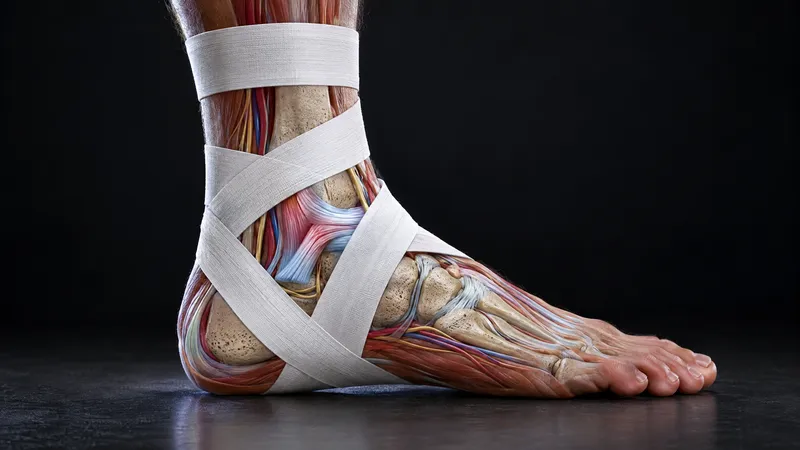
What does sports taping do?
Sports taping means applying adhesive tape to the skin over a joint or muscle to change how it moves or feels. What it does depends on which kind of tape you use and how it goes on.
Rigid tape is a woven fabric with no stretch. It holds a joint firmly, which stabilises it and limits the movement you're trying to protect, like an ankle rolling inwards 1.
Kinesiology tape is elastic. It can stretch to about 120% of its original length and is designed to be worn for 3 to 5 days 1. It doesn't lock a joint down. There are several theories about how it works, including lifting the skin slightly to take pressure off the tissue underneath. Those mechanisms remain largely unproven 1, which is worth knowing before you buy into any of them.
The simplest way to think about it: rigid tape stops movement, while kinesiology tape supports you as you move.
Rigid tape vs kinesiology tape: the real difference
First, the names. In Australia, "sports tape", "athletic tape" and "strapping tape" usually mean the same product: rigid tape. It's a woven fabric with no elasticity, usually backed with a zinc oxide adhesive 1. Kinesiology tape is a different product altogether.
| Rigid (strapping) tape | Kinesiology tape | |
|---|---|---|
| Material | Woven fabric, no stretch 1 | Elastic, stretches to about 120% of its length 1 |
| Main job | Stabilises the joint and restricts movement 1 | Supports without restricting normal movement |
| How long it stays on | Usually applied for a specific session or event, then removed | Can be worn for 3 to 5 days 1,6 |
| What the pain evidence shows | The only tape type to reach a clinically meaningful effect on pain, in the medium term 1 | A small, short-term effect that may not be noticeable in practice 1,2 |
Neither tape is better outright. They do different jobs. If a joint needs protecting while it heals, or you have a known instability going into a game, rigid tape is usually the tool for that. If the goal is comfort while you keep moving, kinesiology tape is the option people usually reach for, but you should expect modest results from it.
If you'd rather have it done properly than learn from a video, that's what our sports taping service is for.
Does kinesiology taping really work?
This is the question most people are asking. The answer is a little, for a short time, and the evidence is weaker than the marketing suggests.
The largest summary of the research so far pooled 128 systematic reviews, covering 310 separate trials and more than 15,000 people 2. It found kinesiology tape may reduce pain straight after it goes on and over the short term, and may improve function immediately. It showed little to no effect on:
- pain in the medium term
- function beyond the first few days
- muscle strength
- range of motion
- condition-specific symptoms at any stage 2.
The researchers rated all of that evidence as very low certainty. Most of the reviews it drew on were of critically low quality, and the authors concluded that the clinical effects of kinesiology tape are "very uncertain" 2.
A separate 2025 meta-analysis of 28 trials asked how big the pain relief is 1. Elastic tape did reduce pain compared with no tape, both immediately and over the following days. On a 0 to 100 pain scale, though, the average drop was about 9 to 10 points. The researchers set a change of more than 20 points as the threshold for a clinically meaningful difference, roughly the point where you'd notice a real change 1. The authors described elastic tape's effect as small and possibly not clinically significant. They also advised caution because the trials varied a lot from one to the next 1.
The two sources don't fully agree on whether that short-term relief is big enough to notice. They do agree it's short-lived and that tape doesn't make you stronger or more mobile.
So where does that leave you? Kinesiology tape can be a reasonable short-term comfort measure, for example if it helps you get through your rehab exercises with less pain. It isn't a treatment in its own right. If anyone tells you tape will fix the underlying problem, the research doesn't support that.
When rigid tape earns its place
Rigid tape comes out of the same research looking better. In that 2025 meta-analysis, rigid tape beat no tape on pain in the medium term by about 25 points on a 0 to 100 scale. It was the only tape type to clear that 20-point threshold 1. The studies were of fair to good quality overall, and the same caution about variation between trials applies 1.
This matches how physiotherapists tend to use it. Rigid tape does a specific mechanical job: it holds a joint out of the position that hurts it. That's most useful when a structure is healing and needs protecting, or when you're returning to sport with a joint that has let you down before.
Taping an ankle: repeat sprains vs first sprains
Ankles are where taping has been studied most, and the findings are useful if you play sport.
A review of 24 studies found that taping, bracing and neuromuscular training (balance and coordination exercises) all reduced the risk of re-spraining an ankle, and by similar amounts 3. Depending on the study, the risk fell to somewhere between half and one-fifth of what it was without them 3. That's a real effect.
But there's a catch. The benefit came mainly from people who had already sprained that ankle. For a first-ever sprain, the authors found the effect was "either non-existent or very low" 3. Tape isn't much of an insurance policy if you've never been injured. It's mainly useful for protecting an ankle that already has a history.
An earlier systematic review found that tape or a brace reduced how often ankle sprains happened and made the ones that did happen less severe 4. Braces appeared to work better than tape in that review, though every study it included had methodological weaknesses 4. If you need ankle support week after week, a brace may suit you better than being taped each time, so it's worth asking about.
Healthdirect's advice reflects the same picture. To help prevent a sprain it lists an ankle brace or tape (especially for athletes or anyone who has recently sprained an ankle), along with warm-ups that include stretching, strengthening and balance work, and supportive shoes 5. It also notes that most ankle sprains take 4 to 6 weeks to heal, some people have discomfort for up to 12 months, and a sprain that isn't properly treated can lead to chronic ankle instability 5.
The best results come from combining an external support like tape or a brace with balance and strength training 3. The tape protects you while the training builds an ankle that needs less protecting. If you're recovering from a sprain now, our ankle sprain page covers the recovery side, and exercise prescription and conditioning is where that training program gets built.
Should you tape yourself?
Plenty of people tape their own ankles and wrists, and for a simple, familiar job that can be fine. If you're doing it yourself, do a few safety checks every time 6,7:
- Check your skin first. If you've reacted to adhesive tape before, don't use it without advice.
- Don't tape too tight. Tape should never cut off the blood or nerve supply to your fingers or toes.
- Check circulation afterwards. The skin should keep its normal colour and feeling. Numbness, pins and needles, or skin that turns pale or blue all mean the tape comes off.
- Take care removing it. Peel it slowly and gently. Don't tear it off, as that can damage the skin.
A video can show you the steps. What it can't tell you is whether taping suits your injury, which tape to use or which direction to support. It's worth having it done properly at least once so you know what correct taping looks and feels like. If you're a coach or trainer who tapes players regularly, a hands-on course (Sports Medicine Australia runs them) will teach you more than any article can.
When tape isn't the right call
Tape is low-risk, but it's not risk-free, and it isn't right for everyone. General reasons not to use it include 6:
- broken skin or open wounds in the area
- a skin infection
- a known allergy or past reaction to tape adhesive
- poor circulation or reduced feeling in the area being taped.
Skin problems are the most common side effect. In the large kinesiology tape overview, about one extra person in every 173 taped developed skin irritation because of the tape, and about one in every 356 developed itching 2. That's uncommon, but if your skin reacts, take the tape off.
There's also a less obvious reason to hold off. Tape can make a sore joint feel better while the cause, such as a strength deficit, a sudden jump in training load or a movement pattern that breaks down when you're tired, carries on underneath. If you're taping the same area week after week just to get through, that's a sign something needs a proper look.
Where taping fits in a rehab plan
Taping is a short-term tool. It can make you more comfortable in the early, irritable stage of an injury, give you some protection as you return to sport, or help you get through a game you don't want to miss. What it doesn't do is build the strength, control and load tolerance that stop the injury coming back. On the evidence above, that work matters more than the tape does.
That's why we use taping as one part of a plan, not the whole plan. When you're working your way back to sport, taping usually sits alongside a structured return-to-play program through sports physiotherapy.
What to expect from a taping session at Well Motion
We don't tape first and ask questions later. Every appointment starts with working out what's going on: what happened, which movements matter to you, and what the tape needs to do. Only then do we choose between rigid tape, kinesiology tape or a different option such as a brace.
Once the tape is on, we'll explain what it's doing, what it should and shouldn't feel like, and which warning signs mean it needs to come off. You'll also leave knowing the rest of the plan, because the tape on its own isn't the treatment. You can read more about how we approach it on our sports taping page.
FAQs
What does sports taping do?
It changes how a joint moves or how it feels to move. Rigid tape doesn't stretch, so it stabilises a joint and limits movement you're trying to protect. Kinesiology tape is elastic, supports you without locking the joint and can be worn for several days 1. Rigid tape has the stronger evidence for pain relief 1. Kinesiology tape's benefits look small and short-lived 2.
What is the difference between sports tape and kinesiology tape?
"Sports tape" usually means rigid tape with no stretch, used to stabilise a joint. Kinesiology tape stretches to about 120% of its length and can stay on for days 1. They do different jobs. Rigid tape restricts movement; kinesiology tape supports movement. In a 2025 meta-analysis, only rigid tape reduced pain by a clinically meaningful amount 1.
What is the best type of tape for sports taping?
It depends on the job. If you need to protect or stabilise a joint, rigid tape is the better choice. It was the only type in a 2025 meta-analysis to cut pain by a clinically meaningful amount, in the medium term 1. If you want short-term comfort without restricting movement, kinesiology tape is an option, but you should expect only a small effect 1,2. For a recurring ankle problem, a brace may work as well as or better than tape 4. We can help you work out which suits you.