Need urgent care? 24/7 Mobile & After-Hours Emergency Physiotherapy Call (02) 8111 5633 For life-threatening emergencies, always call 000
Knee

ACL Injury & Rehabilitation

5.0 average rating on Google
Registered NDIS Provider
SIRA Registered Provider

You changed direction, or landed awkwardly, and something in the knee let go. Maybe there was a pop. The swelling came up fast, and by morning the knee felt like it belonged to someone else. Since then you've had a scan, a word you half-recognise and possibly a surgery date, but no straight answer about who needs surgery, what recovery involves, or how you'll know you're ready to play again rather than hoping.

What's actually causing it

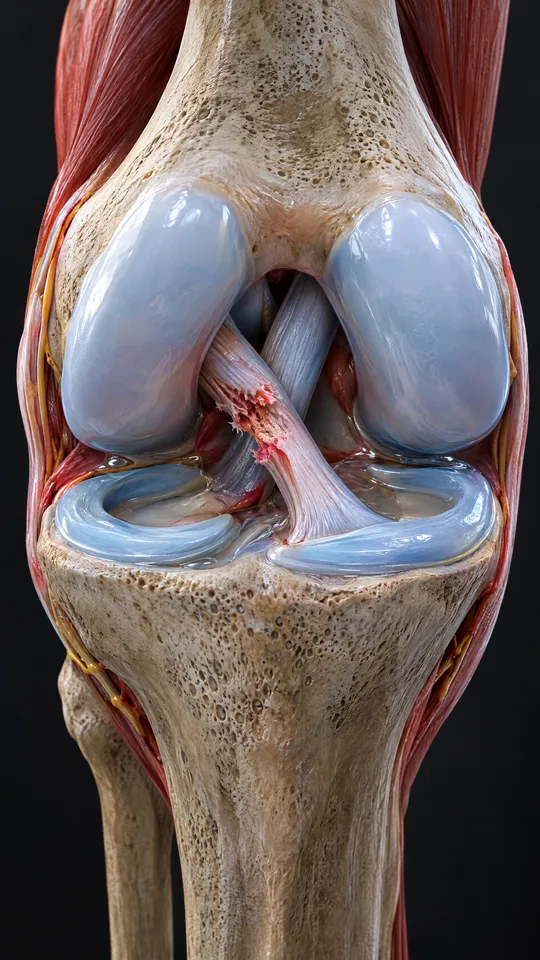
The anterior cruciate ligament sits in the centre of the knee joint, and it's the knee ligament most commonly injured 2. Its job is to stop the shin bone sliding forward on the thigh bone and to control rotation, which is what the knee loses when it ruptures.

Once it's gone, the knee usually still bends, straightens and walks in a straight line. The problem appears the moment you ask it to twist or turn: it gives way 1.

That instability compounds: if the knee keeps giving way you can tear the cartilage inside it, which increases the risk of future knee problems and usually needs another operation 1.

Inside the knee joint showing a torn anterior cruciate ligament crossing in front of the intact posterior ligament

Ruptured, torn, or a meniscus problem? How to tell the difference

"Torn" and "ruptured" are the same injury, described two ways

: healthdirect's own wording is "torn (ruptured)" 1. The distinction people are reaching for is grade: a partial tear, where some of the ligament still does its job, versus a complete rupture, where it has lost continuity. Ask your specialist which one you have.

A meniscus tear feels different, and usually travels with an ACL injury rather than instead of one

: catching, locking or a knee that won't fully straighten, instead of collapsing under a turn. In a 2023 cohort of 80 acute ACL ruptures, 49% had a meniscal injury too 5. If your symptoms sound more mechanical than unstable, start from Meniscus Tear.

How it's diagnosed

A careful examination is often enough to diagnose a torn ACL, before any scan 7. Your clinician will ask exactly how it happened, which movement or what impact, and what the knee is doing now. Then they check each structure in the injured knee and compare it with your other one 7.

Scans mostly add certainty and look for other damage. An X-ray won't show a ligament, but it can show a related bone injury, such as a small piece of bone pulled away where the ligament attaches. An MRI isn't required to diagnose a torn ACL. It does give the best view of the ligaments and cartilage, including the meniscus, and of how bad the tear is 7.

How we treat it

Surgery or not, the shape is the same: restore movement, control swelling, rebuild quadriceps and hamstring strength and co-ordination, then earn your way back to sport against measurable targets 1,6.

1
Assessment, early. What's torn, what's torn with it, and, if you're within about four weeks of the injury, whether a non-surgical pathway is still on the table, because that window closes 5. More in our Cross Bracing Protocol article.
2
Sports physiotherapy for the non-surgical route. The named alternative to reconstruction is physiotherapist-prescribed quadriceps and hamstring strength and co-ordination exercises, with bracing for giving way during sport 1, a real pathway for a non-elite athlete, not a consolation prize.
3
Post-surgical rehabilitation after a reconstruction, staged against your knee, not the calendar:
StageTargets to clear 6
First weekKnee movement starts straight away and weight goes through the leg as you tolerate it, within your surgeon's instructions
Weeks 2–4Quadriceps tightening and straight-leg raises in the first two weeks; leg press possible from week 3 with a hamstring graft, and seated knee straightening in a limited range from week 4, watching for pain at the front of the knee
Before running restarts95% of full bend, full straightening, no more than a trace of swelling, quadriceps above 80% of the other leg, pain-free repeated single-leg hopping
Before return to sport (criteria set for professional athletes)No pain or swelling, full range, a stable knee, jump tests above 90% of the other leg, quadriceps and hamstring strength matching the other leg for pivoting sports, and normal scores for knee function and psychological readiness
OverallRehabilitation continuing for 9 to 12 months 10
1
Return-to-sport testing that decides something. In a two-year study of 106 pivoting-sport athletes, those passing a full criteria battery (over 90 on knee function, self-rated function, quadriceps symmetry and hop symmetry) had a 5.6% reinjury rate against 38.2% for those who failed and returned anyway 3. That comparison didn't reach conventional significance (p=0.075) in a cohort that size, so we won't overstate it. What was significant: level I pivoting sport carried a 4.32 times higher reinjury rate, and more symmetrical quadriceps strength before returning reduced reinjury 3.

Nine months is a floor, not a finish line: guidance is for rehabilitation to continue for 9 to 12 months 10, and time since surgery is treated as necessary but not sufficient unless you also pass physical and psychological criteria 6.

Other treatments we may use

First 48 to 72 hours.

Stop the activity, rest, ice about 15 minutes every couple of hours, bandage firmly down the lower leg, and elevate. Avoid heat, alcohol and massage 2.

The Cross Bracing Protocol.

A medically supervised pathway run with your doctor, not something we prescribe on our own: the knee is braced at 90° for four weeks, then progressively opened until the brace comes off at 12 weeks, with supervised rehabilitation throughout 5. Know its limits before pinning hopes on it: 90% of the 80 participants showed MRI healing at three months, and those healing best more often had normal knee laxity and returned to pre-injury sport, but 14% re-injured their ACL, the study was uncontrolled and single-centre, and the authors say longer follow-up and trials are needed 5. It has to start within roughly four weeks of injury, so it isn't a wait-and-see option.

Reconstruction.

Often the right choice, particularly for high-level athletes 1. That decision is yours and your surgeon's, not ours. Recognised complications include graft failure (the knee giving way again as the graft stretches, or after a further sports injury), loss of knee movement, and discomfort at the front of the knee 1.

Your recovery path: Reset, Rebuild, Return

With or without a reconstruction, ACL rehabilitation runs along The Well Motion Recovery Path™. Your knee earns each step by passing tests, not by reaching a date.

  • Reset: from the injury, and again straight after surgery if you have it. Rest, ice, a firm bandage and elevation at first 2, then early movement and weight bearing within your surgeon's instructions 6. The surgery decision is made here too 1,5. Expect a swollen, stiff knee. We move you on once the swelling has settled and the knee straightens fully.
  • Rebuild: the long middle. Quadriceps and hamstring strength and co-ordination work 1, through sports physiotherapy or post-surgical rehabilitation, building towards running. Expect a knee that feels ready before it measures ready. We move you on when you clear the running criteria in our staged table 6.
  • Return: back to your sport, or to work and activity if sport isn't the goal. We test strength and hopping against your other leg, and how far you trust the knee 3,6. You leave with a prevention program 8 and a plan if the knee gives way 1.

How long it usually takes. After a reconstruction, guidance is for rehabilitation to continue for 9 to 12 months 10. On the Cross Bracing Protocol the brace comes off at 12 weeks 5, but that single uncontrolled study gives no return to sport time, so we won't quote one. Time alone doesn't clear you 6.

Reducing the risk of it happening again

A second ACL injury is the outcome everyone wants to avoid, and some of the risk is in your hands:

  • Do the prevention training. A meta-analysis of 11 studies and 16,316 participants found ACL injury prevention programs cut the risk to roughly a third of the comparison group's. About 71 people had to do the training to prevent one rupture, and no single program came out best 8. Those studies were about ACL injuries in general, so for a second one they're a guide and no more.
  • Pass the tests before you go back. Of 158 professional male athletes followed after a reconstruction, 26 ruptured the graft. Those who returned without meeting all six discharge criteria, strength and hop tests among them, had four times the risk 9.
  • Get your thigh strength even. More symmetrical quadriceps strength before returning meant fewer reinjuries 3, and a weak hamstring-to-quadriceps ratio went with more graft ruptures 9.
  • Speak up if the knee keeps giving way. That's how the cartilage gets torn 1.

When to get it checked properly

Book an assessment instead of waiting it out if:

  • The knee gave way with a pop and swelled within hours
  • It still gives way or feels untrustworthy when you twist or turn 1
  • It catches, locks or won't fully straighten: that points at the cartilage too 1
  • You're inside four weeks of the injury and want to know whether a non-surgical pathway is still on the table, because that window closes 5
  • You're post-reconstruction and not meeting the milestones above, such as full straightening and settled swelling before running restarts 6
  • The knee has started giving way again after a reconstruction 1

A ruptured ACL is serious, but it isn't a verdict. Whichever route you take, the outcome turns largely on the rehabilitation.

Your first appointment

We start by listening: how it began, what makes it worse, and what it's stopping you from doing. Then we examine the area, explain what we find in plain English, and agree a plan with you. Your first visit is 40 minutes at Engadine and 30 minutes at our other clinics.

We see patients at Engadine, Mount Annan, Narellan and Appin, and at home through our mobile physiotherapy service. If you have private health cover, here's how health fund rebates work for physiotherapy.

FAQs

How serious is a ruptured ACL?

Serious, not catastrophic. Roughly a third of people who have a reconstruction never get back to the level they played at 4, level I pivoting sport carries a 4.32 times higher reinjury rate 3, and it's unlikely the knee will ever be exactly as it was 1. Against that: four in five non-elite knees recover to near normal without surgery 1.

Can a ruptured ACL heal on its own?

Sometimes, under specific conditions, and it isn't settled. The long-standing position is that it doesn't heal by itself 2, on a page last reviewed in 2012. A 2023 study of 80 people braced early found MRI healing in 90% at three months, but 14% re-injured their ACL, the series was uncontrolled and single-centre, and the authors called for longer follow-up and trials 5. It starts within about four weeks of injury, so "wait and see" isn't the same as giving it a chance to heal.

What is the recovery time for a ruptured ACL?

Guidance is for rehabilitation to continue for 9 to 12 months after reconstruction 10. Treat that as a floor: reinjury risk dropped 51% for each month return was delayed up to nine months, with no benefit after 3. What you can pass matters more than the date.

Can you walk after a ruptured ACL?

Usually yes, which is why it gets underestimated. The problem is the knee giving way on twisting and turning, not an inability to walk in a straight line 1. A knee that walks fine still needs assessing: continued giving way risks tearing the cartilage, which usually means another operation 1.

How long can a torn ACL go untreated?

No safe number, and delay costs you options. Every episode of giving way risks a cartilage tear, which usually needs surgery of its own 1, and delay closes the early non-surgical window: the 2023 bracing protocol begins within roughly four weeks of injury 5. Even without surgery, the knee needs structured strength and co-ordination work to stop it giving way 1.

Can you recover 100% after ACL surgery?

Not usually, not if "100%" means the knee you had before. It's unlikely the knee will ever be as good as it was 1, and while most people make a good recovery, it takes hard work 1. The 2014 figures, over a decade old now and best read as a guide rather than current data, put 81% of 7,556 people back into some sport, 65% at their pre-injury level and 55% back to competitive sport 4. Symmetrical hopping and a positive psychological response were both measured predictors of returning to pre-injury level 4, both trainable.
More Knee conditions

Knee

Meniscus Tear

Catching, locking or swelling after a twist, sometimes with a knee that won't fully straighten.

Read more
Knee

MCL Injury

The MCL runs down the inside of your knee. Most injuries happen when something hits the outside of the knee and forces it inwards; it's the ligament most commonly injured in knee trauma.

Read more
Knee

Prepatellar Bursitis

A bursa is a small fluid-filled sac that cushions bone from the soft tissue around it. The prepatellar bursa sits at the front of your knee, over the kneecap. When it's irritated it swells, and a tender, warm swelling right over the bursa is the classic sign.

Read more
Knee

Patellar Dislocation

A patellar dislocation is the kneecap being forced out of its groove at the end of the thigh bone. It almost always goes outwards, towards the outside of the knee.

Read more
Knee

Baker's Cyst

A Baker's cyst is a build-up of fluid behind the knee, usually excess fluid from the knee joint itself.

Read more

If you've done your ACL and nobody has yet told you what the next nine to twelve months actually involve, or you're already rehabbing and have no idea whether you're on track, book an appointment at Engadine, Mount Annan, Narellan or Appin and we'll build the program around where your knee genuinely is, with real tests to pass rather than dates to wait out.

If you're not certain the ACL is what you've injured, start from the Knee section of our Injury Finder instead.

Book an Assessment
Ahmed Elsayed, Principal Physiotherapist
Reviewed by Ahmed Elsayed Principal Physiotherapist at Well Motion

References

  1. ACL reconstruction. healthdirect (Australian Government funded). Last reviewed January 2026. https://www.healthdirect.gov.au/surgery/acl-reconstruction
  2. Knee injuries. Better Health Channel, Victorian Department of Health. Reviewed 31 July 2012. https://www.betterhealth.vic.gov.au/health/conditionsandtreatments/knee-injuries
  3. Grindem H, Snyder-Mackler L, Moksnes H, Engebretsen L, Risberg MA. Simple decision rules can reduce reinjury risk by 84% after ACL reconstruction: the Delaware-Oslo ACL cohort study. British Journal of Sports Medicine, 2016;50(13). PMID 27162233. https://pubmed.ncbi.nlm.nih.gov/27162233/
  4. Ardern CL, Taylor NF, Feller JA, Webster KE. Fifty-five per cent return to competitive sport following anterior cruciate ligament reconstruction surgery: an updated systematic review and meta-analysis. British Journal of Sports Medicine, 2014;48(21). PMID 25157180. https://pubmed.ncbi.nlm.nih.gov/25157180/
  5. Filbay SR, Dowsett M, Chaker Jomaa M, et al. Healing of acute anterior cruciate ligament rupture on MRI and outcomes following non-surgical management with the Cross Bracing Protocol. British Journal of Sports Medicine, 2023;57(23). PMID 37316199. https://pubmed.ncbi.nlm.nih.gov/37316199/
  6. Kotsifaki R, Korakakis V, King E, et al. Aspetar clinical practice guideline on rehabilitation after anterior cruciate ligament reconstruction. British Journal of Sports Medicine, 2023;57(9):500-514. https://doi.org/10.1136/bjsports-2022-106158
  7. American Academy of Orthopaedic Surgeons. Anterior Cruciate Ligament (ACL) Injuries. OrthoInfo. https://www.orthoinfo.org/diseases--conditions/anterior-cruciate-ligament-acl-injuries/
  8. Clar C, Fischerauer SF, Leithner A, Rasic L, Ruckenstuhl P, Sadoghi P. Reducing ACL injury risk: a meta-analysis of prevention programme effectiveness. Knee Surgery, Sports Traumatology, Arthroscopy, 2025;33(8):2815-2824. PMID 39529589. https://pubmed.ncbi.nlm.nih.gov/39529589/
  9. Kyritsis P, Bahr R, Landreau P, Miladi R, Witvrouw E. Likelihood of ACL graft rupture: not meeting six clinical discharge criteria before return to sport is associated with a four times greater risk of rupture. British Journal of Sports Medicine, 2016;50(15):946-51. PMID 27215935. https://doi.org/10.1136/bjsports-2015-095908
  10. van Melick N, van Cingel REH, Brooijmans F, et al. Evidence-based clinical practice update: practice guidelines for anterior cruciate ligament rehabilitation based on a systematic review and multidisciplinary consensus. British Journal of Sports Medicine, 2016;50(24):1506-1515. https://doi.org/10.1136/bjsports-2015-095898