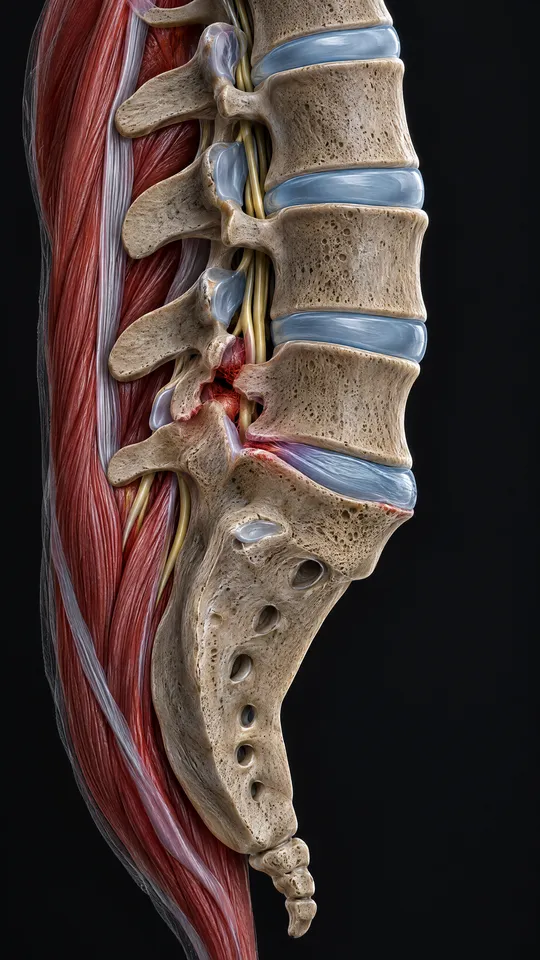
What's actually causing it
At the back of each vertebra is a small bridge of bone called the pars interarticularis. Spondylolisthesis is when one vertebra slides forward relative to the one beneath it 2, most often at the base of the spine (L5 on S1), with the age-related type most often at L4 on L5 2. There are two common routes.
The young-athlete route. A weakness or stress fracture develops in the pars, usually from sport that repeatedly stresses the lower back 1. That fracture is called spondylolysis. Gymnastics, fast bowling, football, wrestling and weightlifting are all linked to it 2,6,8. At least 6% of people have this fracture by the end of childhood 9, and it's more common in males 12.
The adult route. Age-related wear in the joints and discs lets a vertebra gradually drift forward 1. This degenerative type is more common in women 2.
Symptoms can include low back pain or stiffness that spreads into the buttocks or thighs, tight hamstrings, and sometimes leg pain, numbness or tingling 1. It's diagnosed on X-ray, with CT or MRI if needed 1. In a study of 188 adults scanned for other reasons, having a slip wasn't linked with low back pain 12, and some people never feel it 1. A slip on a report isn't automatically the whole story behind your pain.