Self-care between sessions.
Regular movement, checking your desk set-up, and heat 5. Low-risk, and easy to try.
It starts at the back of your neck, usually on one side, and works its way up over your head towards your forehead. It's worse after a long drive or a day at the screen, and turning to reverse the car feels stiffer on that side than the other. Pain relief takes the edge off, but the pattern keeps coming back.
That's the typical shape of a cervicogenic headache: one you feel in your head that actually starts in your neck. It's managed differently from tension headache and migraine, so the diagnosis matters.
The problem sits in the top joints of your neck, where your skull rests on the spine and the joints just below 1. When those joints, or the muscles around them, aren't moving or working well, the pain is felt in your head 1. That's all "cervicogenic" means: generated in the neck (the cervical spine).
Muscles often join in. Tightness, often with tender trigger points, is commonly found in the upper trapezius (across the top of your shoulder), the levator scapulae (from your neck to your shoulder blade), the scalenes at the side of your neck, and the small muscles right under the base of your skull 1.
Sometimes it follows a neck injury such as whiplash 1. Often there's no single event, just long stretches in one posture and a neck that gradually moves less 1,5.
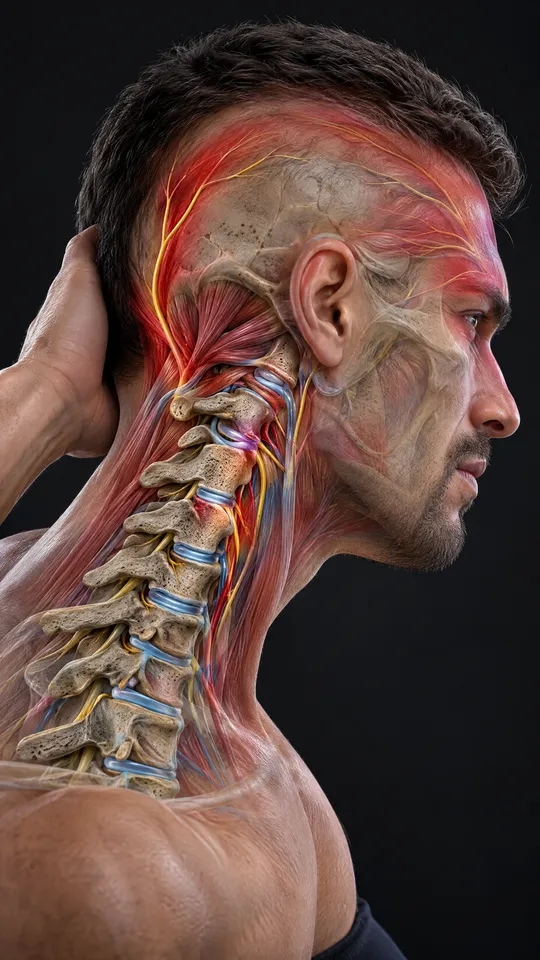
Plenty of headaches come with a sore neck, so a sore neck on its own doesn't make a headache cervicogenic. The pattern is what tells them apart 1,6:
| Cervicogenic headache | Tension-type headache | Migraine | |
|---|---|---|---|
| Where | One side, starting at the neck or back of the head and spreading forward | Both sides | Can switch sides |
| What it's like | Brought on by neck movement or sustained postures, with reduced neck movement | Pressing | Throbbing, often with light and sound sensitivity or nausea |
A physiotherapist can also test the top neck joint directly: with your chin tucked fully down, your head is turned to each side. Clearly restricted turning to one side points to that joint, and studies put the test's accuracy at 85 to 91% 1.
If your pattern sounds more like the middle column, our tension headaches page is the better fit. Migraine is managed differently again, and is worth talking through with your GP.
This one is harder to pin down than most headaches, and it helps to know that going in. The international headache classification asks for two things: evidence of a problem in the neck, and evidence that the neck is what's causing the headache 6. In practice that usually means a neck that moves less than it should, and your headache getting clearly worse when the neck is moved or pressed in particular ways 6. Occasionally a specialist confirms it by numbing a structure in the neck, or the nerve that supplies it, to see whether the headache switches off 6.
Scans help less than you'd expect. Changes in the upper neck show up on imaging in plenty of people who never get headaches, so a finding there is a hint, not proof 6.
Assessment comes first: where the headache starts, what sets it off, how your neck moves, and whether another headache type fits better. Conservative care is the recommended first choice 2. If your neck is the driver:
What the evidence supports. Combining the two wasn't significantly better than either alone, though 10% more people gained relief 2. A 2026 review of 29 trials found manual therapy beat a sham treatment in the first two weeks but not at 12 months, on low-certainty evidence 3. Exercise evidence is rated low to very low quality 4.
So: a sensible first step, most likely to help in the short term, and not a guaranteed cure. We'd rather tell you that before you book than after.
Regular movement, checking your desk set-up, and heat 5. Low-risk, and easy to try.
Understanding what sets your headaches off, and adjusting around it, is treatment in its own right.
Simple pain relief is part of standard self-care advice 5. Physiotherapists don't prescribe medication, so that conversation belongs with your GP or pharmacist.
A cervicogenic headache is a neck problem felt in the head, not an injury that heals on a schedule. On The Well Motion Recovery Path™ you move up a phase when your neck and your headaches show you are ready, not when a date arrives.
How long it usually takes. There is no healing clock here. The main trial ran treatment for 6 weeks and found the benefit still there at 12 months 2. That is one trial from 2002, and a newer review found manual therapy ahead of sham only in the first two weeks 3. Recovery time varies from person to person.
No trial has set out to prevent cervicogenic headaches. The closest evidence is a treatment trial, and the rest is standard NHS self-care advice:
See your GP or seek urgent care if your headache comes with any of these 5:
Without those, it isn't an emergency. It's worth an assessment when it keeps coming back, sits on one side and seems tied to how your neck moves. Symptoms can improve over a few months, though full recovery can take time 5.
We start by listening: how it began, what makes it worse, and what it's stopping you from doing. Then we examine the area, explain what we find in plain English, and agree a plan with you. Your first visit is 40 minutes at Engadine and 30 minutes at our other clinics.
We see patients at Engadine, Mount Annan, Narellan and Appin, and at home through our mobile physiotherapy service. If you have private health cover, here's how health fund rebates work for physiotherapy.
Treat the neck, not just the headache. Manipulation and specific low-load neck exercise both worked in a major trial 2, though newer reviews find short-term relief more certain than long-term 3,4. Regular movement, a better desk set-up and heat help between sessions 5.
The usual ones are in the sternocleidomastoid at the front of the neck, the upper trapezius, the temporalis at the temple and the suboccipital muscles under the base of the skull 1. They're part of the picture alongside the upper neck joints, not the whole story.
There's no reliable figure for a single episode. Over the longer term, symptoms can improve within a few months, though full recovery can take time 5. If it's still recurring after that, it's worth reassessing the plan.
Stiff, aching, recurring neck pain that builds through the day at a desk or on the tools.
Read moreNeck pain, stiffness or headache that started after a car accident, often a day or two later.
Read moreYou've woken with your head stuck tilted to one side, and a spasm that won't let you straighten it. Infants too.
Read morePain, numbness, tingling or weakness travelling from your neck down into your shoulder, arm or hand.
Read moreArm symptoms coming from compression in the narrow space between your neck and shoulder, often worse overhead.
Read moreAching at the base of your neck and between your shoulder blades after hours looking down at a screen.
Read more
How would you like to reach us?
Message us on WhatsAppFor bookings and enquiries. Please don't send medical details. Call (02) 8111 5633Request a call-back
Request sent
Thank you. We'll call you back on the number you gave us.
This is a preview, so nothing was actually sent.