Early self-care.
Heat or ice 2, raising the leg, and avoiding activities that make the knee sore 1. Paracetamol or anti-inflammatories can help with pain 1. Physiotherapists don't prescribe medication, so check with your GP or pharmacist.
Maybe you noticed it kneeling down: a soft, rounded lump at the back of your knee, and a tight, full feeling when you bend it. Or a scan has come back mentioning a "popliteal cyst", and nobody explained what that means.
It's a Baker's cyst, and the lump is usually the least important part of it. Here's what's behind it, and what helps.
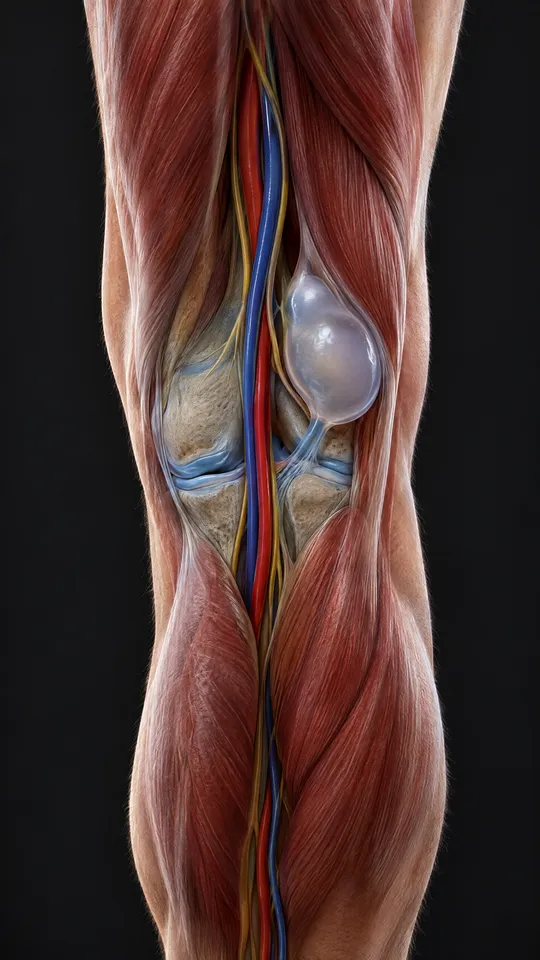
Your knee joint makes its own fluid, called synovial fluid, which keeps the joint moving smoothly. Behind the knee sits a bursa: a small, fluid-filled sac. When the knee produces too much synovial fluid, the excess makes that bursa expand and bulge. That bulge is a Baker's cyst 2. You may also hear it called a popliteal cyst, after the popliteal space at the back of the knee.
So the useful question is why your knee is making extra fluid. In adults, it's usually because something else is affecting the joint 3. Common drivers are a knee injury such as torn cartilage or a torn meniscus, osteoarthritis, rheumatoid arthritis, gout or infection. Sometimes no clear reason turns up 1. Baker's cysts are more common between the ages of 35 and 70 3. They also turn up in children, where watching and waiting is the usual recommendation 2.
Plenty of Baker's cysts cause no symptoms at all 2. When they do, you might notice:
You often can't tell on your own. A Baker's cyst can burst, leaking fluid down into the calf and causing pain and sometimes bruising around the ankle 2. That can look very like a deep vein thrombosis (DVT), a blood clot in a deep leg vein, and the two are hard to tell apart without an examination 2,3.
So if your calf suddenly becomes painful, swollen or warm, or the skin turns red or darker, get it checked urgently 2,3. A ruptured cyst usually settles over a few weeks 3, but a clot needs ruling out first.
A doctor can usually diagnose a Baker's cyst by examining your knee and asking about your symptoms 1. They'll also go through your medical history for conditions that can cause one, such as rheumatoid arthritis 2. One quick check is shining a light through the lump, which can show it's filled with fluid 2.
Scans are mostly about finding the cause. An X-ray can show arthritis in the knee joint 2, and an ultrasound or MRI may be arranged to check what's behind the cyst 1 3. Your GP may also refer you to a specialist for more tests, or to rule out anything serious 3.
Because the cyst is usually a symptom of the knee, most of our work is on the knee.
One honest caveat. We can't promise physiotherapy will shrink the cyst itself. The largest review of Baker's cyst treatments we found didn't assess exercise or physiotherapy on its own 4. What physio targets is the knee problem behind the cyst, and how well that knee works for you.
Heat or ice 2, raising the leg, and avoiding activities that make the knee sore 1. Paracetamol or anti-inflammatories can help with pain 1. Physiotherapists don't prescribe medication, so check with your GP or pharmacist.
Used briefly to take weight off a painful knee 2.
Your doctor may drain the cyst or give a corticosteroid injection 1,3. These are medical procedures, not something we perform. The research behind them is low quality, and cysts coming back has historically been common 4.
Usually aimed at repairing damage inside the knee joint 1. Surgery to remove the cyst itself is rare 3. Surgical studies favour treating the problem inside the joint along with the cyst, but that evidence comes only from looking back at past cases 5.
A Baker's cyst is a sign of the knee behind it, so The Well Motion Recovery Path™ is built around that knee. You move up a phase on what the knee can do, not on a date.
How long it usually takes. There is no set timeline, because the cyst follows the knee problem behind it. Many go away without treatment, though that can take a few months to a few years 1,3. A burst cyst is quicker. In one case series of 16 adults, with no comparison group, all settled within three weeks of non-surgical care 7.
A cyst comes back when the knee keeps making extra fluid, so the research on recurrence is mostly about the knee:
Get urgent medical care if you have 1,2,3:
Book an assessment if the lump or ache isn't settling, is limiting how far you can walk, or your knee won't fully straighten. Finding and treating the cause is what tends to help 3. If you're unsure how urgent it is, the healthdirect helpline (1800 022 222) can help you decide 1.
Most people with a Baker's cyst never have complications 1.
We start by listening: how it began, what makes it worse, and what it's stopping you from doing. Then we examine the area, explain what we find in plain English, and agree a plan with you. Your first visit is 40 minutes at Engadine and 30 minutes at our other clinics.
We see patients at Engadine, Mount Annan, Narellan and Appin, and at home through our mobile physiotherapy service. If you have private health cover, here's how health fund rebates work for physiotherapy.
Often you don't have to. Many go away without treatment 1, though it can take a few months to a few years 3. The most reliable route is treating the knee problem behind it 3, with physiotherapy to keep the knee strong and mobile 2. Your doctor may also consider draining, a cortisone injection or, if other treatments fail, surgery 2.
It can be. Light activity such as walking can help manage the pain 1. But symptoms are often worse after walking 1,3, so the dose matters. Walk within comfort, and if the knee is noticeably tighter or sorer afterwards, scale it back and talk to your physio about the plan 1.
Don't keep pushing through activities that make your knee sore 1. And don't ignore sudden calf pain, swelling, warmth or redness. Get it checked urgently, because it could be a burst cyst or a blood clot 2,3.
Often nothing serious. Many go away on their own, and most people have no complications. Some develop ongoing pain and swelling, or the cyst ruptures into the calf 1. The knee problem behind it is often the bigger reason to get it looked at 3.
None of the health sources we used recommends one, so we won't claim it treats the cyst. It's a comfort question. If a support helps you walk more easily, bring it along and we'll check it suits the knee problem behind the cyst.
A twist or sudden change of direction, often with a pop at the time, and a knee that hasn't felt trustworthy since.
Read morePain on the outside of the knee that builds through a run, settles with rest, then comes straight back on the next one.
Read moreAn ache at the front, around or behind the kneecap. Worse on stairs, on hills, and after long sitting.
Read moreCatching, locking or swelling after a twist, sometimes with a knee that won't fully straighten.
Read moreA tender, bony lump just below the kneecap in a growing, sporty teenager.
Read moreMorning stiffness and an ache after activity, building over years rather than days.
Read moreThe MCL runs down the inside of your knee. Most injuries happen when something hits the outside of the knee and forces it inwards; it's the ligament most commonly injured in knee trauma.
Read moreA bursa is a small fluid-filled sac that cushions bone from the soft tissue around it. The prepatellar bursa sits at the front of your knee, over the kneecap. When it's irritated it swells, and a tender, warm swelling right over the bursa is the classic sign.
Read moreA patellar dislocation is the kneecap being forced out of its groove at the end of the thigh bone. It almost always goes outwards, towards the outside of the knee.
Read morePatellar tendinopathy, often called jumper's knee or patellar tendonitis, is pain in the tendon just below your kneecap that builds when the tendon is overloaded.
Read more
How would you like to reach us?
Message us on WhatsAppFor bookings and enquiries. Please don't send medical details. Call (02) 8111 5633Request a call-back
Request sent
Thank you. We'll call you back on the number you gave us.
This is a preview, so nothing was actually sent.