Hands-on treatment.
Manual therapy can sit alongside the exercise work, but the evidence on how well conservative treatments work in this condition is limited and varied 4. We treat it as an adjunct, not the main event.
The pain sits on the outside of your ankle, just behind and below the bony bump on that side. It's worse after a walk or a run and eases when you rest. Often there's an ankle sprain somewhere in the story (sometimes several), and a feeling that the ankle never quite came right after the last one. That's a familiar picture of peroneal tendinopathy, which a lot of people know as peroneal tendonitis.
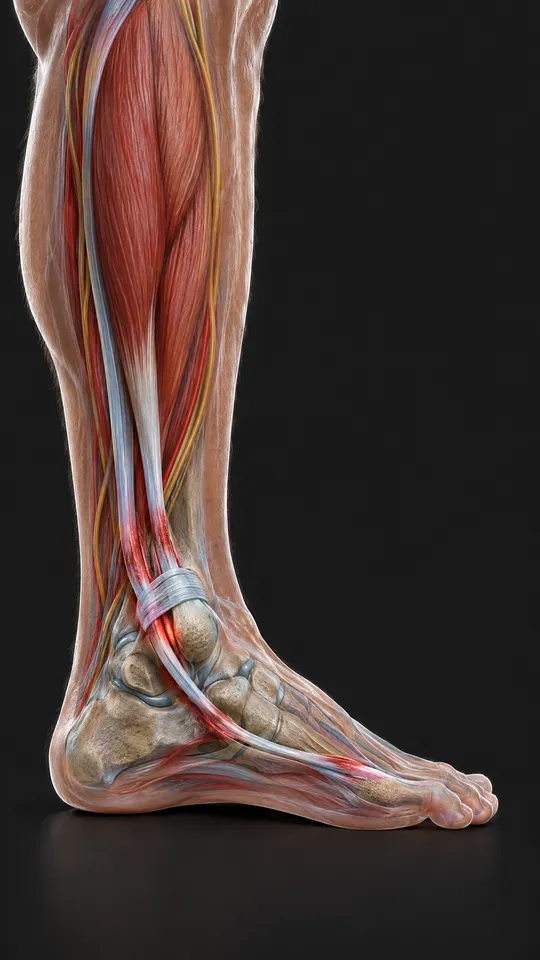
A tendon is the tough cord that joins a muscle to bone. Your two peroneal muscles run down the outside of your lower leg, and their tendons pass behind the bony bump on the outside of your ankle: the lateral malleolus, the lower end of your fibula 2,4.
They do two jobs. They turn your foot outwards, with one of them, the peroneus brevis, providing 63% of that power 3. And they're the first muscles to switch on when your ankle suddenly rolls inwards, which makes them central to keeping the outside of the ankle stable 3.
That's where sprains come in. A sprain can injure the tendons directly 2. And a sprain that wasn't fully rehabilitated tends to leave the peroneal muscles weaker, with a reduced sense of where your foot is in relation to your leg, part of why sprains recur 1. Peroneal problems turn up often in people whose ankles keep giving way, and in people with a high-arched foot that tilts the heel inwards 3,4.
Other causes include repetitive or prolonged activity, a heel-bone fracture that has left the heel widened, and an enlarged bony ridge on the outer heel that the tendons run past 3.
One honest note. Two explanations you may hear stated as fact (that the peroneals switch on too slowly after a sprain, and that the tendon has poor-blood-supply "zones" where it breaks down) are still debated. The first has studies both supporting and refuting it; the second has been refuted and remains a subject of debate 3.
This is the confusion that matters most. Both hurt on the outside of the ankle, both often start with a roll, and peroneal tendon problems are genuinely hard to tell apart from ligament injuries 3. A sudden dislocation of the peroneal tendons is misdiagnosed in up to 40% of cases, usually as a sprain 3.
Clues that point towards the tendons rather than the ligaments:
If what you've got is a recent roll with swelling, our Ankle Sprain page is the better starting point. If the ankle keeps giving way, read about Chronic Ankle Instability too: the two frequently turn up together 3.
Scans help, but they don't settle it on their own. On ultrasound the tendon is often thickened 2. MRI is less reliable than people expect: even in 238 patients already heading for ankle surgery, it missed roughly four in ten peroneal problems, and nothing in their history predicted who it would miss 5.
This is worked out from your story and a hands-on examination, and the story comes first 3. Before going near the sore spot, a clinician looks at how your leg and heel line up, because a heel that tilts inwards can put extra force through the peroneal tendons 3. Then they press along the line of the tendons, check the ankle ligaments for looseness, and may ask you to circle your ankle to see whether a tendon slips out of place 3. In the peroneal compression test, you push your foot up and out hard while they feel behind the outer ankle bone for pain, grating or a pop 3.
Scans come second. A standing X-ray shows your foot shape and any bony cause, and ultrasound can watch the tendons move in real time 3.
First we work out whether the tendons are actually the problem. Then we settle them down, and rebuild the strength and control that protect them.
To be clear: this is a sensible, well-reasoned approach, but the published recommendations rest mainly on case series and expert opinion, not trials 3,4.
Manual therapy can sit alongside the exercise work, but the evidence on how well conservative treatments work in this condition is limited and varied 4. We treat it as an adjunct, not the main event.
Anti-inflammatories and simple pain relief are part of standard first-line care 2,3, a conversation with your GP or pharmacist, not something we prescribe.
There's too little evidence to draw conclusions about them 4, and they carry a risk of causing the tendon to rupture: the authors of one specialist review don't use them at their own institution for that reason 3. That decision belongs with your GP or specialist.
For more severe or stubborn cases, a short spell in a boot or brace may be used 2, and in cases that don't settle, immobilisation for around six weeks 3.
Considered for tears, a tendon that keeps slipping out of its groove, or cases that don't respond to conservative care 2,3. If we think you need a surgical opinion, we'll tell you.
Peroneal tendinopathy treatment follows The Well Motion Recovery Path™. You move up a phase when the tendons tolerate more load, not when a set number of weeks has passed.
How long it usually takes. No study gives a reliable recovery time for non-surgical care 3,4. The one marker comes from an expert consensus panel, which treats symptoms lasting beyond three months as the point to consider further options 4. That is opinion, not trial data.
Nobody has trialled prevention for peroneal tendinopathy itself. What has been tested is preventing the ankle sprains that so often set it off, and the rest of this list goes after known causes:
Get it assessed rather than managing it alone if:
Left untreated, peroneal tendon problems can lead to persistent pain on the outside of the ankle and substantial functional problems 3. But most can be treated successfully without surgery 2: getting it checked is about catching it early, not expecting the worst.
We start by listening: how it began, what makes it worse, and what it's stopping you from doing. Then we examine the area, explain what we find in plain English, and agree a plan with you. Your first visit is 40 minutes at Engadine and 30 minutes at our other clinics.
We see patients at Engadine, Mount Annan, Narellan and Appin, and at home through our mobile physiotherapy service. If you have private health cover, here's how health fund rebates work for physiotherapy.
Mostly without surgery 2: reduce activity enough to let it settle, strengthen on a flat surface rather than a step, wear supportive footwear, and rebuild balance 1,2,4. Anti-inflammatories and an insole may help 2,3. Be aware these recommendations rest mainly on case series and expert opinion 3,4.
Pain, and sometimes swelling, on the outside of the ankle 2, usually just behind or below the outer ankle bone 3. It's typically worse with activity and better with rest 3, and you may notice weakness pushing with the outside of your foot 2.
The research doesn't answer this one directly. What the advice does say: reduce activity enough to let symptoms settle, and switch to footwear that supports the ankle 2. Walking on uneven ground in worn shoes is itself a listed cause 2, and symptoms typically worsen with activity 3. So how much and where you walk matters: we'd rather set your limit with you than give you a generic number.
The research doesn't give a reliable figure for non-surgical recovery. The timeframes you'll see quoted mostly come from surgical studies, and the evidence for conservative timelines is thin 3,4. Recovery depends on how long it's been going, whether there's a tear, and how your ankle responds to loading.
It can be part of treatment, but don't expect it to do the heavy lifting. The evidence on conservative treatments for this condition is limited 4, so we use it alongside strengthening, not instead of it.
It can lead to persistent pain on the outside of the ankle and substantial functional problems 3. That's why an outer-ankle pain that hasn't settled deserves a proper assessment, not more waiting.
You rolled or twisted it, usually landing or changing direction, and it swelled soon after. Includes high ankle (syndesmosis) sprains, where the pain sits higher up the leg.
Read morePain and stiffness at the back of the heel that builds with running or walking load, and is often worst for the first few steps of the day.
Read moreA sudden snap during push-off, sometimes felt as a kick to the back of the heel, and trouble pushing off since.
Read moreAn ankle that keeps giving way on uneven ground, long after the original sprain settled.
Read more
How would you like to reach us?
Message us on WhatsAppFor bookings and enquiries. Please don't send medical details. Call (02) 8111 5633Request a call-back
Request sent
Thank you. We'll call you back on the number you gave us.
This is a preview, so nothing was actually sent.