Ice.
An ice pack for around 20 minutes after a painful activity is the standard advice from both Australian government sources here 1,2: simple, and it helps the after-training flare.
Your child has a sore, bony lump just below the kneecap. It flares after training, it's worse going up stairs, and kneeling is out of the question. They have played through it for weeks: a night off settles it, the next game brings it straight back.
In a child growing fast and playing a lot of sport, that pattern is usually Osgood-Schlatter disease. The name sounds far more serious than the thing itself: an irritated growth plate at the top of the shin bone, which stops for good once that growth plate finishes growing 1.
Growth plates are soft areas of cartilage near the ends of growing bones. They're weaker than bone, so they injure more easily 1. The one that matters here sits at the top of the shin, right where the tendon from the kneecap attaches.
During a growth spurt, bones lengthen faster than the muscles and tendons attached to them can keep up. The thigh muscles and the tendon below the kneecap get tight, and every hard straightening of the knee (sprinting, jumping, kicking, changing direction) pulls on that growth plate 1,2. Repeat that enough and the area becomes inflamed, with tiny micro-fractures at the attachment point. The body repairs them by laying down extra bone, which is where the bump comes from 2: repair tissue, not damage spreading.
Muscle tightness, weakness straightening the knee, limited hamstring flexibility and body weight all appear as risk factors 5. Knock-knees and flat feet are structural contributors 1. About half of affected children report an earlier knee injury 2, and in 20 to 30 per cent both knees are involved 6.
It's common: up to around 10 per cent of adolescents are affected 3,7, and one Australian government health service attributes roughly 13 per cent of adolescent knee pain to it 2.
It sits across two of the things we do: paediatric, because it only happens in growing bones, and sports physiotherapy, because training load is what tips it over.
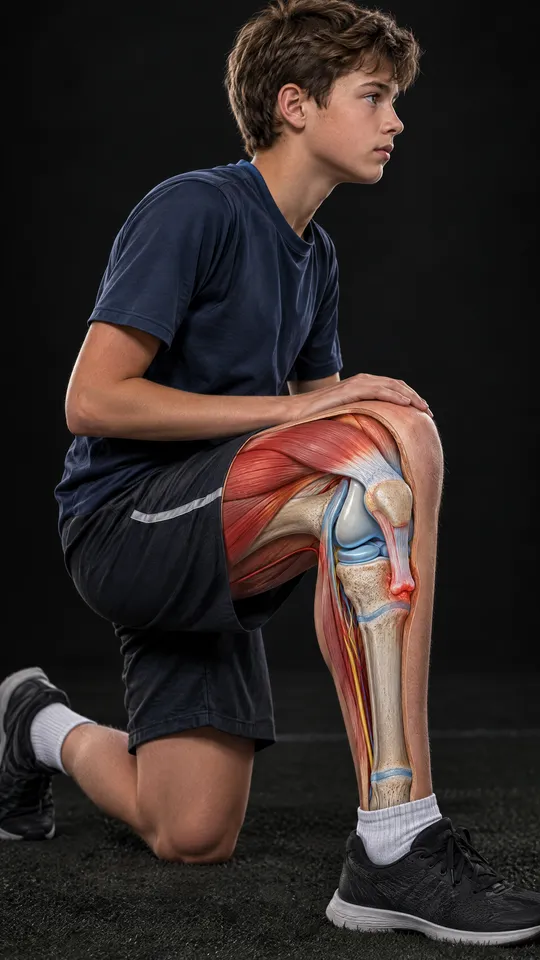
The classic picture is specific: tenderness right on the bony bump below the kneecap, pain that builds gradually with running and jumping, and pain on kneeling. X-rays are usually not needed unless something suggests a different cause 1.
Several other things look similar 11. Pain at the bottom of the kneecap rather than down on the shin points to Sinding-Larsen-Johansson syndrome: the same problem one step higher up. Pain in the tendon itself, without the bony lump, points to patellar tendinopathy, or jumper's knee. Fat pad irritation is also on the list, as are two things that need excluding: a fracture through the bony bump itself, and a growth in the bone or soft tissue 11.
Good news first: this is usually sorted out in the clinic, with no scan. A physio or doctor will check your child's knee and ask what they've been doing 1. The diagnosis comes mainly from the symptoms and the physical examination 2. X-rays usually aren't needed unless something suggests the pain has another cause 1, and when an X-ray or ultrasound is ordered, its job is to rule those other causes out 2.
We look at the legs and feet too. Knock-knees and flat feet can make the condition more likely, so a physio or doctor will check for them and suggest extra treatment if it's needed 1.
The evidence first. A systematic review of conservative treatment screened 767 studies and could include only 13, just two of them randomised trials, quality rated poor to moderate. Stretching and similar approaches showed apparent benefit, but no trial has compared specific exercises against a sham or usual-care alternative 3. So nothing below is proven superior: it's a structured plan built from the best of what exists.
An ice pack for around 20 minutes after a painful activity is the standard advice from both Australian government sources here 1,2: simple, and it helps the after-training flare.
Knee straps that press on the tendon and protective padding are listed among the conservative options 6,11. Supportive, not curative: they can make a session more comfortable alongside the exercise plan, but no strap fixes the load problem.
We offer it for other conditions and won't pretend it's indicated here. For Osgood-Schlatter specifically, it's only been suggested as a possible option 6, and the research on conservative treatments is rated poor to moderate in quality 3.
appears in the literature as an option 2,6: a conversation for your GP or pharmacist, as physiotherapists don't prescribe medication.
is very rarely involved, and only after growth has finished. A small hard lump sometimes remains permanently and occasionally stays painful: that is when surgery is considered 1, never before the growth plate closes 5.
We manage Osgood-Schlatter through The Well Motion Recovery Path™. Your child moves up a phase when the knee copes with the last one, not because a season has ended.
How long it usually takes. In one case series, 16 per cent were back in sport at 12 weeks and 69 per cent at 12 months 4. In a small Danish hospital study, 60.5 per cent still reported knee pain a median 3.75 years after diagnosis, though only about half of those contacted replied 12. The condition stops once the growth plate finishes growing 1.
Nobody has run a prevention trial for Osgood-Schlatter, so the best guide is the research on which kids get it:
Osgood-Schlatter isn't dangerous and the outlook is good. Even so, NSW Health's children's factsheet advises seeing a doctor or physiotherapist early, even if the pain is mild 1, not waiting to see how bad it gets. Get it looked at properly if:
None of those automatically mean something serious: they mean it's worth confirming what you're dealing with instead of assuming.
We start by listening: how it began, what makes it worse, and what it's stopping you from doing. Then we examine the area, explain what we find in plain English, and agree a plan with you. Your first visit is 40 minutes at Engadine and 30 minutes at our other clinics.
We see patients at Engadine, Mount Annan, Narellan and Appin, and at home through our mobile physiotherapy service. If you have private health cover, here's how health fund rebates work for physiotherapy.
Yes. It stops once the growth plate at the top of the shin finishes growing 1, and one Australian government health service describes it as usually resolving on its own within about 12 months, though the knee can stay uncomfortable until growing finishes 2. Conservative management succeeds in over 90 per cent of cases 5. But "it goes away" isn't the same as "ignore it": more recent work describes long-term pain and sport limits that can carry into adulthood 7.
Most often between 10 and 14, through puberty and growth spurts 1. The traditional line is that it mainly affects boys, but a 2020 review found no meaningful difference between the sexes, most likely because far more girls now play high-impact sport 5. If you have a daughter with knee pain and have been told this is a boys' condition, that framing is out of date.
Often, in a modified way: running, jumping and changes of direction are cut back or paused until symptoms improve, with swimming or cycling in their place 6. If the pain is severe, one or two seasons off may be needed 1. Be realistic about timing, though: in that 12-week program, 80 per cent felt better at 12 weeks but only 16 per cent were back playing, rising to 69 per cent at 12 months 4. Feeling better arrives well before playing again does.
Usually it still resolves at the end of growth. But the adolescents in that structured program had been sore for an average of 21 months before anyone gave them a plan 4, recent work describes effects continuing into adulthood 7, and a small hard lump can remain permanently and stay painful 1. Ignoring it mostly costs time, sport and comfort your child didn't have to give up.
None of the sources we used says this condition reduces adult height, and we won't assert it either way. What we can tell you is why the concern is taken seriously: surgery is deliberately deferred until after the growth plate closes, precisely to avoid interfering with it 5,6, and the condition itself resolves when that plate fuses 1. If this is the worry behind your visit, say so.
A twist or sudden change of direction, often with a pop at the time, and a knee that hasn't felt trustworthy since.
Read morePain on the outside of the knee that builds through a run, settles with rest, then comes straight back on the next one.
Read moreAn ache at the front, around or behind the kneecap. Worse on stairs, on hills, and after long sitting.
Read moreCatching, locking or swelling after a twist, sometimes with a knee that won't fully straighten.
Read moreMorning stiffness and an ache after activity, building over years rather than days.
Read moreThe MCL runs down the inside of your knee. Most injuries happen when something hits the outside of the knee and forces it inwards; it's the ligament most commonly injured in knee trauma.
Read moreA bursa is a small fluid-filled sac that cushions bone from the soft tissue around it. The prepatellar bursa sits at the front of your knee, over the kneecap. When it's irritated it swells, and a tender, warm swelling right over the bursa is the classic sign.
Read moreA patellar dislocation is the kneecap being forced out of its groove at the end of the thigh bone. It almost always goes outwards, towards the outside of the knee.
Read morePatellar tendinopathy, often called jumper's knee or patellar tendonitis, is pain in the tendon just below your kneecap that builds when the tendon is overloaded.
Read moreA Baker's cyst is a build-up of fluid behind the knee, usually excess fluid from the knee joint itself.
Read more
How would you like to reach us?
Message us on WhatsAppFor bookings and enquiries. Please don't send medical details. Call (02) 8111 5633Request a call-back
Request sent
Thank you. We'll call you back on the number you gave us.
This is a preview, so nothing was actually sent.